
질화규소 대 시알론 대 탄화규소
Silicon nitride vs sialon vs silicon carbide: which advanced ceramic should you choose?
Silicon nitride vs sialon, and sintered silicon carbide all handle extreme heat and outlast metals – but they win in very different applications. This guide covers the properties, history, and selection logic engineers actually use.
2026년 7월 28일 · 10분 읽기
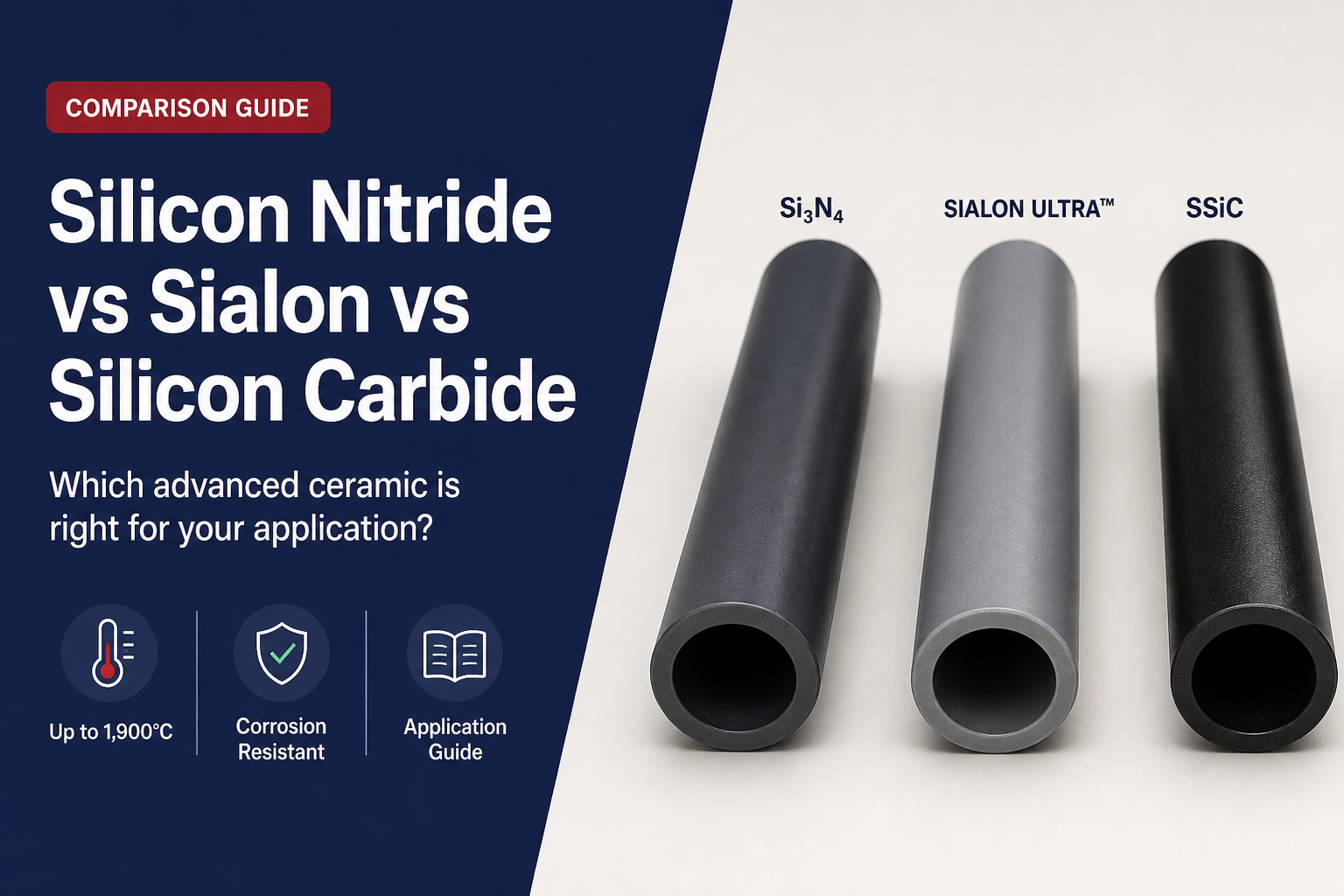
Walk into any serious foundry, chemical plant, or high-temperature furnace installation and you’ll find advanced ceramics doing the hard work that metals cannot. But which one? Silicon nitride vs sialon, and sintered silicon carbide are frequently named in the same breath – all three handle extreme heat, all three resist corrosion, and all three outlast metals in demanding applications. The differences between them, though, are sharp enough to make the wrong choice expensive.
이 가이드는 중복되는 부분을 명확히 정리합니다. 각 재료가 어디서 유래했는지, 실제로 무엇을 할 수 있는지, 그리고 가장 중요한 것은 어떤 응용 분야에서 우수한지 그렇지 않은지를 다룹니다.
한눈에 보기: 세 가지 재료
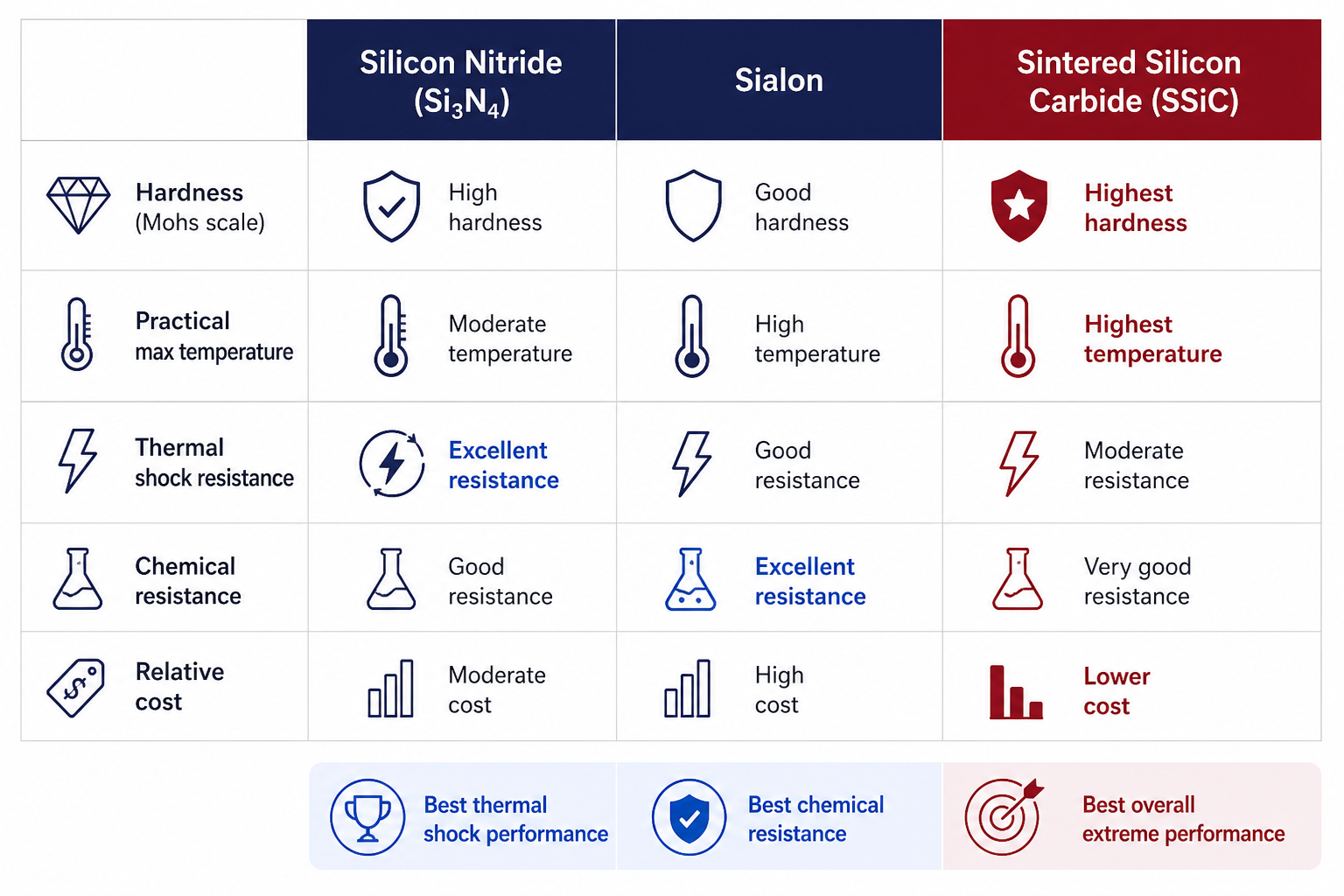 | 속성 | 질화규소 (Si₃N₄) | 사이알론 (SiAlON) | 소결 SiC (SSiC) | | — | — | — | — | | 경도 (모스) | ~9 | ~9 | 9–9.5 | | 실용 최대 온도 (공기 중) | ~1,200–1,400°C | 최대 ~1,400°C | 1,600–1,700°C | | 열충격 저항성 | 우수 | 우수 | 양호 | | 용융 금속 저항성 | 양호 | 탁월 | 양호 | | 화학적 부식 저항성 | 양호 | 양호 | 우수 | | 밀도 (g/cm³) | ~3.2 | ~3.2–3.4 | ~3.1–3.2 | | 상대적 비용 | 중간 | 중간–높음 | 중간–높음 |
어떤 단일 재료도 모든 항목에서 우위를 점하지 못합니다. 이것이 바로 이 비교가 존재하는 이유입니다.
질화규소: 정밀 세라믹
산업계로의 170년 여정
질화규소는 세 가지 중 가장 오랜 역사를 가지고 있지만, 그 대부분은 특별히 유용하지 않았습니다. 1857년 프랑스 화학자 생트클레어 드빌과 뵐러에 의해 처음 합성되었으며, 한 세기 동안 거의 무시된 실험실의 호기심이었습니다. 1960년대와 1970년대에 이르러서야 엔지니어들이 항공기 터빈 엔진 내부에서 견딜 수 있는 재료를 진지하게 찾기 시작하면서, Si₃N₄는 그에 걸맞은 산업적 관심을 받게 되었습니다.
The ceramic engine dream – replacing metal with silicon nitride for turbocharger rotors, glow plugs, and combustion chambers – only partially succeeded. But the research it generated did not go to waste. By the 1980s and 1990s, silicon nitride had found its real calling in bearings, cutting tools, and molten metal handling, where its unique combination of properties proved genuinely hard to match.
질화규소가 잘하는 것
Silicon nitride’s defining characteristic is its combination of high strength and excellent thermal shock resistance.
Engineers can rapidly heat and cool it without cracking – a property that comes from its low thermal expansion coefficient and the covalent bonding structure of its Si–N framework.
또 다른 뛰어난 특성은 고속에서의 내마모성입니다. 연간 약 30만 개 생산되는 실리콘 나이트라이드 터보차저 로터 는 기존 베어링을 파괴할 온도와 회전 속도에서도 재료가 경도를 유지하고 치수 안정성을 보이기 때문에 사용됩니다. 연간 5천만 달러 규모의 절삭 공구 시장 이 Si₃N₄에 존재하는 것도 같은 이유입니다. 이 재료는 주철과 니켈계 초합금을 텅스텐 카바이드보다 최대 25배 빠른 표면 속도로 가공할 수 있습니다.
질화규소는 또한 용융된 비철 금속(알루미늄, 아연, 주석, 납)을 오염시키지 않고 처리할 수 있습니다. 따라서 금속 가공에서 열전대 보호관, 노즐 및 도가니에 적합합니다.
Where Silicon Nitride Falls Short
Silicon nitride decomposes above about 1,850°C, but that’s a theoretical ceiling, not a working temperature. In practice, practical operating temperatures top out at approximately 1,200–1,400°C depending on the grade and atmosphere. Engineers cannot use it above this range without risking material degradation.
It also loses ground to sialon specifically when molten aluminium contact is involved. Molten aluminium attacks silicon nitride more readily than sialon – a narrow but commercially significant difference in the foundry world.
사이알론: 주조용 세라믹
질화규소에서 탄생
Sialon – pronounced “sigh-alon” – is not a compound but a family of ceramic alloys derived from silicon nitride. The name is an acronym: Silicon Aluminium Oxynitride. When aluminium and oxygen atoms are substituted into the silicon nitride crystal lattice, they stabilize what would otherwise be a less workable phase of the material and add an entirely new set of thermal and chemical properties.
이 재료는 1971년에 처음 보고되었으며, 뉴캐슬 대학교와 영국 국립물리연구소의 병행 연구를 통해 개발되었습니다. K.H. Jack의 1976년 Journal of Materials Science 논문, “Sialons and related nitrogen ceramics,”은 이후 10년간 상업화를 가속화한 이론적 기반을 제공했습니다.
Founders launched Sialon Ceramics ApS in 1986 – the same decade that sialon transitioned from laboratory material to commercial product – and the company has manufactured sialon and silicon carbide components for extreme-temperature foundry and industrial applications ever since.
사이알론의 장점
The second headline is thermal shock resistance. Sialon’s low thermal expansion and high-temperature strength retention mean it can be plunged into molten metal, rapidly cycled, and withdrawn without cracking – cycle after cycle. Sialon ULTRA™ thermocouple protection tubes from Sialon Ceramics operate at up to 1,400°C, and manufacturers build them to ±0.02 mm tolerances; heater tubes handle direct contact with molten metal at up to 1,100°C.
Beyond foundry use, engineers use sialon in cutting tools for machining chill cast iron, welding fixtures, chemical processing equipment, and oil and gas applications where chemical stability at elevated temperature is the defining requirement.
사이알론의 한계
사이알론은 세 가지 중 가장 단단하지 않습니다. – 탄화규소가 모스 경도에서 이를 능가합니다. 단단한 입자에 대한 순수한 내마모성이 주요 하중인 응용 분야(블라스트 노즐, 연마성 슬러리의 기계적 씰)에서는 SSiC가 일반적으로 더 강한 선택입니다.
시알론은 또한 상한 온도 극한에서 SSiC를 따라잡을 수 없습니다. Sialon Ceramics의 SSiC 제품 라인(XICAR™)은 공기 중 1,700°C, 제어된 분위기에서 최대 1,900°C로 정격되어 있으며, 이는 시알론이 도달할 수 없는 범위입니다.
소결 탄화규소: 극한 조건용 세라믹
연마재에서 엔지니어링 세라믹까지 130년
Silicon carbide has the most dramatic origin story of the three. In 1891, Edward Goodrich Acheson was trying to make artificial diamonds. Instead, he passed current through a clay-and-coke mixture and accidentally produced something that cut glass. He named it Carborundum and founded the company that bore its name. This gave industry its first man-made abrasive harder than corundum.
For most of the 20th century, SiC remained primarily a powder: grinding wheels, sandpapers, cutting compounds. The leap to dense sintered engineering ceramics came in the 1970s and 1980s. Improved sintering techniques let engineers produce solid components with the material’s full mechanical properties intact. XICAR™ sintered silicon carbide from Sialon Ceramics represents the current state of the art in this lineage. Its components are rated to 1,900°C and manufactured up to 3,000 mm in length.
소결 SiC가 잘하는 것
SSiC’s competitive advantages cluster around two properties that no other advanced ceramic matches at once: hardness and thermal conductivity.
At 9–9.5 on the Mohs scale and approximately 2,500 HV Vickers hardness, sintered silicon carbide is the hardest of the three materials. Indeed, it ranks among the hardest substances known outside diamond and cubic boron nitride. As a result, this translates directly into superior wear life in abrasive applications: blast nozzles, pump impellers handling abrasive slurries, mechanical seals in harsh chemical settings, and kiln furniture subject to constant thermal and mechanical wear.
In addition, its thermal conductivity of 120–200 W/m·K is exceptional for a ceramic – far above silicon nitride (~20–30 W/m·K) and sialon (~10–20 W/m·K). Consequently, this makes SSiC the natural choice for heat exchangers, furnace components, and any application where heat must move through the component efficiently.
Furthermore, continuous service temperature in oxidizing atmospheres exceeds 1,600°C. Specifically, XICAR™ components are rated to 1,700°C in air and 1,900°C in controlled or reducing atmospheres. Notably, no silicon nitride or sialon product reaches these temperatures.
Finally, chemical resistance is comprehensive: SSiC withstands most acids, bases, and molten salts without meaningful attack. As a result, this makes it the preferred material for pump impellers, valve seats, and process equipment in chemical plants where the fluid is harsh and contamination from the vessel material is not acceptable.
소결 SiC의 단점
SSiC’s thermal shock resistance is good but not exceptional – it falls short of both silicon nitride and sialon. Its higher thermal conductivity than the nitride-based ceramics helps somewhat. But its lower fracture toughness means rapid, uncontrolled thermal cycling carries more risk than with sialon. Applications that involve repeated plunging into molten metal – heater tubes, thermocouple protection tubes in aluminium furnaces – typically favour sialon or silicon nitride for exactly this reason.
SSiC는 또한 충격 측면에서 세 가지 중 가장 취성이 강합니다. 기계적 충격 하중이 가해지는 응용 분야에서는 사이알론의 약간 더 나은 파괴 인성이 중요해집니다.
어떤 재료가 어디에서 우세한가
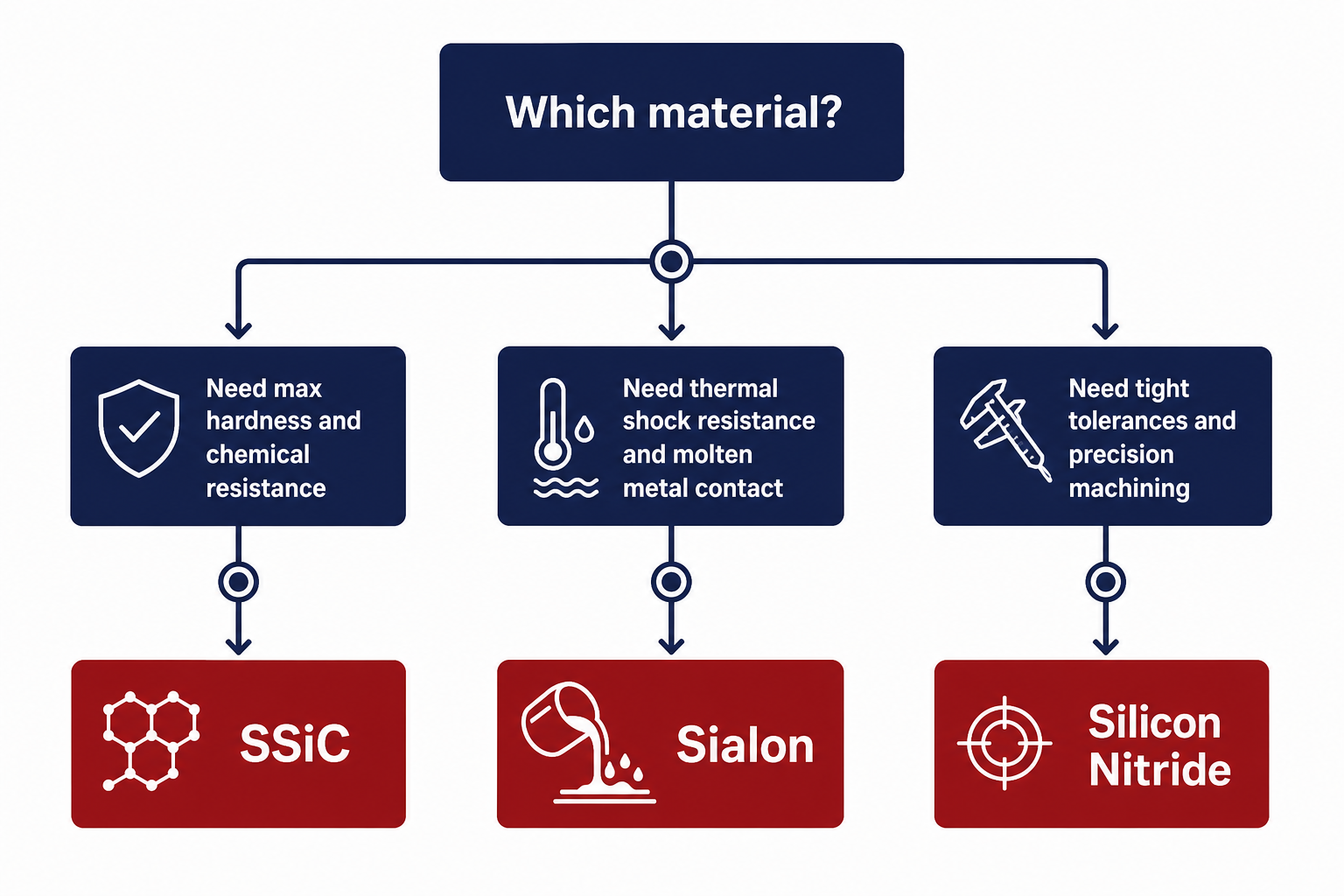 다음과 같은 경우 실리콘 나이트라이드를 선택하세요:
- 정밀 베어링, 절삭 공구 또는 엔진 부품이 응용 분야입니다
- 열 사이클링 하에서 엄격한 치수 공차가 요구됩니다
- 주철 또는 니켈 초합금의 고속 가공이 사용 사례입니다
- 비용은 상위 옵션에 비해 중요한 제약 조건입니다
Pick sialon when:
- 용융 알루미늄, 아연, 황동 또는 기타 비철 금속이 관련된 경우
- 열충격이 빈번하고 심각한 경우(용융 금속에 빠르게 투입 및 인출하는 반복 사이클)
- 열전대 보호, 침지 가열 또는 라이저 튜브 응용 분야
- 내식성과 적당한 온도가 주요 하중인 화학 처리 환경
다음과 같은 경우 소결 탄화규소를 선택하십시오:
- 연마 매체에 대한 최대 경도와 내마모성이 주요 요구 사항인 경우
- 공기 중 작동 온도가 1,400°C를 초과하는 경우
- Heat transfer through the component is important (heat exchangers, furnace components)
- Chemical resistance to acids, bases, or molten salts at high temperature is needed
- Large-format components (mechanical seals, blast nozzles, kiln shelves) are required
재료별 응용 분야
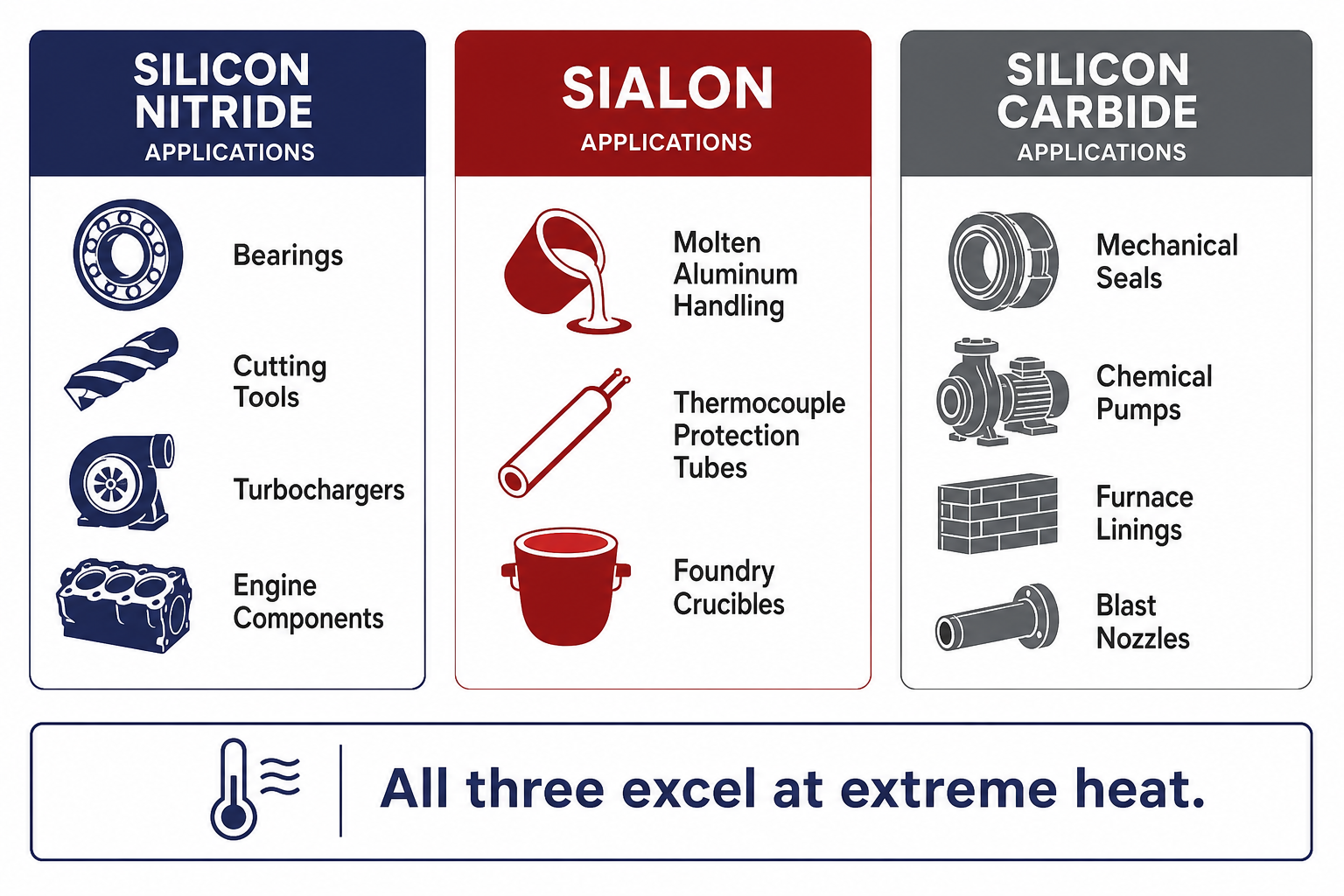 세 가지 재료는 실제로 동일한 용도에서 직접 경쟁하는 경우가 거의 없습니다. 실제로는:
- Silicon nitride dominates automotive powertrain (turbocharger rotors, glow plugs), machine tool bearings, and cutting tools for hard metals.
- Sialon dominates non-ferrous foundry equipment: thermocouple protection tubes, immersion heater tubes, degassing rotors, riser tubes for aluminium diecasting, and ladles and crucibles where molten metal resistance is critical.
- Sintered silicon carbide dominates mechanical seals, pump impellers, blast nozzles, kiln furniture, furnace linings, heat exchangers, semiconductor processing fixtures, and ballistic protection panels.
The overlap zone – extreme heat with no other dominant constraint – is where material selection becomes a genuine engineering decision rather than an obvious one.
Sialon 세라믹 사용해 보기
Sialon Ceramics has manufactured sialon and sintered silicon carbide components since 1986. Whether the application calls for a Sialon ULTRA™ thermocouple protection tube rated to 1,400°C, an immersion heater tube guaranteed for 12 months in molten aluminium, or a XICAR™ sintered silicon carbide component rated to 1,900°C in controlled atmosphere – the company produces custom geometries to ±0.02 mm tolerances, in lengths up to 3,000 mm.
sialon.com에서 전체 제품 범위를 살펴보세요, 또는 팀에 직접 문의 하여 특정 응용 분야에 대해 논의하십시오.
출처
- 위키백과: Sialon
- 위키백과: 질화규소
- AZoM: 질화규소(Si₃N₄) 특성 및 응용
- AZoM: 탄화규소(SiC) 특성 및 응용 분야
- Jack, K.H. (1976). “Sialons and related nitrogen ceramics.” Journal of Materials Science, 11(6): 1135–1158
- Cao, G.Z.; Metselaar, R. (1991). “α’-Sialon 세라믹: 리뷰.” Chemistry of Materials, 3(2): 242
- 위키백과: 에드워드 구드리치 에치슨
- 사이알론 세라믹: Sialon ULTRA™ 히터 튜브


 ZDialer 통화