
Sialon-dompelverwarmer voor de aluminiumgieterij
Siliciumnitride-dompelverwarmer voor gesmolten aluminium: een handleiding voor ingenieurs in de gieterij
Gasovens verspillen tot wel 80% van hun energie voordat deze het aluminiumbad bereikt. Een dompelverwarmer van siliciumnitride heeft een rendement van meer dan 99% — hier leest u hoe deze werkt en wanneer dit de juiste keuze is. In dit artikel bespreken we waarom een Sialon-dompelverwarmingssysteem voor aluminium een doorbraak kan betekenen voor industriële verwarmingstoepassingen.
26 juli 2026 · 11 min. leestijd
TL;DR
Bij indirecte verwarming op gas gaat 55–80% van de energie verloren aan de atmosfeer voordat er ook maar iets van uw aluminium bereikt. Een dompelverwarmer van siliciumnitride brengt dat verlies terug tot bijna nul – >99% van het toegevoerde elektriciteitsverbruik wordt omgezet in warmte in het metaal. Het resultaat is 30–50% lagere energiekosten, een temperatuurregeling binnen ±2°C in plaats van ±10–15°C, en aanzienlijk minder slak per ploeg. De technologie die dit mogelijk maakt, is keramiek van silicium-aluminiumoxynitride (sialon): dit materiaal is onbeperkt bestand tegen gesmolten aluminium omdat het metaal het oppervlak simpelweg niet bevochtigt. Sialon Ceramics levert deze verwarmingselementen al sinds 1986 aan gieterijen en biedt er nu een garantie van 12 maanden op, die zowel chemische aantasting als elektrische defecten dekt.
Het probleem met indirecte verwarming
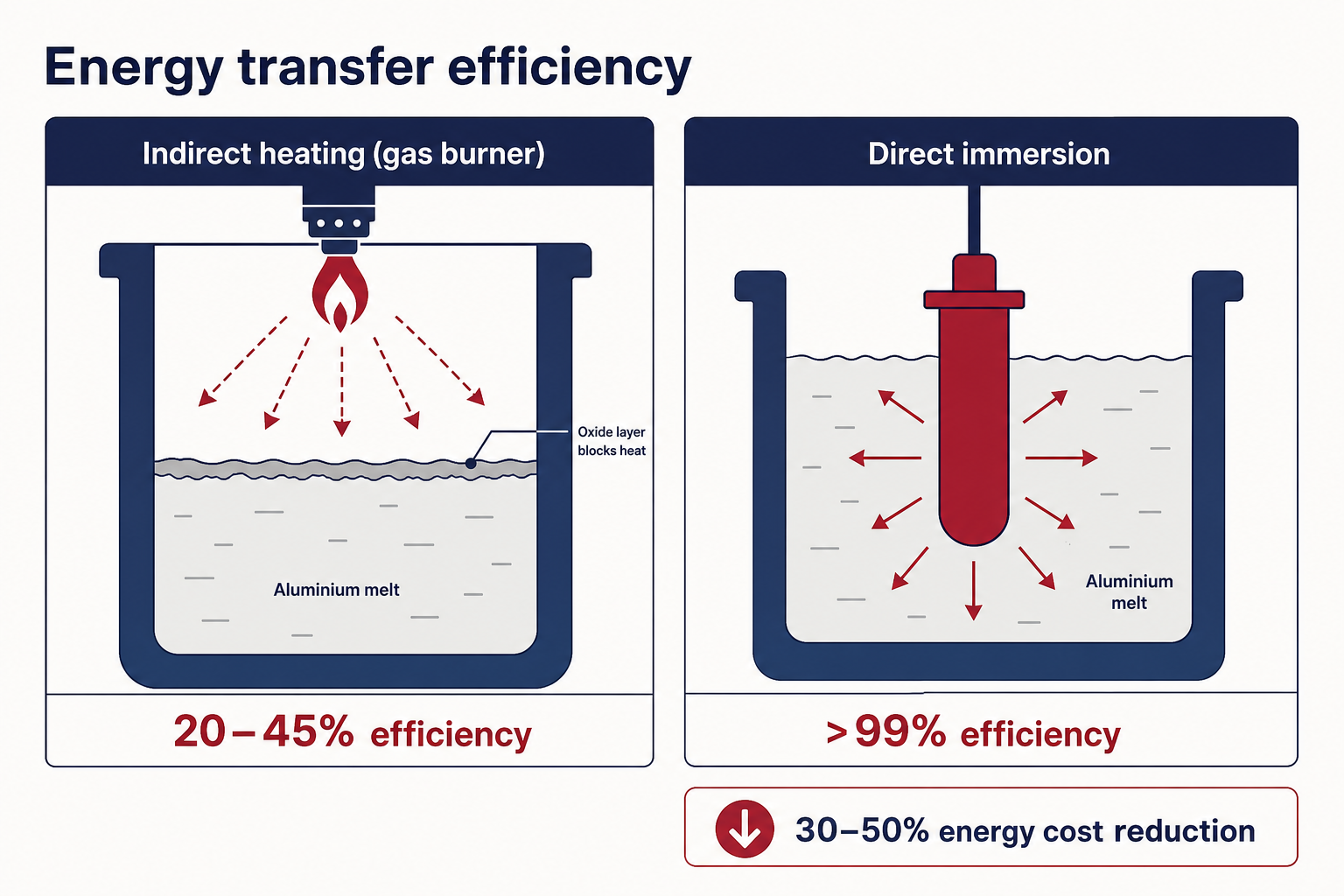
Elke ingenieur die met een gasgestookte weerkaatsingsoven werkt, kent de fysica, maar de cijfers blijven ongemakkelijk als je ze naast elkaar legt. Om een smeltbad op 720 °C te houden, moet de ovenatmosfeer 900–1.000 °C bereiken, omdat het warmteverloop extreem is: hete verbrandingsgassen verwarmen het vuurvaste dak en de wanden, die warmte naar beneden uitstralen, waardoor het smeltoppervlak wordt verwarmd, dat – dankzij de sterk reflecterende oxidelaag van aluminium – een aanzienlijk deel direct weer terugkaatst. Het beste thermische rendement voor een gasgestookte indirecte oven ligt rond de 45%. In oudere of minder geoptimaliseerde opstellingen is dit 20–30%.
Die oververhitte atmosfeer heeft nog een ander effect: het tast je aluminium van bovenaf aan. Het smeltoppervlak is heter dan de rest van de smelt. De vorming van oxiden is evenredig met de temperatuur, waardoor er aan het oppervlak voortdurend slak ontstaat. Door de turbulentie van de branderjets worden die oxiden weer in de smelt teruggevoerd. Voor gietstukken voor de lucht- en ruimtevaart of voor hoogwaardige auto-onderdelen zijn insluitsels die uit deze cyclus voortkomen geen onbelangrijk kwaliteitsprobleem – ze zijn de reden voor afkeuring.
Het probleem met indirecte verwarming is niet alleen de gasrekening. Het gaat om de totale kosten van energieverspilling, metaalverlies door slakken en het percentage defecte producten als gevolg van een bad dat niet op een constante temperatuur kan worden gehouden.
 —
—
Hoe directe dompelverwarming werkt
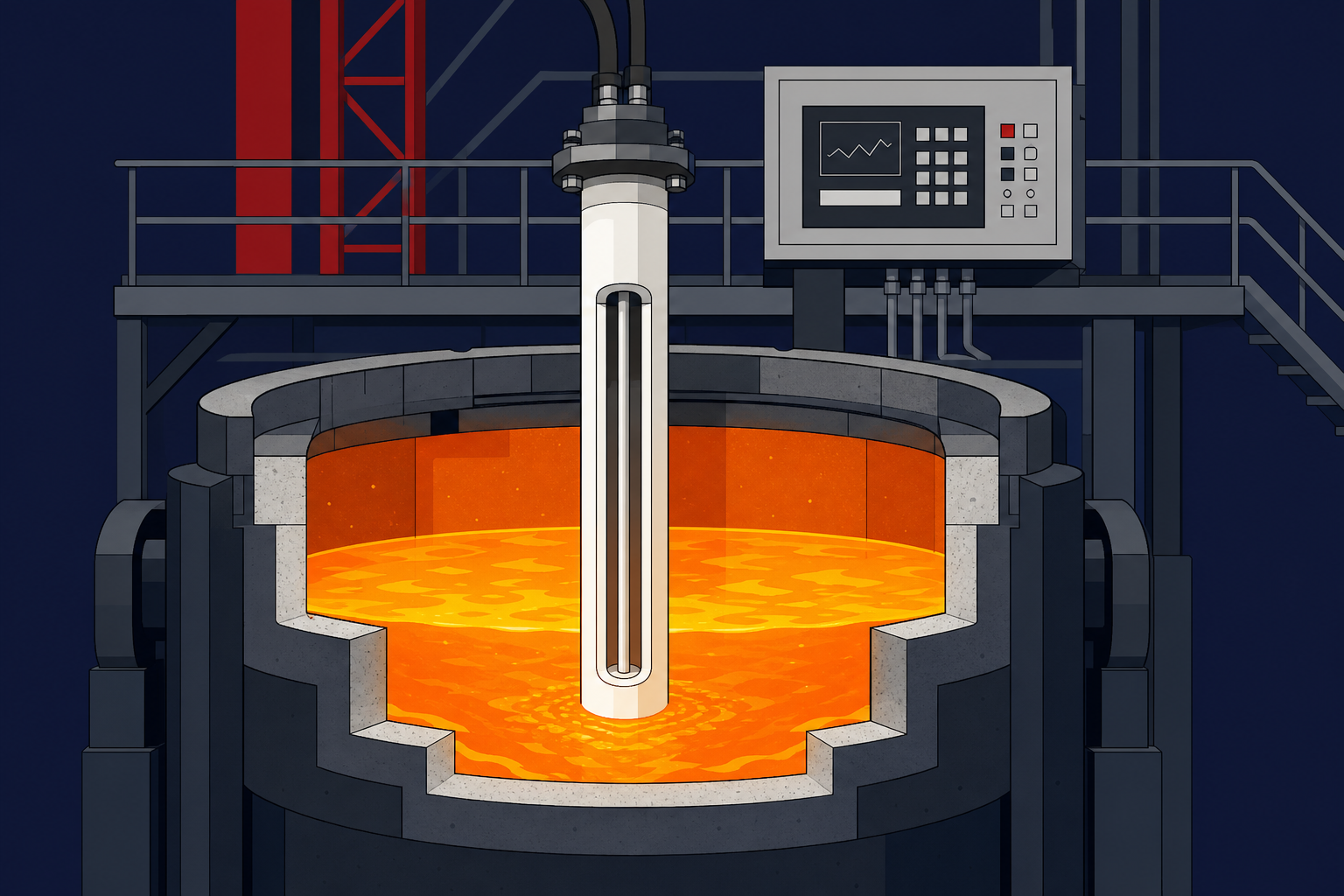
Het werkingsprincipe is eenvoudig: plaats de warmtebron in het metaal in plaats van erboven. Een dompelverwarmer is een weerstandsverwarmingselement dat is omhuld door een beschermende keramische mantel en via een flensverbinding door de ovenwand of het deksel is gemonteerd, waarbij de verwarmde zone volledig in het gesmolten bad is ondergedompeld.
De warmteoverdracht vindt plaats door geleiding, rechtstreeks van het keramische oppervlak naar het omringende aluminium. De benodigde temperatuurgradiënt is minimaal – om een bad van 720 °C op temperatuur te houden, hoeft het verwarmingsoppervlak slechts ongeveer 750 °C te zijn, in vergelijking met een ovenatmosfeer van 900–1.000 °C in een gassysteem. Dankzij die kleine gradiënt bedraagt het rendement meer dan 99%. Er is geen verlies door rookgassen, geen verlies door vuurvaste materialen en er gaat niets verloren aan het verwarmen van lucht.
Het tweede onderdeel betreft de temperatuurregeling. Meer bepaald zorgt een PID-regelaar, die is aangesloten op een thermokoppel in de smelt, ervoor dat de badtemperatuur automatisch binnen ±2 °C van de ingestelde waarde wordt gehouden. Hierdoor is geen handmatige aanpassing nodig. Bovendien schakelt de verwarming in en uit op basis van de realtime badtemperatuur, in plaats van op basis van een meting van de ovenatmosfeer, die enkele minuten achterloopt op de temperatuur van het metaal.
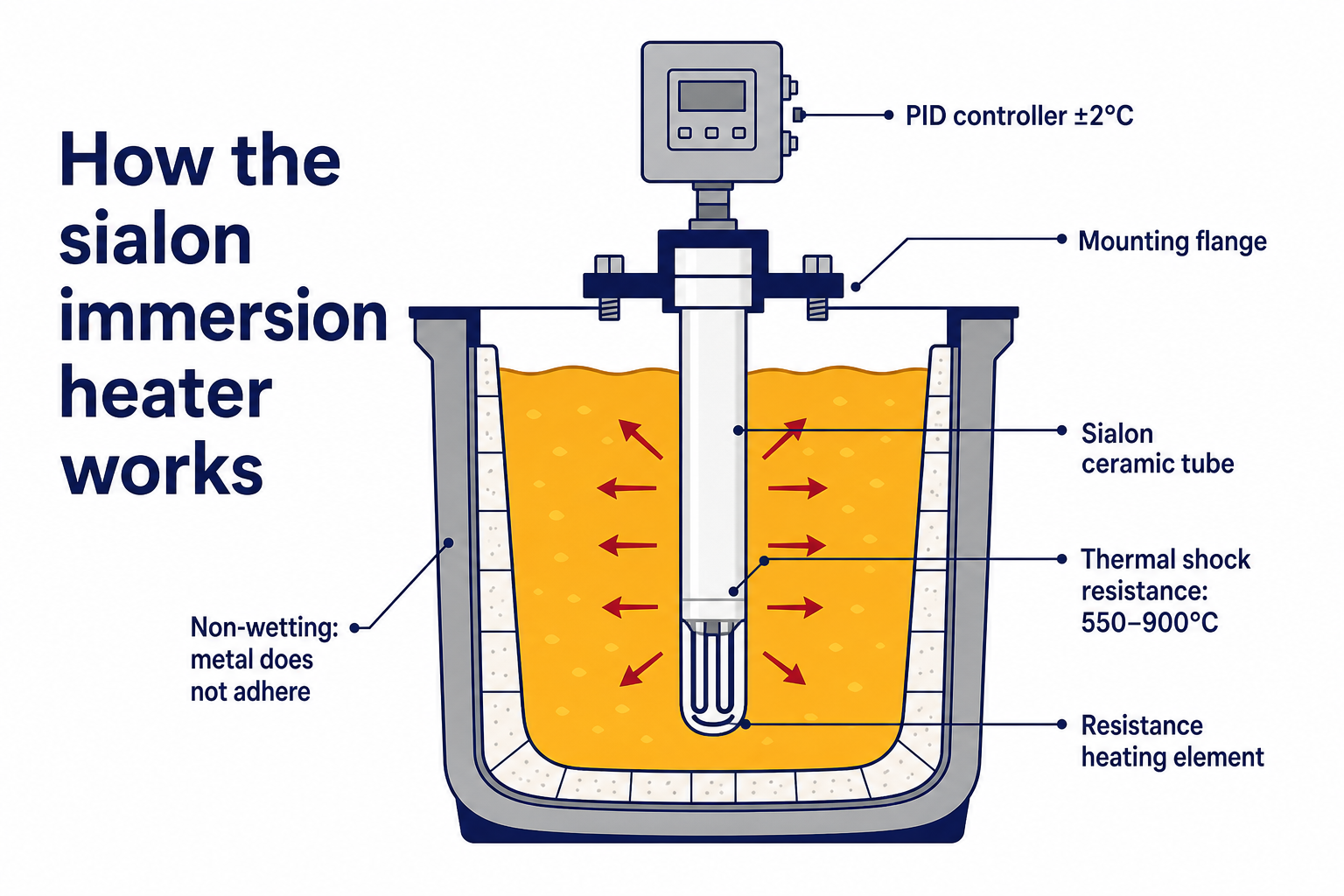 Natuurlijke convectie zorgt voor de verdeling. Heet metaal in de buurt van de verwarming stijgt op; koeler metaal uit de rest van het bad zakt naar beneden om het te vervangen. De beweging is rustig en continu, zonder de turbulentie die een gasbrander veroorzaakt. Het oppervlak blijft rustig. De oxidelaag blijft intact en drijft bovenop, in plaats van in de massa te worden opgenomen.
Waarom eerdere dompelverwarmers faalden – en wat siliciumnitride daarin heeft veranderd
Het concept van dompelverwarming is niet nieuw. Wat er decennialang voor zorgde dat het geen gangbare praktijk werd, waren de materialen: de beschermbuis begaf het steeds weer, en als dat gebeurde in een omgeving met gesmolten metaal, had dat ernstige gevolgen.
In de vroege ontwerpen kwamen drie storingsvormen het meest voor:
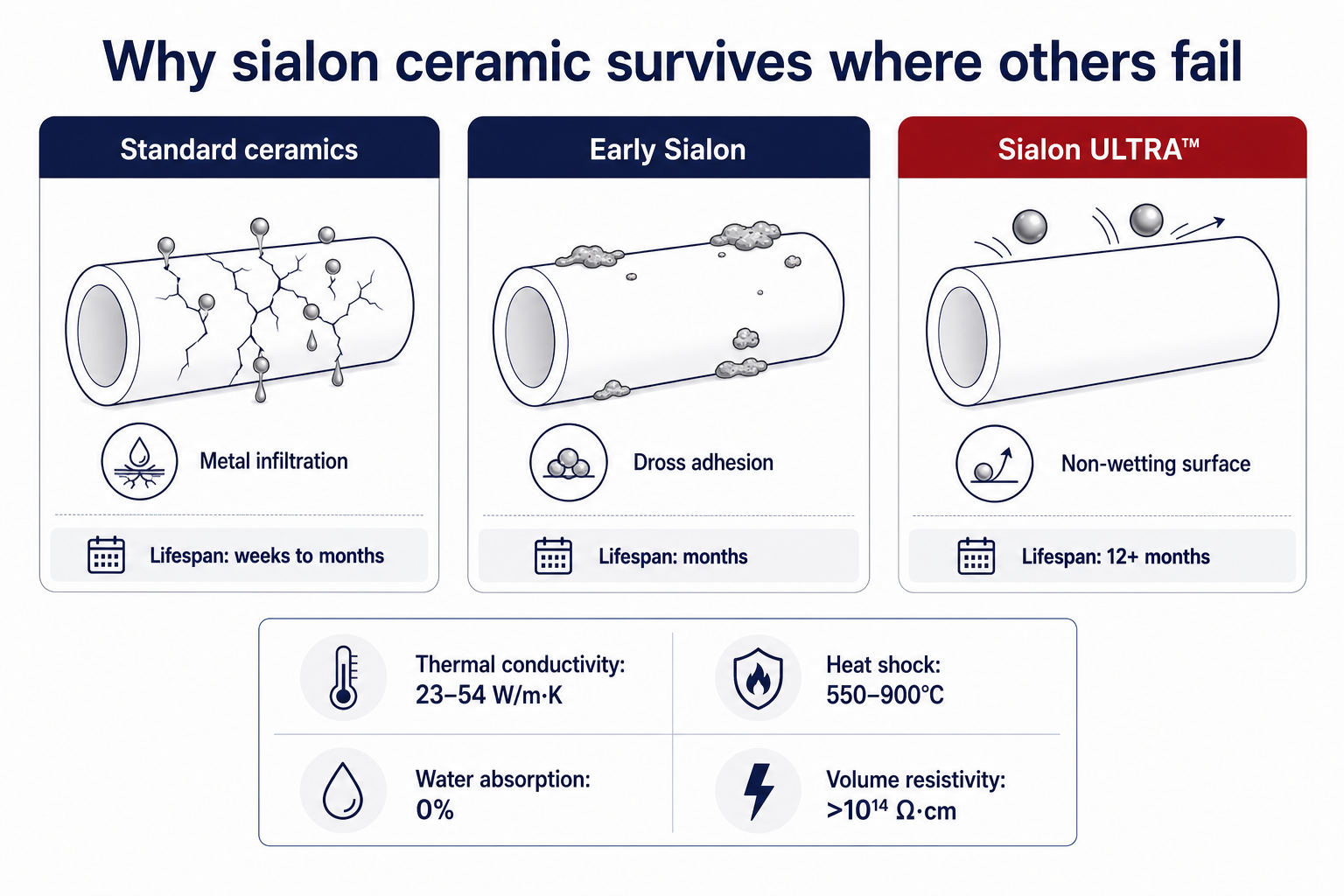
Metaalinfiltratie. Gietijzeren buizen en vroege buizen van aluminiumoxide-grafiet vertoonden porositeit. In de loop van enkele weken drong aluminium in de poriën door. De buis werd zwaar en elektrisch geleidend. Dit leidde tot kortsluitingen.
Chemische aantasting. De vloeimiddelen en zouten die bij het gieten van aluminium worden gebruikt – met name ontgassingsmiddelen op chloorbasis – tastten standaardkeramiek snel aan. Een buis die in een schone legering zes maanden meegaat, gaat bij een proces met agressieve vloeimiddelen mogelijk slechts zes weken mee.
Scheuren door thermische schokken. Een koude keramische buis die rechtstreeks in gesmolten metaal van 720 °C wordt ondergedompeld, zal barsten. Operators die de voorverwarmingsprocedures hebben overgeslagen, hebben dit op pijnlijke wijze ondervonden.
Sialon-keramiek – silicium-aluminiumoxynitride, Si₃Al₃O₃N₅ – pakt elke faalmodus op materiaalniveau aan.
Niet-bevochtigbaar oppervlak
De cruciale eigenschap is de niet-bevochtigbaarheid. Gesmolten aluminium hecht niet aan sialonoppervlakken — het metaal stroomt om de buis heen, net zoals water van een in de was gezette oppervlakte afloopt. Dit is geen coating; het is een intrinsieke eigenschap van de korrelstructuur van siliciumnitride. Zonder bevochtiging kan er geen infiltratie plaatsvinden. Zonder infiltratie blijft de buis gedurende haar gehele levensduur elektrisch isolerend. De volumeweerstand bedraagt meer dan 10¹⁴ Ω·cm — beter dan bij de meeste industriële keramische materialen na langdurig gebruik.
Weerstand tegen vloeimiddel- en zoutcorrosie
Sialon is bovendien vrijwel ongevoelig voor aantasting door vloeimiddelen en zouten. Gieterijen die gebruikmaken van ontgassing op basis van chloor, vloeimiddelen op basis van natrium of agressieve chemicaliën voor het verwijderen van oxiden, kunnen sialon-verwarmingselementen bij deze processen inzetten zonder dat er sprake is van versnelde slijtage.
Weerstand tegen thermische schokken
Wat betreft thermische schokken: de weerstand tegen thermische schokken varieert van 550 tot 900 °C, afhankelijk van de kwaliteit. Dat betekent dat snelle temperatuurschommelingen die een standaard aluminiumoxidebuis zouden doen barsten, sialon intact laten — mits het voorverwarmingsprotocol wordt gevolgd. Door de buis vijftien minuten boven het smeltoppervlak te houden voordat deze wordt ondergedompeld, wordt vocht uit de lucht verdreven en wordt het keramiek getemperd. Sla je dit over, dan zal zelfs sialon barsten.
De prestatiecijfers
Dit zijn de daadwerkelijke voordelen van de overstap van indirecte gasverwarming naar onderdompeling in siliciumnitride, op basis van gedocumenteerde resultaten bij verschillende gieterijen:
| Metrisch | Indirect (gasgestookt) | Onderdompeling in siliciumnitride |
|---|---|---|
| Thermisch rendement | 20–45 % | >99% |
| Energiebesparing versus gas | — | 30–50% kostenbesparing |
| Temperatuurnauwkeurigheid | ±10–15 °C | ±2 °C |
| Metaalverlies aan slakken | 1–2% per dienst | <0.5% per shift |
| Directe CO₂-uitstoot | Directe verbranding (Scope 1) | Nul direct (Scope 2) |
| Typisch rendement op investering (ROI) van een warmhoudoven | — | Jonger dan 8 maanden |
Het cijfer voor de vermindering van de slak verdient meer aandacht dan het doorgaans krijgt. Op een productielijn met een hoog volume, waar per ploegendienst meerdere tonnen worden verwerkt, is een vermindering van het metaalverlies met 1,5% geen afrondingsfout – het gaat om tonnen aluminium per jaar die niet op de slakhoop terechtkomen. Bij de huidige LME-prijzen is dat een aanzienlijke post. Het vereenvoudigt ook de afhandeling van gevaarlijk afval: kleinere slakvolumes betekenen lagere verwijderingskosten en eenvoudigere naleving van de regelgeving.
Voor bedrijven die onderdelen leveren aan de lucht- en ruimtevaartindustrie of aan tier-1-toeleveranciers in de automobielindustrie, kan het kwaliteitsaspect het energieaspect volledig overstijgen. Een bad dat op ±2 °C wordt gehouden, zorgt voor minder oxide-insluitsels en behoudt een constantere viscositeit gedurende de gehele gietcyclus. Minder insluitsels betekent minder afkeuringen. Minder afkeuringen betekent minder hersmelten, waardoor de kringloop van energie-efficiëntie wordt gesloten.
“Klanten melden energiebesparingen van 20%, 30% en zelfs 40% bij het gebruik van dompelverwarmers in uiteenlopende toepassingen.” – Atherm, fabrikant van dompelverwarmers
“Dompelverwarmers zorgen ervoor dat het oppervlak koeler blijft dan de bodem. Het oppervlak blijft ongerept. Er vormt zich minder oxide. Er hoeft minder afgeschuimd te worden. De metaalopbrengst neemt toe.” – Technische documentatie van AdTech
De garantie die het verschil maakt tussen premium en budget
Een gegeven dat veel zegt over het ontwerp van een verwarmingstoestel: wat de fabrikant bereid is schriftelijk te garanderen.
De Sialon ULTRA™ aluminium dompelverwarmer wordt geleverd met een garantie van 12 maanden tegen zowel chemische aantasting als elektrische defecten in gesmolten aluminium. Die dubbele dekking – chemisch en elektrisch – is belangrijk, omdat goedkopere verwarmers doorgaans slechts één van beide of geen van beide dekken. Een garantie die alleen tegen chemische aantasting geldt, biedt geen bescherming als het interne element kortsluiting maakt als gevolg van porositeit in het keramiek. Een garantie van 6 maanden, van welke aard dan ook, geeft aan hoe groot het vertrouwen van de fabrikant is.
De dubbele garantie van 12 maanden weerspiegelt het resultaat van 40 jaar materiaalontwikkeling door Sialon Ceramics: een keramiek met een porositeit die vrijwel nul is (0% wateropname), elektrische isolatie die gedurende de gehele levensduur behouden blijft (>10¹⁴ Ω·cm volumeweerstand), en een in de korrelchemie ingebouwde weerstand tegen flux. Deze eigenschappen komen rechtstreeks tot uiting in de garantie die het bedrijf bereid is te bieden.
Voordelige dompelverwarmers van sialon van mindere kwaliteit of gebonden siliciumcarbide lijken op het eerste gezicht vaak aantrekkelijk vanwege hun lagere aanschafprijs. In de praktijk leidt een hogere porositeit echter tot snellere infiltratie, een kortere levensduur en vaker vervangen – waarbij elke vervanging het risico op een productieonderbreking met zich meebrengt. Over een periode van 24 maanden gezien vallen de totale eigendomskosten doorgaans gunstiger uit voor het hoogwaardige keramiek.
Technische overwegingen: installatie, dimensionering en onderhoud
Om het maximale uit een siliciumnitride-dompelverwarmer te halen, is het van belang dat een aantal installatie- en bedrijfsparameters correct worden ingesteld.
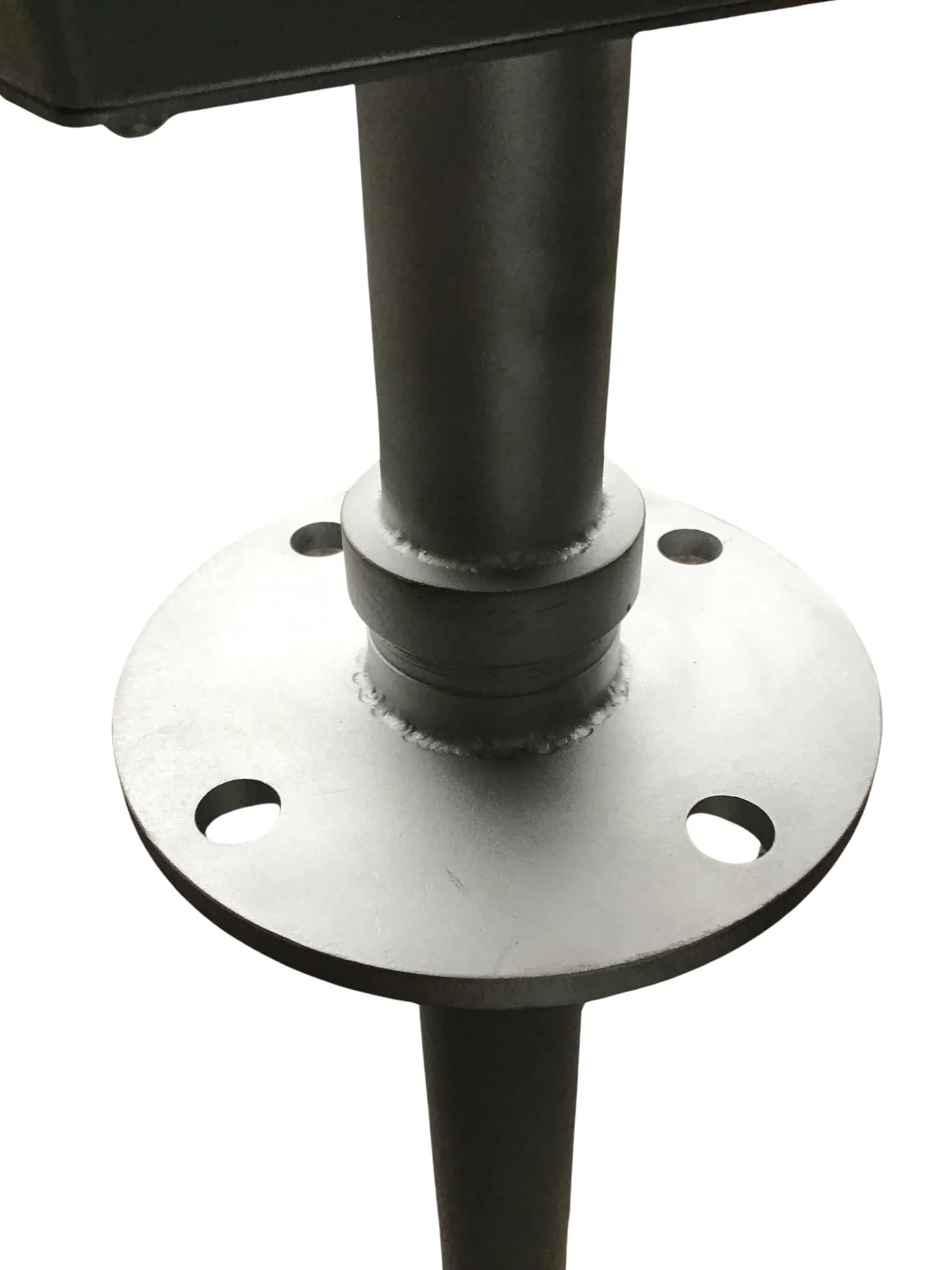 Montagerichting. Verticale montage zorgt ervoor dat de mechanische belasting op de keramische buis tot een minimum wordt beperkt. Horizontale of schuine montage is mogelijk met de juiste ondersteuning, maar vanwege de broosheid van het keramiek vormt een onondersteunde overhang een risico.
Dompeldiepte. De verwarmde zone moet minimaal 150 mm vrije ruimte boven de ovenbodem hebben (om te voorkomen dat deze onder bezonken slib komt te liggen) en moet minimaal 150 mm onder het minimale badniveau blijven. Als het badniveau daalt en de verwarmde zone bloot komt te liggen, stijgen de temperaturen van de verwarmingselementen snel.
Vermogensdichtheid. De standaardaanbeveling is 20–25 kW/m² buisoppervlak. Overschrijding hiervan leidt tot plaatselijke oververhitting van het aluminium dat direct tegen de buis aanligt, waardoor het voordeel van minder slakvervorming teniet wordt gedaan.
Voorverwarmingsprotocol. Plaats de verwarming vóór het onderdompelen gedurende 10–15 minuten op laag vermogen boven het smeltoppervlak. Hierdoor wordt vocht uit de lucht uit het keramiek verdreven en wordt de buis gehard tegen thermische schokken. Medewerkers die deze stap overslaan, zijn verantwoordelijk voor het merendeel van de voortijdige defecten aan de buis.
Plaatsing van de thermokoppels. Het regelthermokoppel moet in de buurt van de verwarming worden geplaatst, zonder deze te raken; een apart veiligheidsthermokoppel moet de temperatuur van de smeltmassa meten. Door de PID op basis van deze twee punten af te stellen, krijgt u een responsieve regeling zonder temperatuuroverschrijding.
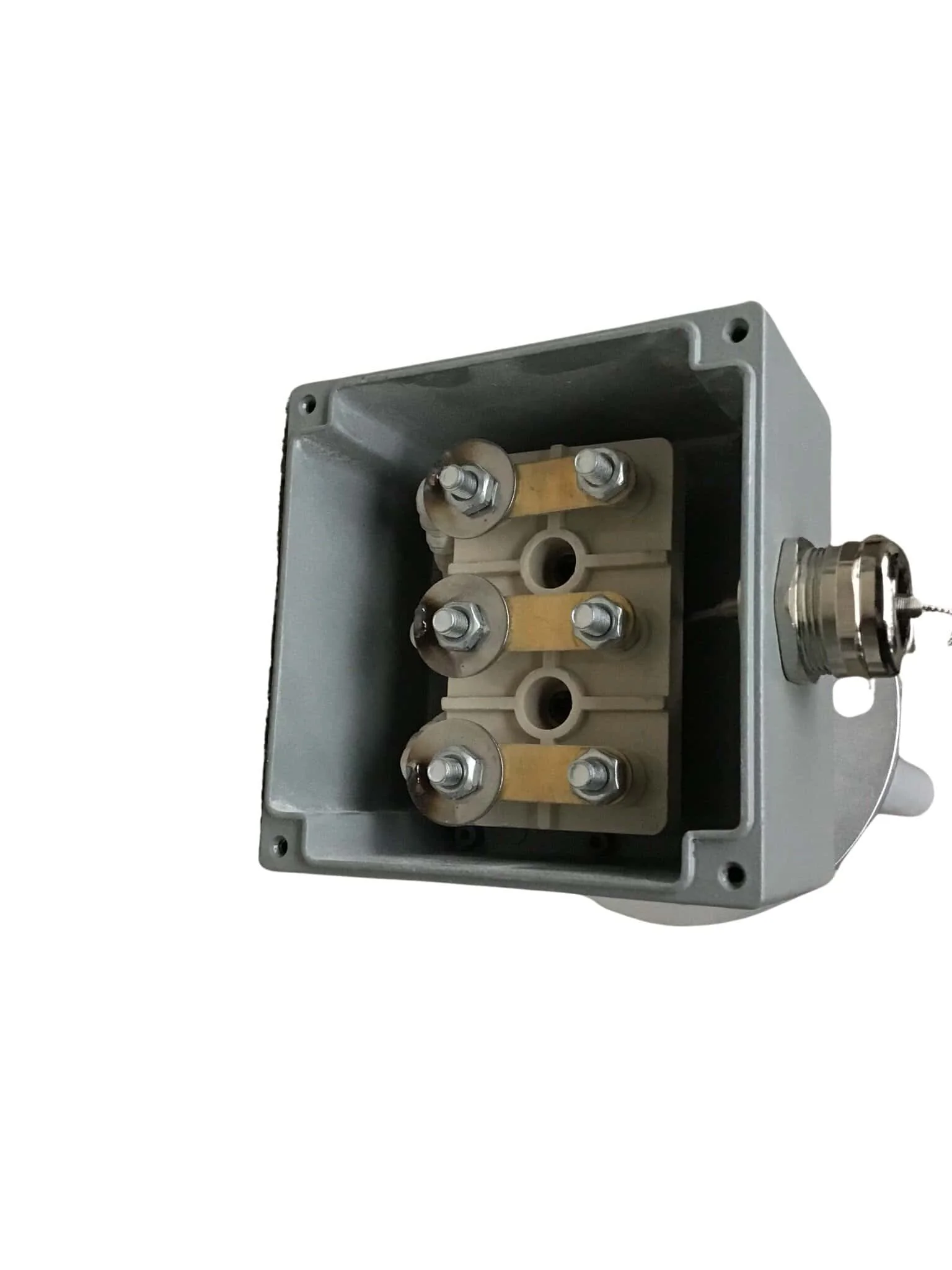
De Sialon ULTRA™-verwarmer is volledig aanpasbaar: nominaal vermogen, spanning (480 V driefasig, 480 V of 220 V eenfasig, of op maat tot 600 V), buitendiameter, totale lengte, lengte van de verwarmingszone en een optioneel geïntegreerd type K-thermokoppel. De standaard buitendiameter van de buis is 55 mm. De capaciteiten variëren van 450 kg tot 3.100 kg voor integratie in ovens, inclusief compatibiliteit met Striko Westomat-doseerovens.
 —
—
Waar directe dompelverwarming in uw gieterij past
Dompelverwarming is de juiste technologie voor het op temperatuur houden en handhaven; het is geen smelttechniek. De gangbare opstelling in de meeste gieterijen bestaat uit een gas- of inductiesmeltoven voor de lading, gevolgd door een met dompelverwarming uitgeruste warmhoudoven voor het smeltbad dat de gietmachine voedt.
Toepassingen waarin de Sialon ULTRA™-verwarming het beste presteert:
- Warmhoudovens – de belangrijkste toepassing; houden de temperatuur tussen productiecycli op peil zonder enige tussenkomst van de operator
- Ontgassings- en filtratie-eenheden – compenseren het warmteverlies tijdens de verwijdering van waterstof en de filtratie met keramisch schuim, zonder het oppervlak aan te tasten
- Opwarmen van gietlepels – dankzij draagbare verwarming blijft de temperatuur van het metaal tijdens het transport door de fabriek op peil
- Lagedrukgieten (LPDC) – krappe ovenruimtes waar branders niet passen; de compacte afmetingen van de verwarming vormen hier een voordeel
- Filterkisten en filterwielen – voorkomen dat het metaal tijdens het filteren afkoelt tot onder de gietviscositeit
Voor grote bedrijven die EV-gigafabrieken of OEM-productielijnen in de lucht- en ruimtevaart bevoorraden, wordt de verschuiving in de CO₂-boekhouding ook steeds relevanter: bij dompelverwarming worden de directe verbrandingsemissies (Scope 1) omgezet in aangekochte elektriciteit (Scope 2). Naarmate de elektriciteitsnetten koolstofarm worden, versterkt die verschuiving zich in de loop van de tijd zonder dat er verdere technologische veranderingen nodig zijn.
Probeer Sialon Ceramics eens
Sialon Ceramics houdt zich al 40 jaar bezig met het ontwerpen van keramische componenten voor de specifieke omstandigheden in omgevingen met gesmolten non-ferrometalen – niet als uitbreiding van het productassortiment, maar als de enige focus van het bedrijf. De Sialon ULTRA™ aluminium dompelverwarmer is het resultaat van die specialisatie: vier ULTRA-kwaliteiten (ULTRA-001 tot en met ULTRA-004) met op maat afgestemde materiaaleigenschappen, volledige aanpassing aan de specificaties van uw oven en een garantie van 12 maanden tegen zowel chemische aantasting als elektrische defecten – iets wat de meeste concurrenten niet kunnen evenaren.
 Als u gasgestookte warmhoudovens gebruikt en nog geen onderzoek hebt gedaan naar dompelverwarming, zijn de energiecijfers op zich meestal al reden genoeg om hierover eens te praten. De productpagina bevat de gedetailleerde specificaties; het team in Kopenhagen biedt directe technische ondersteuning bij vragen over dimensionering en integratie. Voor activiteiten in Noord-Amerika: gratis ondersteuning via +1 (833) 709-1399.
Veelgestelde vragen
Wat is een siliciumnitride-dompelverwarmer en hoe werkt deze in een aluminiumgieterij?
Een siliciumnitride-dompelverwarmer is een direct verwarmingselement van silicium-aluminiumoxynitride (Si₃Al₃O₃N₅) keramiek, ontworpen om volledig ondergedompeld te worden in een bad van gesmolten aluminium. In plaats van het bad van buitenaf te verwarmen, geeft het element via elektrische weerstand warmte rechtstreeks door de keramische mantel af aan het omringende metaal, waardoor een energie-efficiëntie van meer dan 99% wordt bereikt. Het niet-bevochtigende oppervlak van het siliciumnitridekeramiek voorkomt dat gesmolten aluminium aan de buis blijft kleven, waardoor het element continu kan functioneren in een houdoven bij 660–750 °C zonder dat het aan kwaliteit inboet.
Hoeveel energie kan een aluminiumgieterij besparen door over te stappen van gasverwarming naar dompelverwarming met siliciumnitride?
Gieterijen die overschakelen van indirecte verwarming op gas (doorgaans met een thermisch rendement van 20–45%) naar directe dompelverwarming met siliciumnitride (rendement van >99%) melden steevast een daling van de verwarmingskosten met 20–40%. Bij een warmhoudoven van 2 ton die continu in bedrijf is, vertaalt zich dat in een terugverdientijd van minder dan 8 maanden, uitsluitend door de energiebesparingen, nog afgezien van de verminderde slakverliezen en de lagere onderhoudsfrequentie.
Kan een dompelverwarmer van siliciumnitride een gasoven in een aluminiumgieterij volledig vervangen?
Voor het bewaren en op temperatuur houden, ja. Voor het smelten van koud schroot vanuit vaste toestand, nee. De gangbare opstelling in de meeste gieterijen bestaat uit een gas- of inductiesmeltoven om de lading te smelten, gevolgd door een met dompelverwarming verwarmde warmhoudoven om het smeltbad met een nauwkeurigheid van ±2 °C op temperatuur te houden voor het gieten. Siliciumnitride-dompelverwarmers zijn verkrijgbaar in configuraties met een ovencapaciteit van 450 kg tot 3.100 kg, inclusief integratie met Striko Westomat-doseerovens.
Welke garantie geldt er voor de Sialon Ceramics-dompelverwarmer van siliciumnitride, en wat valt er onder deze garantie?
De Sialon ULTRA™ aluminium dompelverwarmer wordt geleverd met een volledige garantie van 12 maanden tegen zowel chemische aantasting in gesmolten aluminium als elektrische defecten. Deze dubbele dekking weerspiegelt het vertrouwen in zowel de weerstand van het keramiek tegen aantasting door vloeimiddel en oxiden, als de betrouwbaarheid van het elektrische ontwerp bij continue thermische en elektrische belasting in een omgeving met gesmolten metaal.
Wat zijn de oorzaken van defecten aan siliciumnitride-dompelverwarmingsbuizen, en hoe kan dit worden voorkomen?
De meeste defecten zijn terug te voeren op drie hoofdoorzaken: het bevochtigen en binnendringen van aluminium in de poriën van het keramiek, chemische aantasting door vloeimiddelen en zouten, en thermische schokken als gevolg van snelle temperatuurschommelingen. Sialon-keramiek (Si₃Al₃O₃N₅) biedt echter een oplossing voor alle drie. Ten eerste voorkomt de porositeit van vrijwel nul dat metaal binnendringt. Bovendien is de chemische samenstelling ervan vrijwel immuun voor aantasting door vloeimiddelen. Ten slotte maakt de weerstand tegen thermische schokken van 550–900 °C directe onderdompeling mogelijk, mits een voorverwarmingsprotocol van 10–15 minuten wordt gevolgd.
Het resultaat is een levensduur van meer dan 12 maanden, terwijl keramiek van mindere kwaliteit slechts enkele weken meegaat.


 ZDialer-oproep