
Sintered-Silicon-Carbide-Ceramics
Sintered silicon carbide: the complete engineering guide to SSiC ceramics
A technical engineering guide to sintered silicon carbide (SSiC): how it’s made, its key properties, industrial applications, and when to choose it over other ceramics.
July 29, 2026 · 11 min read
TL;DR
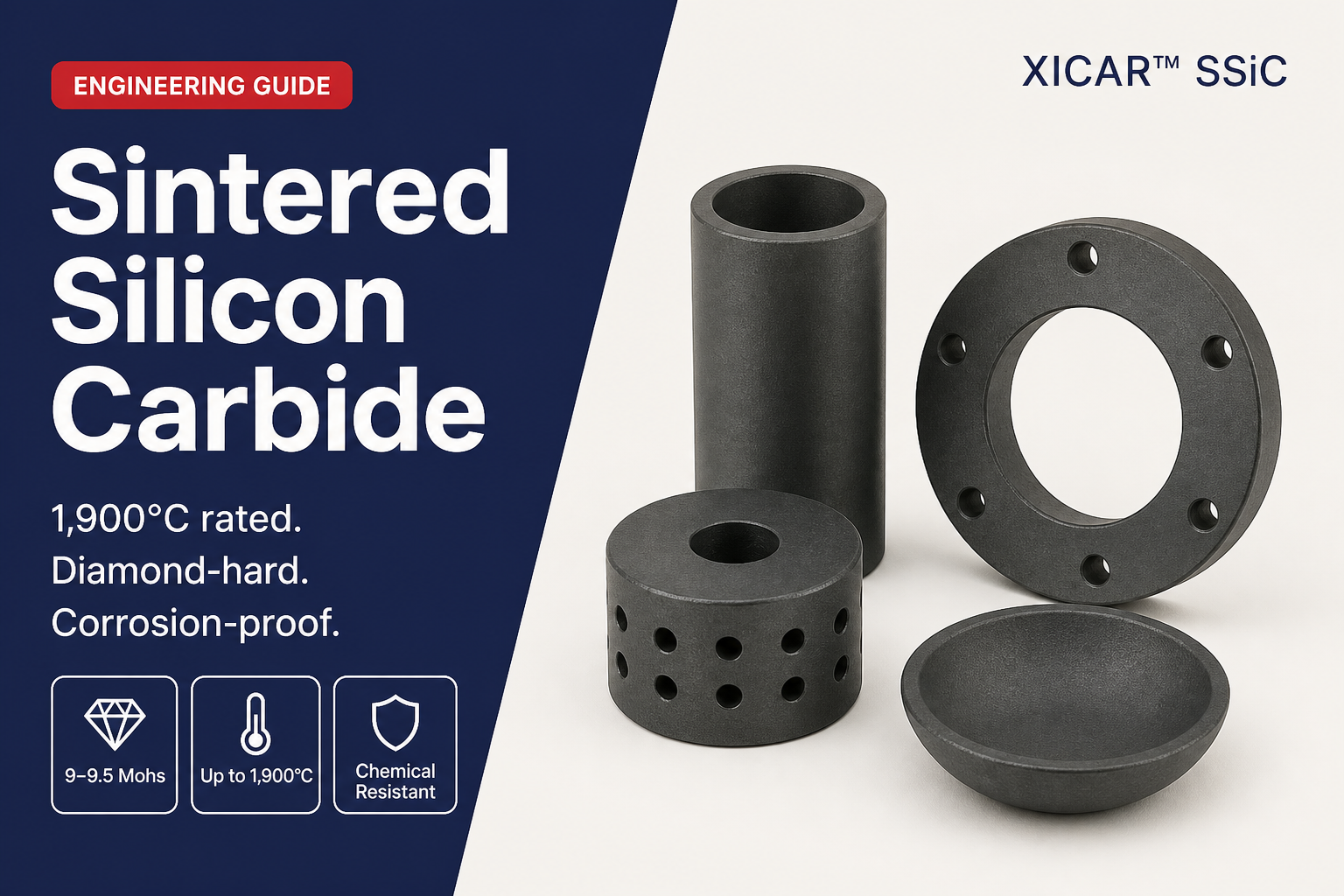
Sintered silicon carbide (SSiC) is what engineers reach for when no other material survives. It operates at up to 1,900°C in controlled atmosphere, carries a Mohs hardness of 9-9.5 – second only to diamond among naturally occurring materials – and resists essentially every acid, alkali, and molten salt an industrial process can throw at it. The sintering process is what sets SSiC apart from cheaper reaction-bonded alternatives: sub-micron SiC powder, fired in an argon atmosphere at 2,100-2,200°C, produces a fully dense ceramic with zero residual metal phase and zero porosity – properties you simply cannot get from infiltration-based grades. The global SSiC market reached $2.8 billion in 2025 and is growing at 6.9% per year, driven by semiconductor fabs, chemical processing plants, and non-ferrous foundries all discovering the same thing: once you need a component that genuinely won’t fail, SSiC is usually the answer. Sialon Ceramics’ XICAR™ SSiC line delivers components up to 3,000 mm in length with HEXOLOY®-equivalent performance – backed by 40 years of custom ceramic manufacturing from Copenhagen.
What is sintered silicon carbide?
Silicon carbide (SiC) is a compound of silicon and carbon that doesn’t exist in nature in usable quantities – it has to be synthesised. The Acheson process, developed in 1893, produces the raw material by reacting silica sand with carbon at around 2,500°C. What you get is a crystalline SiC powder that can then be formed and densified into components. How you densify it is everything: the manufacturing route determines the final material’s properties more than almost any other variable.
Sintered silicon carbide is produced by pressureless sintering – packing SiC powder with a small fraction of non-oxide sintering aids (typically boron and carbon), forming it to near-net shape, and firing in an inert argon atmosphere at 2,100-2,200°C. At those temperatures, the particles bond at their grain boundaries and the component densifies to virtually zero porosity. No free silicon remains in the structure. That absence of residual metal phase is the defining property of SSiC: it’s the reason the material is chemically inert in environments that would degrade every other SiC grade.
The main alternative – reaction-bonded silicon carbide (RBSC) – infiltrates a porous SiC preform with liquid silicon. It’s cheaper and can form more complex geometries, but the 10-12% free silicon left in the structure has a melting point of only 1,410°C and is attacked by strong bases and hydrofluoric acid. For many applications that’s acceptable. For applications where it isn’t, you need SSiC.
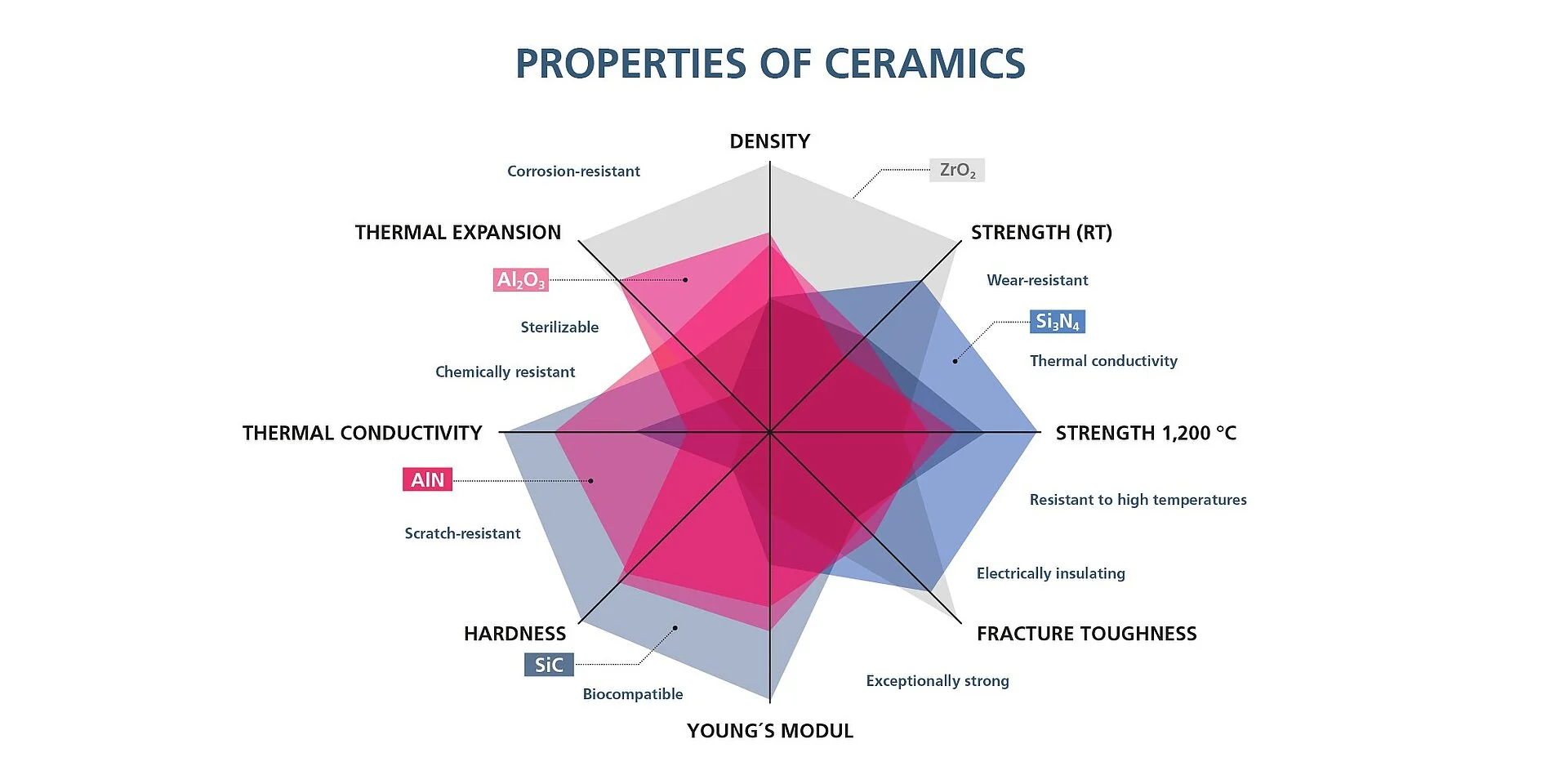
The spider chart above shows where SiC (labelled) sits relative to other technical ceramics: dominant on hardness and thermal conductivity, strong on high-temperature strength. What it doesn’t show is that these advantages are maximised in the sintered grade specifically – SSiC sits at the extreme of what SiC can be.
How SSiC is made – the sintering process
Understanding the process explains why SSiC costs more than RBSC and why the premium is usually worth it. The four steps are:
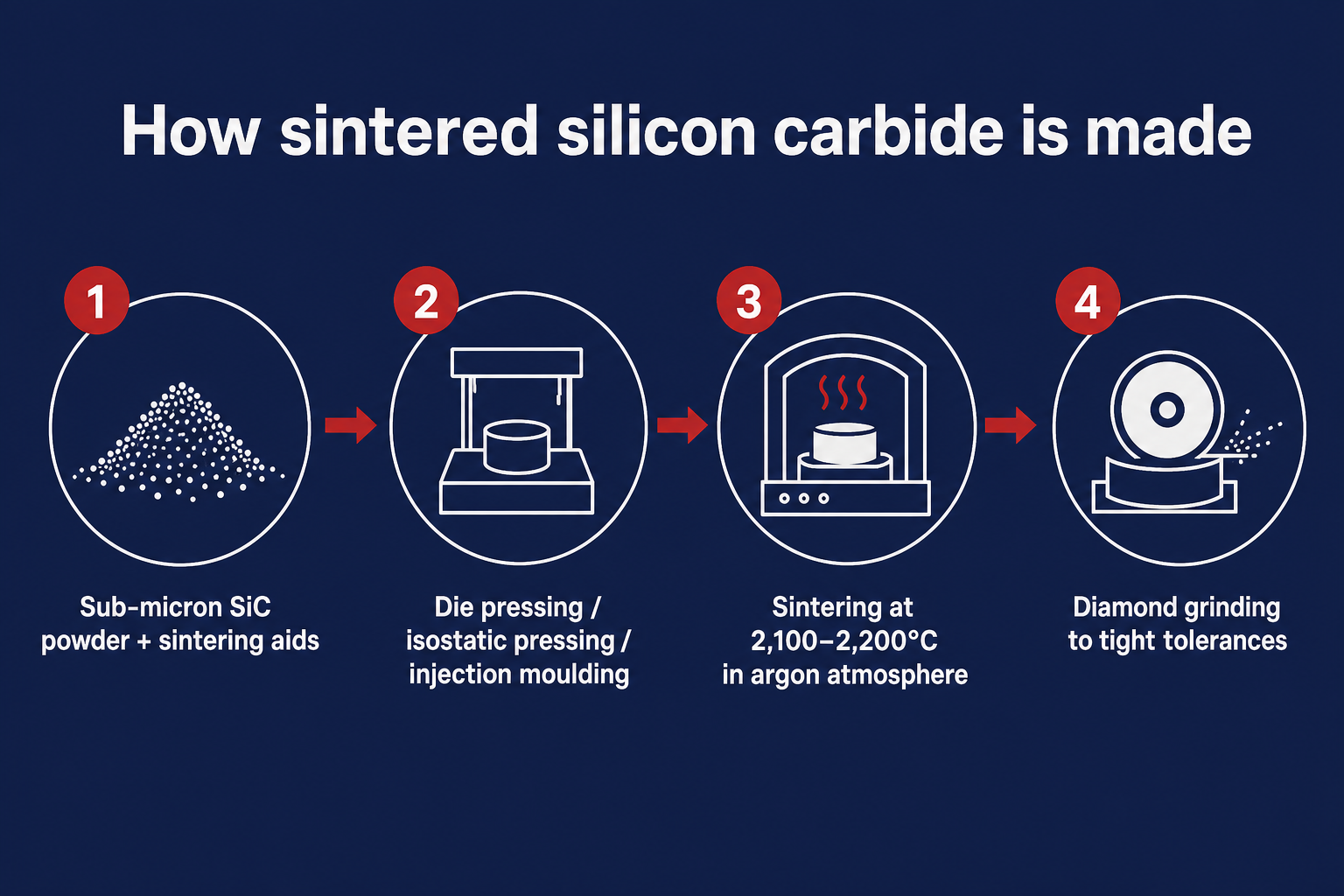
Powder preparation. Sub-micron SiC powder – particle size under 1 micron – is blended with sintering aids, typically boron and carbon in small percentages. The particle size matters: finer powder gives a higher surface area for bonding, which means lower sintering temperatures and better densification. Getting the blend right is where the materials science expertise lives.
Forming. The powder mixture is shaped using conventional ceramic processing: die pressing for simple geometries, isostatic pressing for thicker sections and better density uniformity, or injection moulding for complex thin-walled parts. The formed “green” body is fragile and oversized by around 17-20% – it will shrink during sintering.
Sintering. The green body fires in an argon atmosphere at 2,100-2,200°C, well above the SiC decomposition temperature in air (around 1,600°C). The argon atmosphere prevents oxidation. At these temperatures, grain boundary diffusion drives densification: pores close, grains grow, and the component reaches theoretical density (3.1 g/cm³) with zero residual metal phase. The dimensional shrinkage is predictable and uniform, which is why net-shape or near-net-shape forming is almost always used – post-sintering machining with diamond tools is possible but expensive.
Finishing. Diamond grinding or lapping achieves the final tolerances. SSiC’s extreme hardness (≥22 GPa Vickers) means only diamond tooling can cut it, which is both a limitation (machining cost) and a practical advantage once installed (nothing in service wears it down easily).
“The challenge with SSiC is that you can’t machine it cheaply after sintering. You have to get the shape right before firing. Experienced suppliers work from engineering drawings and get the blank to near-net-shape so the diamond grinding is minimal – that’s where the cost difference between suppliers shows up.” – Practical Machinist forum, engineering machining community
Material properties: what the numbers actually mean
Here’s the complete property table for SSiC. These values are from AZoM’s SSiC materials database and corroborated by CeramTec’s SiC engineering data:
| Property | SSiC | Unit |
|---|---|---|
| Density | 3.1 | g/cm³ |
| Porosity | 0 | % |
| Vickers hardness | ≥22,000 | MPa (≥22 GPa) |
| Mohs hardness | 9–9.5 | – |
| Flexural strength | 550 | MPa |
| Compressive strength | 3,900 | MPa |
| Young’s modulus | 410 | GPa |
| Fracture toughness (KIC) | 4.6 | MPa·m½ |
| Thermal conductivity | 120–200 | W/m·K |
| Coefficient of thermal expansion | 4.0 | × 10⁻⁶/°C |
| Max. operating temperature (air) | 1,650 | °C |
| Max. operating temperature (inert) | 1,900 | °C |
| Density vs steel | ~40% | – |
A few of these deserve commentary rather than just a table entry.
Hardness. 9-9.5 on the Mohs scale puts SSiC just below diamond (10) and cubic boron nitride (9.5). In practical terms, this means standard abrasive media – silica sand, alumina grit, process slurries – simply can’t scratch it. Pump seals, nozzles, and liners in abrasive environments last years rather than months.
Thermal conductivity. 120-200 W/m·K is roughly 3-5× higher than alumina and silicon nitride, and about 8-10× higher than stainless steel. In a heat exchanger tube or a thermocouple protection tube, this means heat moves through the wall fast – which is exactly what you want when the point is temperature measurement accuracy or heat transfer efficiency.
Low thermal expansion. 4.0 × 10⁻⁶/°C combined with high thermal conductivity is what produces the material’s excellent thermal shock resistance. When a ceramic heats up, it expands; the faster heat conducts through the wall, the less differential expansion builds up across a section. SSiC handles rapid temperature cycling that would crack alumina outright.
Density. 3.1 g/cm³ – roughly 40% of steel. For large components like thermocouple tubes up to 3,000 mm, this weight saving matters in handling, mounting, and furnace load calculations.
SSiC vs other SiC grades – choosing the right one
Not all silicon carbide is the same material. The SiC family includes several grades with meaningfully different properties:
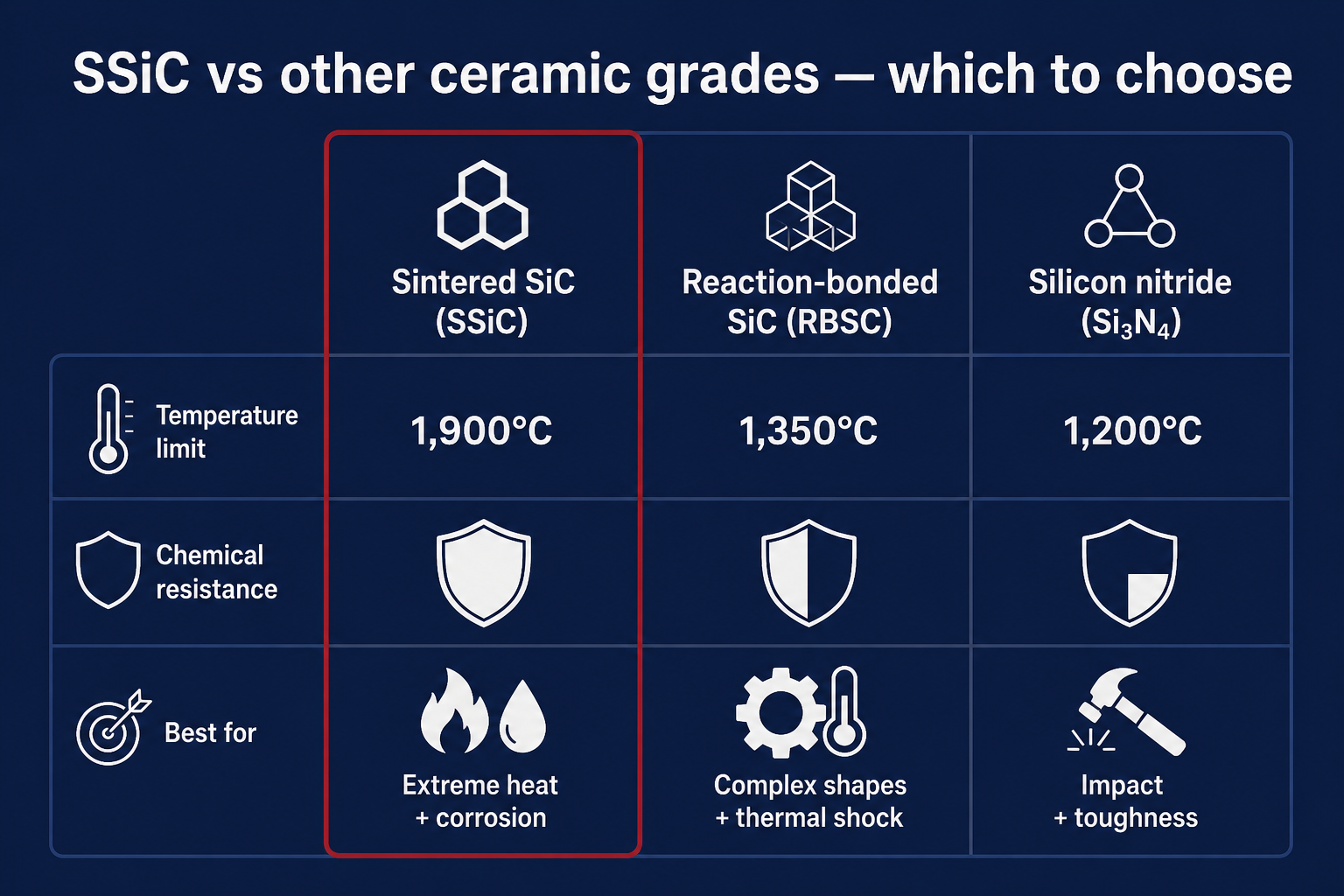
SSiC vs reaction-bonded SiC (RBSC/RBSiC). RBSC contains 10-12% free silicon, which caps its temperature ceiling at around 1,350-1,400°C (silicon melts at 1,410°C) and limits its chemical resistance. Where RBSC wins is geometric complexity – the silicon infiltration process can fill detailed features that pressureless sintering can’t reliably produce – and price. If your application runs below 1,350°C and your process chemistry is benign, RBSC is often the economical choice. Above 1,350°C or in aggressive chemistry, SSiC is the only viable SiC option.
SSiC vs silicon-infiltrated SiC (SiSiC). SiSiC is essentially another name for RBSC in European industrial usage. Same trade-offs apply.
SSiC vs silicon nitride (Si₃N₄). Silicon nitride has better fracture toughness (typically 6-8 MPa·m½ vs 4.6 for SSiC) and performs better under mechanical impact. Where SSiC dominates is hardness, thermal conductivity, and chemical resistance to molten non-ferrous metals – silicon nitride is attacked by some aluminium alloys at temperature, which is why sialon (silicon aluminium oxynitride) was developed as a molten-metal-specific alternative to Si₃N₄. For thermocouple protection in molten brass, copper, and cast iron, SSiC handles environments that silicon nitride and sialon both struggle with.
SSiC vs alumina (Al₂O₃). Alumina is cheaper and more widely available, but its thermal conductivity (20-30 W/m·K) is roughly one-fifth of SSiC, and it starts to lose strength above 1,200°C. For demanding temperature applications, the comparison is rarely close once total cost of ownership is considered.
Industrial applications of sintered silicon carbide
SSiC earns its place across a wide range of industries – not because it’s versatile in the “one material, many uses” marketing sense, but because the same combination of hardness, temperature resistance, and chemical inertness happens to be exactly what several different problems need.
Mechanical seals and pump components
The largest single application for SSiC globally is mechanical seals – particularly in chemical processing pumps. The combination of extreme hardness, low friction coefficient against itself or carbon, corrosion immunity, and dimensional stability under thermal cycling makes SSiC the default seal face material wherever the process fluid is aggressive.
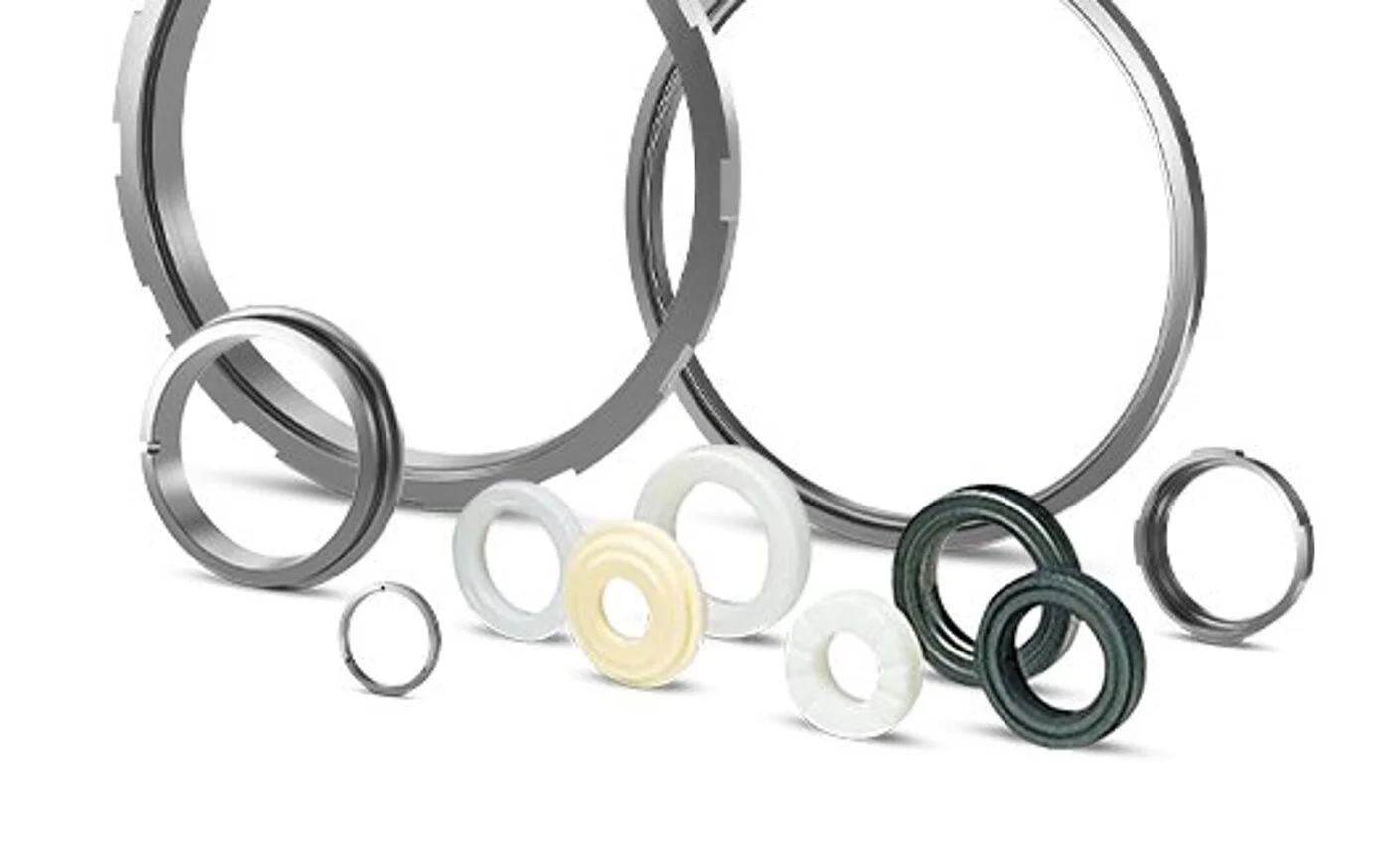
In a slurry pump running abrasive mineral processing tailings, alumina seal faces last weeks. SSiC seal faces run for years. The hardness difference is categorical: Mohs 9-9.5 vs Mohs 9 for alumina sounds close, but the Vickers values diverge sharply (22,000 MPa for SSiC vs 14,000-18,000 MPa for alumina). In pump bearings handling corrosive fluids, the combination of chemical resistance and hardness means SSiC allows designs with no lubrication – the bearing runs directly on the process fluid.
Thermocouple protection tubes in high-temperature metal processing
In foundries processing non-ferrous metals above 1,100°C – molten brass at 900-950°C, copper at 1,085-1,200°C, cast iron at 1,200-1,450°C – SSiC thermocouple protection tubes provide continuous temperature monitoring that steel tubes simply cannot. Steel corrodes in those melts within days. SSiC, with its zero porosity and chemical inertness to non-ferrous metals, runs indefinitely.
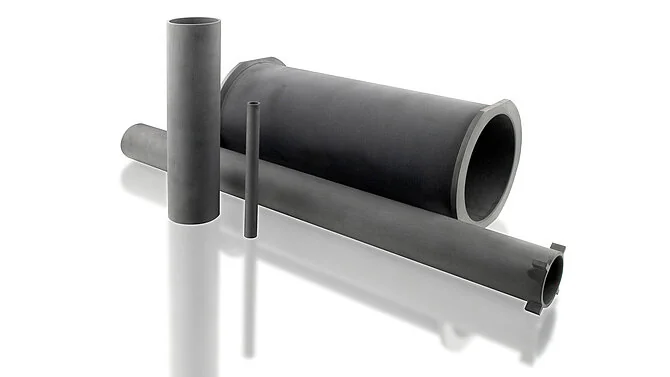
The high thermal conductivity (120-200 W/m·K) matters here in a specific way: a thick-walled protection tube with low thermal conductivity introduces significant measurement lag. An SSiC tube with high conductivity transmits the metal temperature to the thermocouple element with minimal error, which matters when you’re trying to hold a tight temperature window in a precision casting process.
Crucibles for metal melting and processing
SSiC crucibles handle the applications that sit above the temperature or chemistry limits of graphite-clay and silicon carbide-graphite crucibles. XICAR™ crucibles from Sialon run from 620°C for aluminium and zinc alloy smelting up to 1,400°C for copper, gold, and silver melting in induction furnaces.
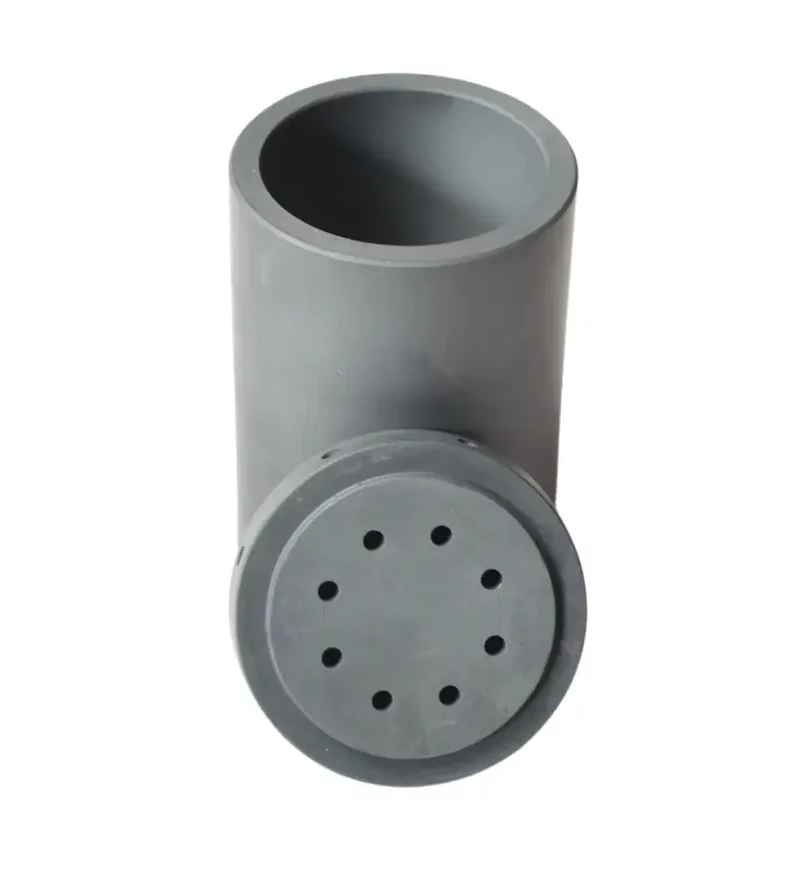
The anti-oxidation coatings on the XICRU™ HT and NF series extend service life in air atmospheres. For applications in induction furnaces, the material’s electrical conductivity (SSiC is a semiconductor, unlike alumina) means it can be heated directly by the induction field – a useful design flexibility.
Custom components: nozzles, wear liners, pump parts
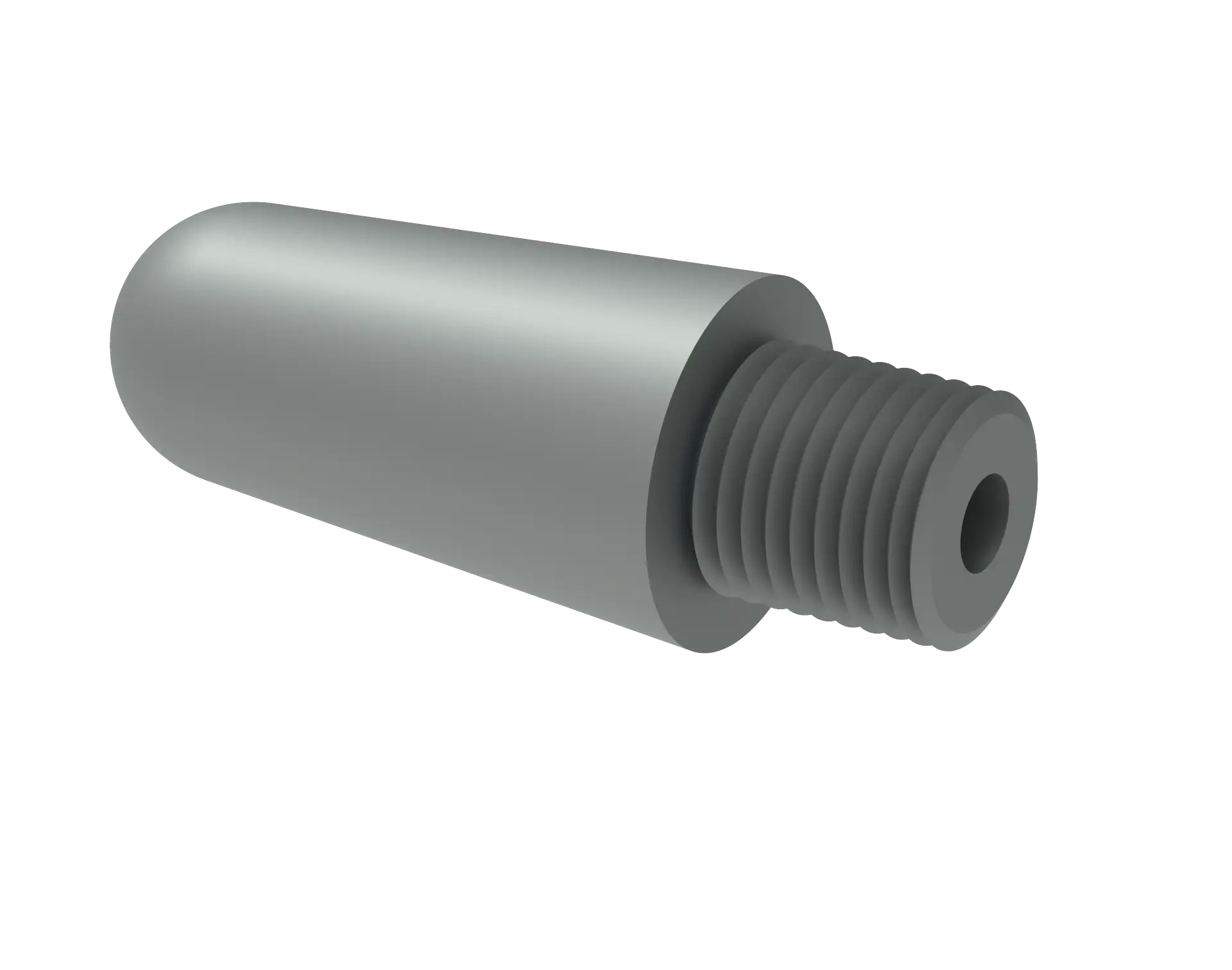
The combination of wear resistance and chemical inertness makes SSiC a natural fit for anything that sees abrasive or corrosive flow at high velocity. Burner nozzles, spray nozzles, extrusion dies, wear plates, and cyclone liners are all well-established applications.
Semiconductor manufacturing
The semiconductor industry’s push to larger wafer sizes and higher process temperatures has made SSiC a critical material for wafer boats, cantilever paddles, and process chamber components. The material’s purity – no metal phase to contaminate the process – combined with its thermal stability makes it one of a very short list of materials that can operate inside a diffusion furnace at 1,200°C without introducing impurities.
CO2 capture from seawater
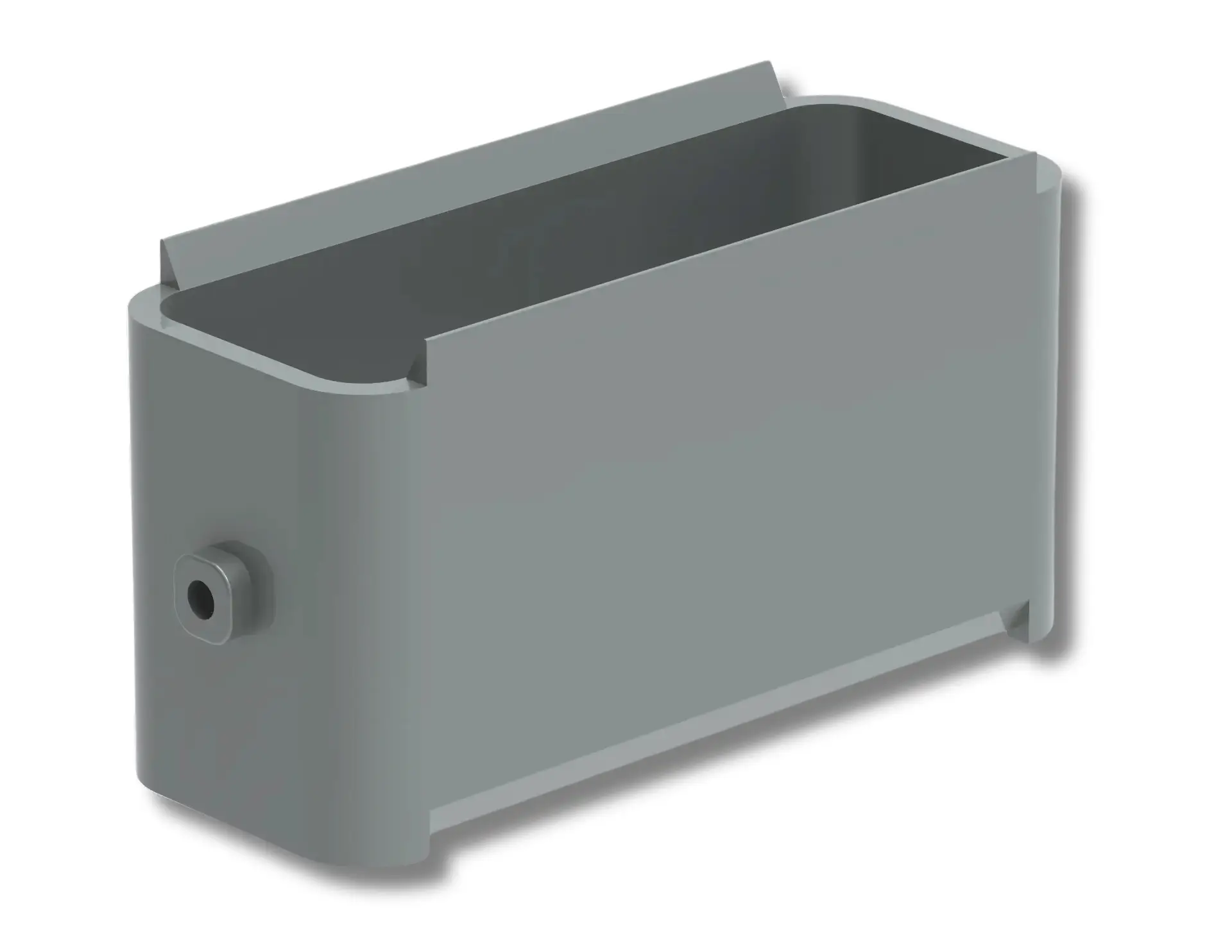
This one is less obvious but worth knowing about: SSiC kilns are now being used in emerging electrochemical CO2 capture from seawater processes, where the combination of seawater corrosion resistance, high-temperature capability, and structural integrity makes SSiC the only viable liner material.
What SSiC can’t do (and when to choose something else)
The honest answer on SSiC’s limitations is short but important.
It’s brittle. Fracture toughness of 4.6 MPa·m½ is lower than RBSC and significantly lower than silicon nitride (6-8 MPa·m½). SSiC doesn’t deform before fracture – it chips and cracks. Applications with significant mechanical impact, vibration, or thermal shock from rapid quenching should either choose RBSC for the thermal shock tolerance or silicon nitride for the toughness. The Sialon ULTRA™ product line, based on sialon (silicon aluminium oxynitride), is specifically engineered for molten aluminium environments where thermal shock cycling is severe – SSiC is less forgiving in that specific scenario.
Post-sintering machining is expensive. Only diamond tooling works, and complex features cut after sintering cost multiples of the same feature formed into the green body before firing. Get the geometry right at the design stage with your supplier and source near-net-shape blanks.
It’s not cheap. SSiC carries a meaningful price premium over RBSC and alumina. The economics almost always work out in favour of SSiC when you account for service life and downtime – but the upfront cost requires the conversation.
XICAR™ sintered silicon carbide from Sialon Ceramics
Sialon Ceramics Denmark ApS has manufactured technical ceramics since 1986. Their XICAR™ SSiC line covers the full range of applications the material is suited for, from standard crucibles to bespoke components machined to drawings.
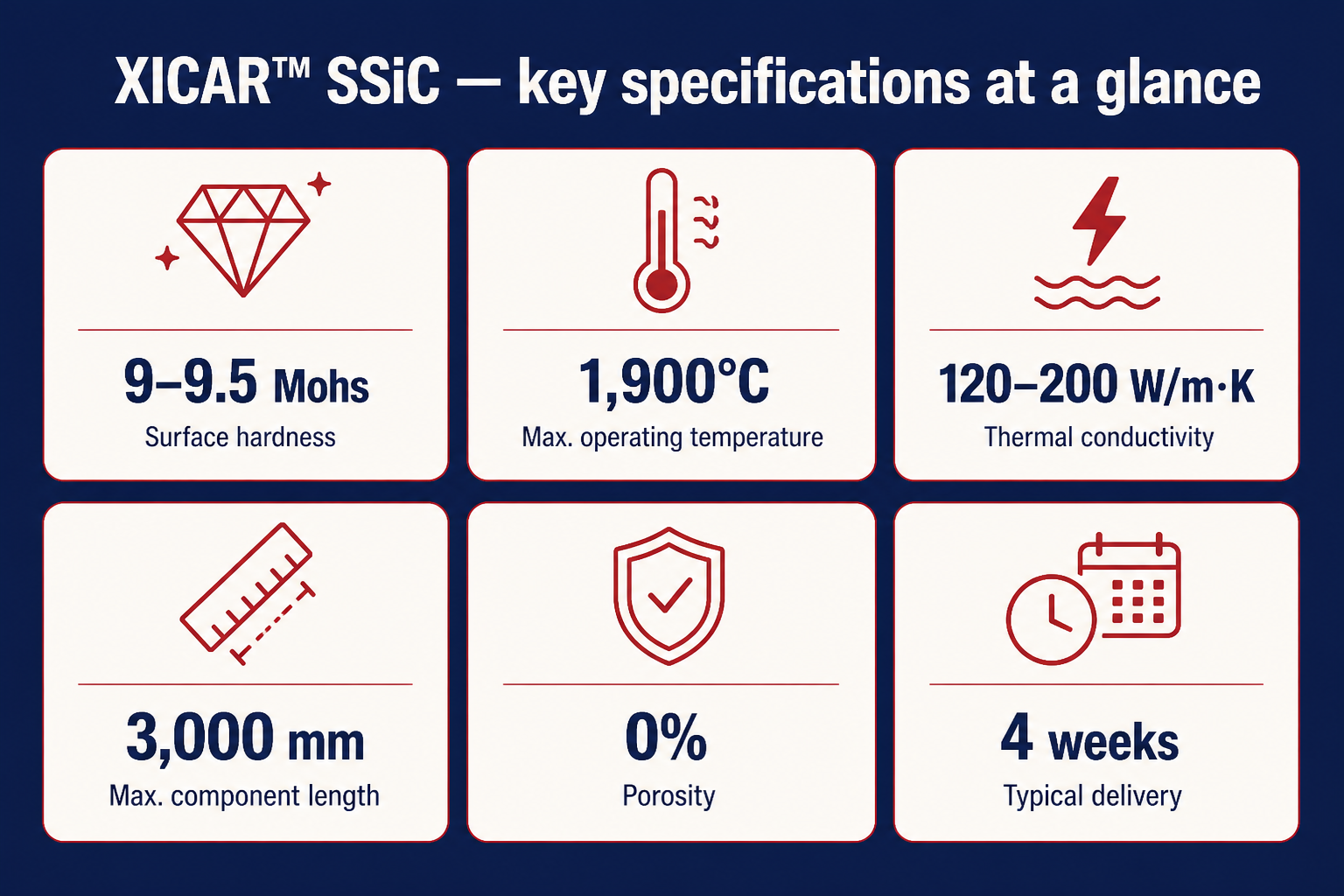
Dimensional range. Components up to 3,000 mm in length and 300 mm in outer diameter. For thermocouple protection tubes, this means full-length installations in tall furnaces or launders without joints.
Performance benchmark. XICAR™ is positioned as a direct alternative to Saint-Gobain’s HEXOLOY® SE – equivalent mechanical and thermal properties, with Sialon’s 40 years of application engineering available to support selection and installation.
Product families:
- XICRU™ crucibles – HT series (900-1,400°C, zinc oxide distillation and copper/gold/silver melting), NF series (620-920°C, aluminium and zinc alloy smelting), induction furnace and resistance furnace variants, up to Ø1525 mm
- XICAR™ thermocouple protection tubes – up to 3,000 mm, rated 1,700°C in air / 1,900°C in controlled atmosphere, for Type R or S elements, suitable for molten brass, copper, cast iron, stainless steel, silicon metal
- Custom SSiC components – burner nozzles, wear plates and liners, pump components, seals and bearings, furnace fixtures, any geometry
Lead time and support. Typical delivery 4 weeks from drawing approval. No-obligation quotation with engineering consultation included. ISO 14001 certified. A Spain office (Valencia) is opening in 2026, extending European coverage.
Warranty. 12-month warranty against chemical attack in application – a term worth comparing against competitor offerings where warranty coverage often doesn’t exist or covers only manufacturing defects.
Prøv Sialon Keramikk
Sialon Ceramics has been making sintered silicon carbide and sialon ceramic components for foundries, chemical processors, and semiconductor manufacturers since 1986. The XICAR™ SSiC line covers standard crucibles, thermocouple tubes, and fully custom components – all with a 12-month warranty and 4-week lead time. If you’re replacing a component that keeps failing in an extreme environment, it’s worth a conversation.
Ofte stilte spørsmål
What is the maximum operating temperature of sintered silicon carbide?
Sintered silicon carbide (SSiC) operates at up to 1,650°C in air and up to 1,900°C in a controlled inert atmosphere such as argon. This makes it one of the highest-temperature-rated ceramic materials available. Sialon Ceramics’ XICAR™ SSiC is rated to 1,900°C in controlled atmosphere across its full product range, including thermocouple protection tubes and crucibles.
What is the difference between sintered silicon carbide and reaction-bonded silicon carbide?
Sintered silicon carbide (SSiC) is produced by pressureless sintering of SiC powder in an inert atmosphere at 2,100–2,200°C, resulting in zero porosity and no free silicon phase. Reaction-bonded SiC (RBSC) is made by infiltrating a porous SiC preform with liquid silicon, leaving 10–12% residual free silicon in the structure. This limits RBSC’s maximum use temperature to around 1,350°C (close to silicon’s 1,410°C melting point) and its chemical resistance in strongly alkaline environments and hydrofluoric acid. SSiC has superior hardness, temperature capability, and chemical resistance; RBSC is cheaper and can form more complex geometries.
How hard is sintered silicon carbide?
SSiC has a Mohs hardness of 9–9.5 and a Vickers hardness of ≥22,000 MPa (≥22 GPa), making it the second hardest ceramic material after diamond and cubic boron nitride. In practical terms, this means standard abrasive media – silica sand, alumina grit, process slurries – cannot scratch SSiC surfaces, giving it excellent wear resistance in pump seals, nozzles, and liners exposed to abrasive flow.
Can sintered silicon carbide be machined after sintering?
SSiC can only be machined using diamond grinding or lapping tools – no conventional cutting tools work on it. Post-sintering machining is possible but expensive due to the tooling cost and slow material removal rates. The standard approach is to design components to near-net-shape before sintering so that only finish grinding is required after firing. Sialon Ceramics accepts customer drawings and manufactures to near-net-shape as standard practice.
What industries use sintered silicon carbide components?
The primary industries are chemical processing (pump seals, valve components, heat exchanger tubes), non-ferrous metallurgy (thermocouple protection tubes for molten copper, brass, and cast iron; crucibles for gold, silver, and aluminium melting), semiconductor manufacturing (wafer processing equipment, diffusion furnace components), and mining/pulp-and-paper (wear-resistant pump and slurry handling components). Emerging applications include SSiC kilns for CO2 capture from seawater.


 ZDialer-anrop