
Nitreto de silício vs Sialon vs Carboneto de silício
Silicon nitride vs sialon vs silicon carbide: which advanced ceramic should you choose?
Silicon nitride vs sialon, and sintered silicon carbide all handle extreme heat and outlast metals – but they win in very different applications. This guide covers the properties, history, and selection logic engineers actually use.
28 de julho de 2026 · leitura de 10 min
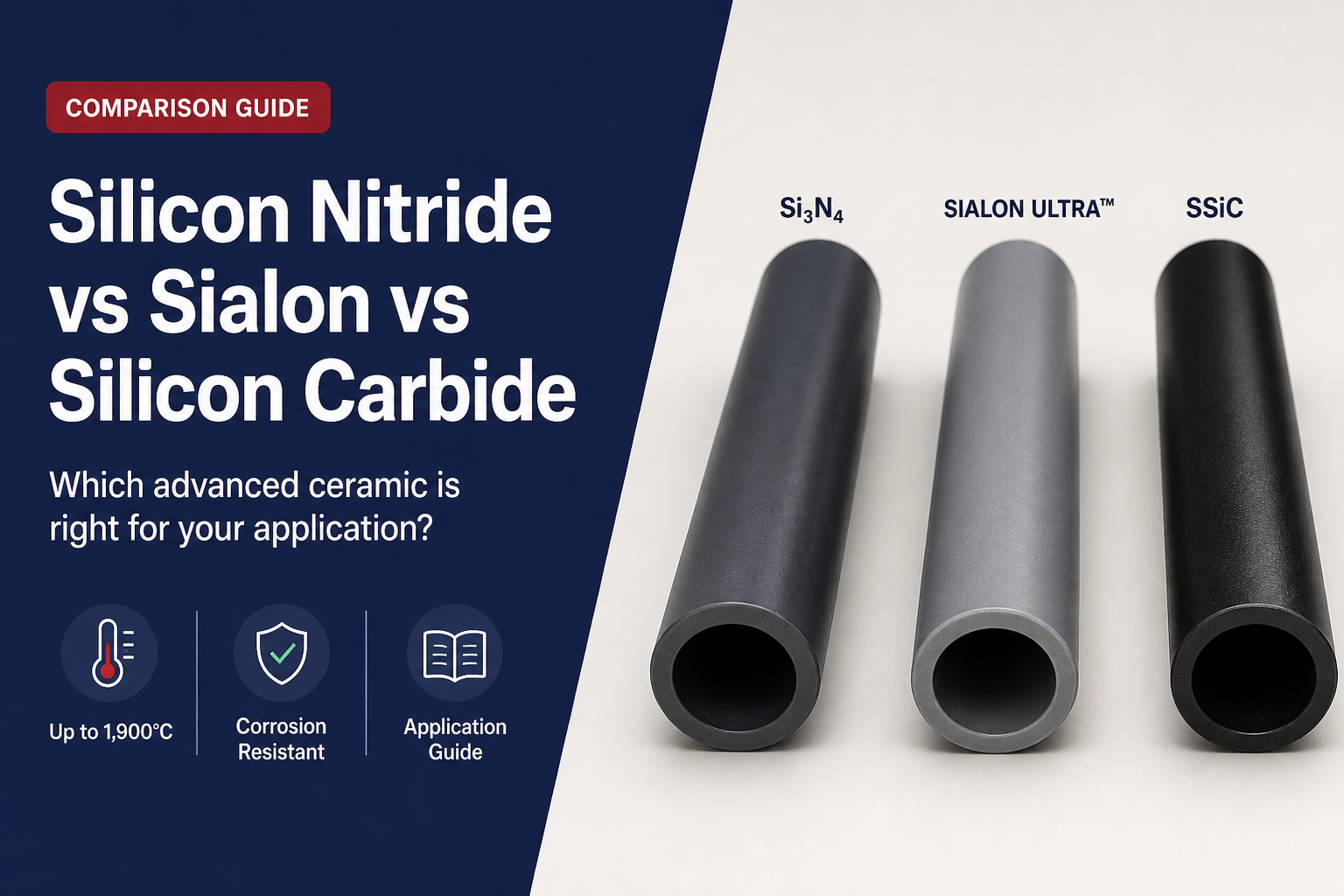
Walk into any serious foundry, chemical plant, or high-temperature furnace installation and you’ll find advanced ceramics doing the hard work that metals cannot. But which one? Silicon nitride vs sialon, and sintered silicon carbide are frequently named in the same breath – all three handle extreme heat, all three resist corrosion, and all three outlast metals in demanding applications. The differences between them, though, are sharp enough to make the wrong choice expensive.
Este guia elimina a sobreposição. Ele aborda a origem de cada material, o que ele realmente pode fazer e – mais importante – em quais aplicações ele vence e em quais não.
Em Resumo: Os Três Materiais
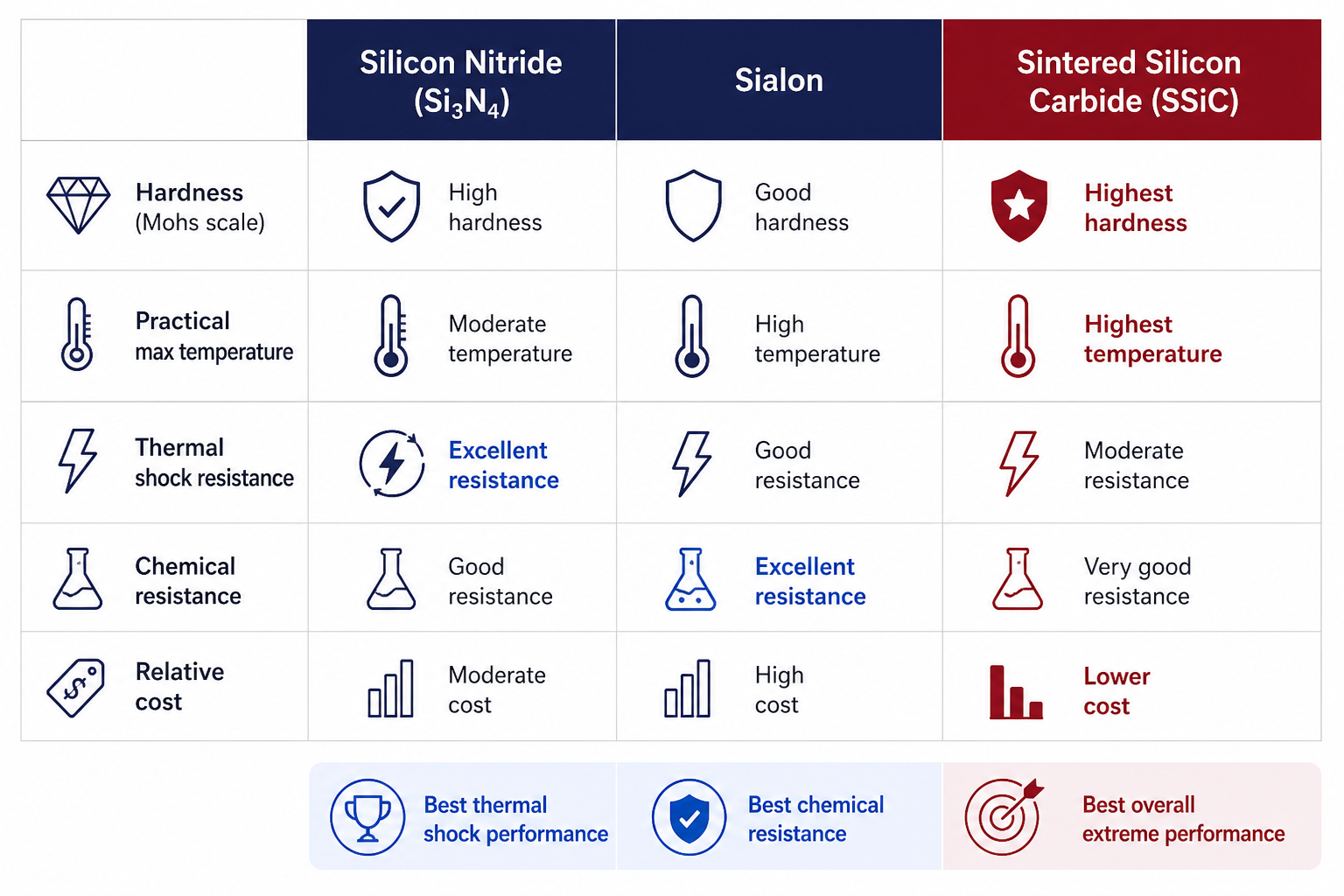 | Propriedade | Nitreto de Silício (Si₃N₄) | Sialon (SiAlON) | SiC Sinterizado (SSiC) | | — | — | — | — | | Dureza (Mohs) | ~9 | ~9 | 9–9,5 | | Temperatura máxima prática (ar) | ~1.200–1.400°C | Até ~1.400°C | 1.600–1.700°C | | Resistência ao choque térmico | Excelente | Excelente | Boa | | Resistência a metais fundidos | Boa | Excecional | Boa | | Resistência à corrosão química | Boa | Boa | Excelente | | Densidade (g/cm³) | ~3,2 | ~3,2–3,4 | ~3,1–3,2 | | Custo relativo | Médio | Médio–Alto | Médio–Alto |
Nenhum material único vence em todas as linhas. Esse é exatamente o ponto – e a razão pela qual esta comparação existe.
Nitreto de Silício: A Cerâmica de Precisão
Uma Jornada de 170 Anos até a Indústria
O nitreto de silício tem a história mais longa dos três, embora a maior parte dele não fosse particularmente útil. Foi sintetizado pela primeira vez em 1857 pelos químicos franceses Sainte-Claire Deville e Wöhler – uma curiosidade de laboratório que ficou amplamente ignorada por um século. Não foi até as décadas de 1960 e 1970, quando os engenheiros começaram a procurar seriamente por materiais que pudessem sobreviver dentro dos motores de turbina de aeronaves, que o Si₃N₄ recebeu a atenção industrial que merecia.
The ceramic engine dream – replacing metal with silicon nitride for turbocharger rotors, glow plugs, and combustion chambers – only partially succeeded. But the research it generated did not go to waste. By the 1980s and 1990s, silicon nitride had found its real calling in bearings, cutting tools, and molten metal handling, where its unique combination of properties proved genuinely hard to match.
O Que o Nitreto de Silício Faz Bem
Silicon nitride’s defining characteristic is its combination of high strength and excellent thermal shock resistance.
Engineers can rapidly heat and cool it without cracking – a property that comes from its low thermal expansion coefficient and the covalent bonding structure of its Si–N framework.
A sua outra característica distintiva é a resistência ao desgaste em alta velocidade. Os ~300.000 rotores de turbocompressor de nitreto de silício fabricados anualmente existem porque o material permanece duro e dimensionalmente estável a temperaturas e velocidades de rotação que destruiriam rolamentos convencionais. O mercado anual de ferramentas de corte de 50 milhões de dólares para Si₃N₄ existe pela mesma razão: ele usina ferro fundido e superligas à base de níquel a velocidades de superfície até 25 vezes mais rápidas que o carboneto de tungsténio.
O nitreto de silício também lida com metais não ferrosos fundidos – alumínio, zinco, estanho, chumbo – sem contaminar o fundido. Isso o torna viável para bainhas de termopares, bicos e cadinhos no processamento de metais.
Onde o Nitreto de Silício Fica Aquém
Silicon nitride decomposes above about 1,850°C, but that’s a theoretical ceiling, not a working temperature. In practice, practical operating temperatures top out at approximately 1,200–1,400°C depending on the grade and atmosphere. Engineers cannot use it above this range without risking material degradation.
It also loses ground to sialon specifically when molten aluminium contact is involved. Molten aluminium attacks silicon nitride more readily than sialon – a narrow but commercially significant difference in the foundry world.
Sialon: A Cerâmica de Fundição
Nascido do Nitreto de Silício
Sialon – pronounced “sigh-alon” – is not a compound but a family of ceramic alloys derived from silicon nitride. The name is an acronym: Silicon Aluminium Oxynitride. When aluminium and oxygen atoms are substituted into the silicon nitride crystal lattice, they stabilize what would otherwise be a less workable phase of the material and add an entirely new set of thermal and chemical properties.
O material foi relatado pela primeira vez em 1971, desenvolvido através de pesquisas paralelas na Universidade de Newcastle e no Laboratório Nacional de Física do Reino Unido. O artigo de K.H. Jack de 1976 no Journal of Materials Science, “Sialons and related nitrogen ceramics,” forneceu a estrutura teórica que acelerou a comercialização na década seguinte.
Founders launched Sialon Ceramics ApS in 1986 – the same decade that sialon transitioned from laboratory material to commercial product – and the company has manufactured sialon and silicon carbide components for extreme-temperature foundry and industrial applications ever since.
O que o Sialon Faz Bem
A propriedade principal do Sialon é sua resistência excepcional à molhabilidade e corrosão por metais não ferrosos fundidos, particularmente alumínio. Enquanto o nitreto de silício é apenas resistente, o sialon é genuinamente imune na maioria das condições de processamento de alumínio. Tubos de proteção para termopares, tubos de aquecedor de imersão, tubos de ascensão para fundição sob baixa pressão e rotores de desgaseificação para alumínio se beneficiam dessa propriedade de maneiras que outras cerâmicas têm dificuldade em igualar.
The second headline is thermal shock resistance. Sialon’s low thermal expansion and high-temperature strength retention mean it can be plunged into molten metal, rapidly cycled, and withdrawn without cracking – cycle after cycle. Sialon ULTRA™ thermocouple protection tubes from Sialon Ceramics operate at up to 1,400°C, and manufacturers build them to ±0.02 mm tolerances; heater tubes handle direct contact with molten metal at up to 1,100°C.
Beyond foundry use, engineers use sialon in cutting tools for machining chill cast iron, welding fixtures, chemical processing equipment, and oil and gas applications where chemical stability at elevated temperature is the defining requirement.
Onde o Sialon Fica Aquém
O Sialon não é o mais duro dos três – o carboneto de silício o supera na escala de Mohs. Em aplicações onde a resistência à abrasão pura contra partículas duras é a carga principal (bicos de jateamento, selos mecânicos em lamas abrasivas), o SSiC é tipicamente a escolha mais forte.
O Sialon também não consegue igualar o SSiC no extremo superior de temperatura. A linha de produtos SSiC da Sialon Ceramics (XICAR™) é classificada para 1.700°C ao ar e até 1.900°C em atmosferas controladas – uma faixa que o sialon simplesmente não consegue alcançar.
Carbeto de Silício Sinterizado: A Cerâmica para Condições Extremas
130 Anos de Abrasivo a Cerâmica de Engenharia
Silicon carbide has the most dramatic origin story of the three. In 1891, Edward Goodrich Acheson was trying to make artificial diamonds. Instead, he passed current through a clay-and-coke mixture and accidentally produced something that cut glass. He named it Carborundum and founded the company that bore its name. This gave industry its first man-made abrasive harder than corundum.
For most of the 20th century, SiC remained primarily a powder: grinding wheels, sandpapers, cutting compounds. The leap to dense sintered engineering ceramics came in the 1970s and 1980s. Improved sintering techniques let engineers produce solid components with the material’s full mechanical properties intact. XICAR™ sintered silicon carbide from Sialon Ceramics represents the current state of the art in this lineage. Its components are rated to 1,900°C and manufactured up to 3,000 mm in length.
O Que o SiC Sinterizado Faz Bem
SSiC’s competitive advantages cluster around two properties that no other advanced ceramic matches at once: hardness and thermal conductivity.
At 9–9.5 on the Mohs scale and approximately 2,500 HV Vickers hardness, sintered silicon carbide is the hardest of the three materials. Indeed, it ranks among the hardest substances known outside diamond and cubic boron nitride. As a result, this translates directly into superior wear life in abrasive applications: blast nozzles, pump impellers handling abrasive slurries, mechanical seals in harsh chemical settings, and kiln furniture subject to constant thermal and mechanical wear.
In addition, its thermal conductivity of 120–200 W/m·K is exceptional for a ceramic – far above silicon nitride (~20–30 W/m·K) and sialon (~10–20 W/m·K). Consequently, this makes SSiC the natural choice for heat exchangers, furnace components, and any application where heat must move through the component efficiently.
Furthermore, continuous service temperature in oxidizing atmospheres exceeds 1,600°C. Specifically, XICAR™ components are rated to 1,700°C in air and 1,900°C in controlled or reducing atmospheres. Notably, no silicon nitride or sialon product reaches these temperatures.
Finally, chemical resistance is comprehensive: SSiC withstands most acids, bases, and molten salts without meaningful attack. As a result, this makes it the preferred material for pump impellers, valve seats, and process equipment in chemical plants where the fluid is harsh and contamination from the vessel material is not acceptable.
Onde o SiC Sinterizado Fica Aquém
SSiC’s thermal shock resistance is good but not exceptional – it falls short of both silicon nitride and sialon. Its higher thermal conductivity than the nitride-based ceramics helps somewhat. But its lower fracture toughness means rapid, uncontrolled thermal cycling carries more risk than with sialon. Applications that involve repeated plunging into molten metal – heater tubes, thermocouple protection tubes in aluminium furnaces – typically favour sialon or silicon nitride for exactly this reason.
O SSiC também é o mais frágil dos três em termos de impacto. Em aplicações com carregamento de choque mecânico, a tenacidade à fratura ligeiramente melhor do sialon torna-se relevante.
Qual Material Vence Onde
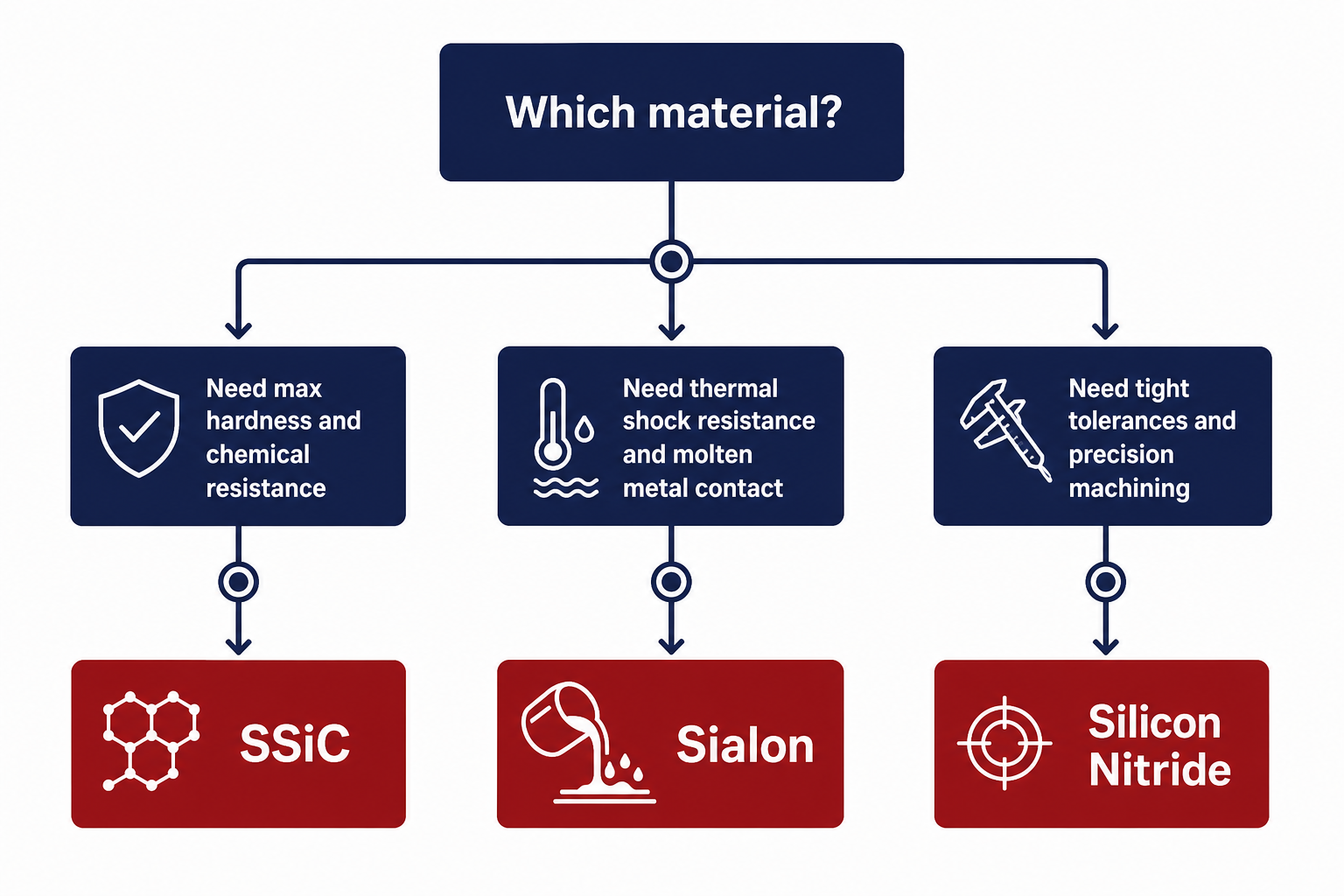 Escolha nitreto de silício quando:
- Rolamentos de precisão, ferramentas de corte ou componentes de motor são as aplicações
- São necessárias tolerâncias dimensionais apertadas sob ciclos térmicos
- Usinagem em alta velocidade de ferro fundido ou superligas de níquel é o caso de uso
- O custo é uma restrição significativa em relação às opções de nível superior
Pick sialon when:
- Envolvem alumínio fundido, zinco, latão ou outros metais não ferrosos
- Choque térmico é frequente e severo (ciclagem rápida para dentro e para fora de metal fundido)
- Proteção de termopares, aquecimento por imersão ou aplicações em tubos de ascensão
- Ambientes de processamento químico onde a resistência à corrosão e a temperatura moderada são as principais cargas
Escolha carboneto de silício sinterizado quando:
- Dureza máxima e resistência ao desgaste contra meios abrasivos é o requisito principal
- Temperaturas de operação excedem 1.400°C no ar
- A transferência de calor através do componente é importante (trocadores de calor, componentes de forno)
- Chemical resistance to acids, bases, or molten salts at high temperature is needed
- Large-format components (mechanical seals, blast nozzles, kiln shelves) are required
Domínios de Aplicação por Material
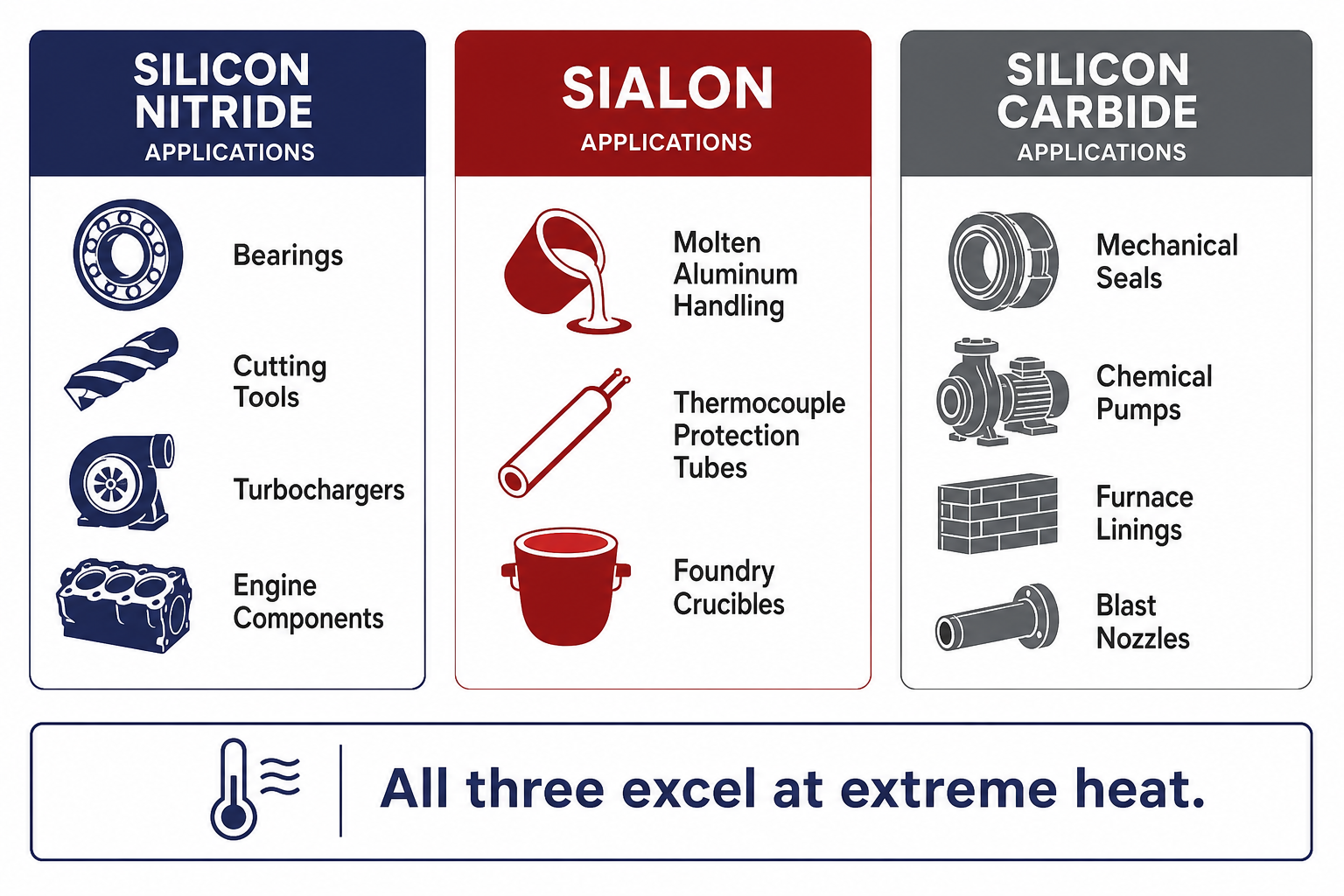 Os três materiais raramente competem diretamente na mesma aplicação. Na prática:
- Silicon nitride dominates automotive powertrain (turbocharger rotors, glow plugs), machine tool bearings, and cutting tools for hard metals.
- Sialon dominates non-ferrous foundry equipment: thermocouple protection tubes, immersion heater tubes, degassing rotors, riser tubes for aluminium diecasting, and ladles and crucibles where molten metal resistance is critical.
- Sintered silicon carbide dominates mechanical seals, pump impellers, blast nozzles, kiln furniture, furnace linings, heat exchangers, semiconductor processing fixtures, and ballistic protection panels.
The overlap zone – extreme heat with no other dominant constraint – is where material selection becomes a genuine engineering decision rather than an obvious one.
Experimente Cerâmicas Sialon
Sialon Ceramics has manufactured sialon and sintered silicon carbide components since 1986. Whether the application calls for a Sialon ULTRA™ thermocouple protection tube rated to 1,400°C, an immersion heater tube guaranteed for 12 months in molten aluminium, or a XICAR™ sintered silicon carbide component rated to 1,900°C in controlled atmosphere – the company produces custom geometries to ±0.02 mm tolerances, in lengths up to 3,000 mm.
Explore toda a gama de produtos em sialon.com, ou contacte a equipa diretamente para discutir a sua aplicação específica.
Fontes
- Wikipédia: Sialon
- Wikipédia: Nitreto de silício
- AZoM: Propriedades e Aplicações do Nitreto de Silício (Si₃N₄)
- AZoM: Propriedades e Aplicações do Carboneto de Silício (SiC)
- Jack, K.H. (1976). “Sialons and related nitrogen ceramics.” Journal of Materials Science, 11(6): 1135–1158
- Cao, G.Z.; Metselaar, R. (1991). “α’-Sialon ceramics: A review.” Chemistry of Materials, 3(2): 242
- Wikipédia: Edward Goodrich Acheson
- Cerâmicas Sialon: Tubos de aquecimento Sialon ULTRA™


 Chamada ZDialer