
Silisyum Nitrür vs Sialon vs Silisyum Karbür
Silicon Nitride vs Sialon vs Silicon Carbide: which advanced ceramic should you choose?
Silicon nitride vs sialon and silicon carbide all handle extreme heat and outlast metals – but they win in very different applications. This guide covers the properties, history, and selection logic engineers actually use.
28 Temmuz 2026 · 10 dakikalık okuma
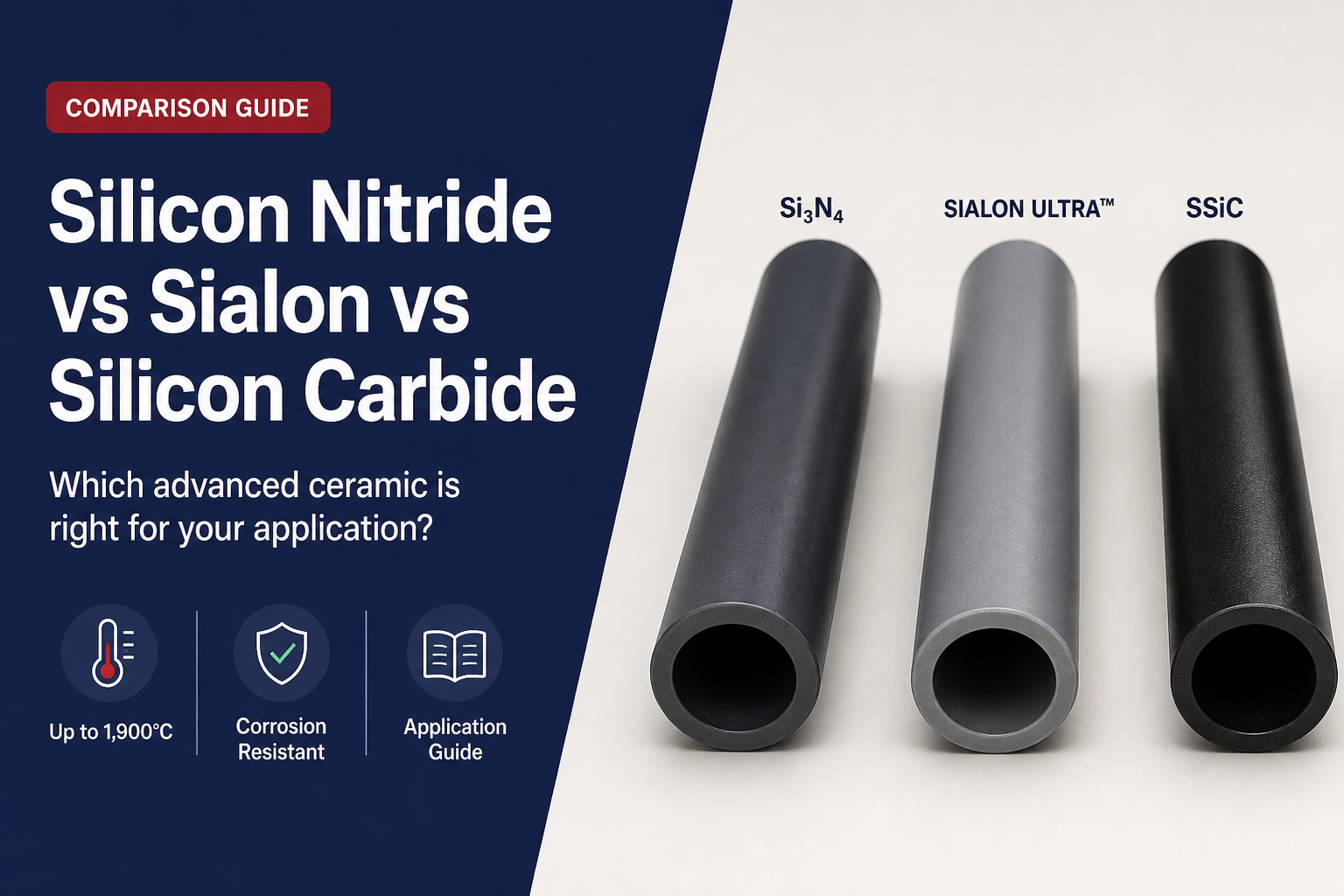
Walk into any serious foundry, chemical plant, or high-temperature furnace installation and you’ll find advanced ceramics doing the hard work that metals cannot. But which one? Silicon nitride, sialon, and sintered silicon carbide are frequently named in the same breath – all three handle extreme heat, all three resist corrosion, and all three outlast metals in demanding applications. The differences between them, though, are sharp enough to make the wrong choice expensive.
Bu rehber, örtüşmeyi ortadan kaldırır. Her malzemenin nereden geldiğini, gerçekte neler yapabileceğini ve – en önemlisi – hangi uygulamalarda kazandığını ve hangilerinde kazanamadığını kapsar.
Bir Bakışta: Üç Malzeme
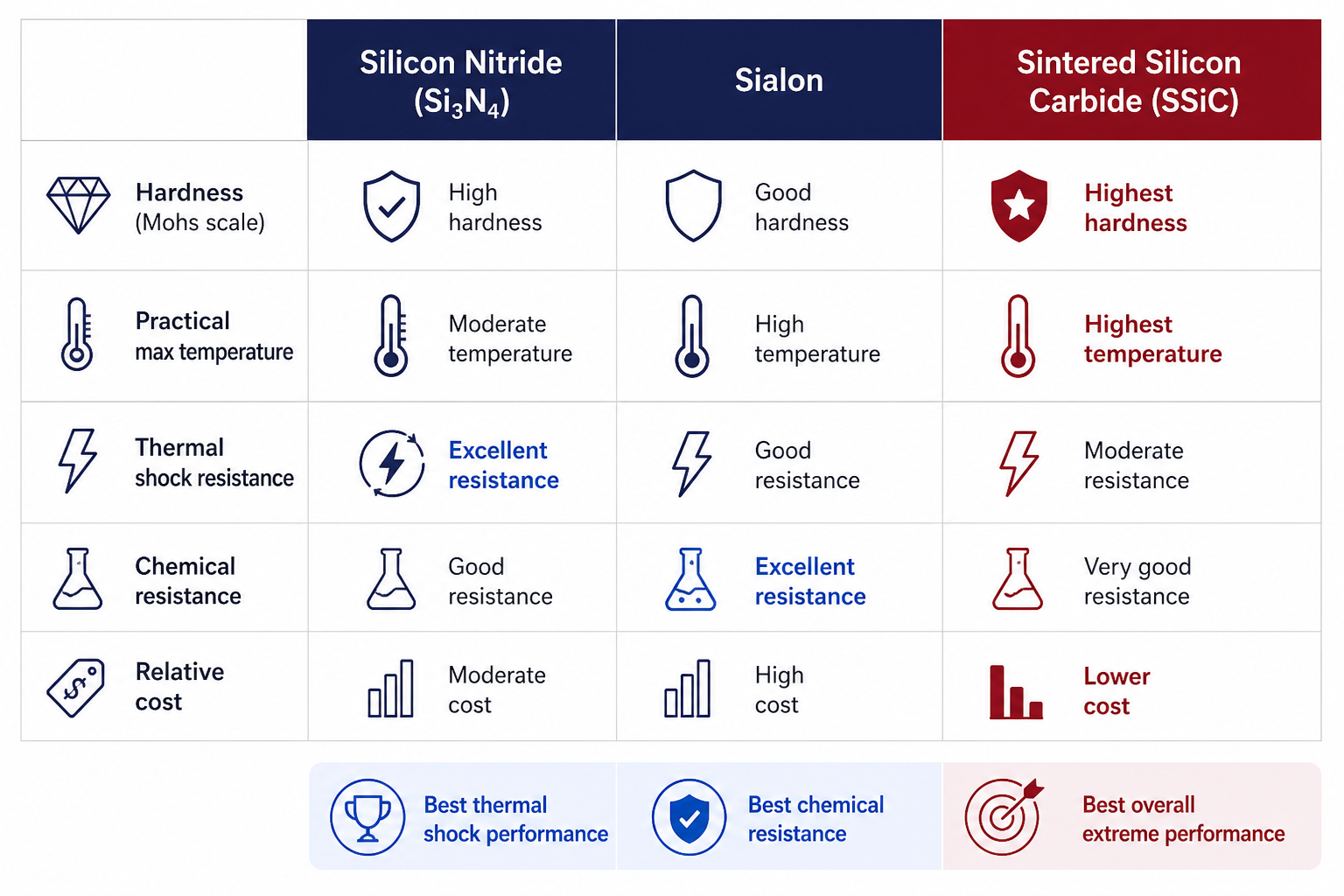 | Özellik | Silisyum Nitrür (Si₃N₄) | Sialon (SiAlON) | Sinterlenmiş SiC (SSiC) | | — | — | — | — | | Sertlik (Mohs) | ~9 | ~9 | 9–9.5 | | Pratik maksimum sıcaklık (hava) | ~1.200–1.400°C | ~1.400°C'ye kadar | 1.600–1.700°C | | Termal şok direnci | Mükemmel | Mükemmel | İyi | | Erimiş metallere direnç | İyi | Olağanüstü | İyi | | Kimyasal korozyon direnci | İyi | İyi | Mükemmel | | Yoğunluk (g/cm³) | ~3.2 | ~3.2–3.4 | ~3.1–3.2 | | Göreceli maliyet | Orta | Orta–Yüksek | Orta–Yüksek |
Hiçbir tek malzeme her satırı kazanmaz. Bütün mesele bu – ve bu karşılaştırmanın var olma nedeni de bu.
Silisyum Nitrür: Hassas Seramik
Sektöre 170 Yıllık Bir Yolculuk
Silisyum nitrür, üçü arasında en uzun geçmişe sahiptir, ancak çoğu pek kullanışlı değildi. İlk olarak 1857’de Fransız kimyagerler Sainte-Claire Deville ve Wöhler tarafından sentezlendi – bir yüzyıl boyunca büyük ölçüde göz ardı edilen bir laboratuvar merakı. Mühendislerin uçak türbin motorlarının içinde hayatta kalabilecek malzemeleri ciddi şekilde aramaya başladıkları 1960’lar ve 1970’lere kadar Si₃N₄ hak ettiği endüstriyel ilgiyi görmedi.
The ceramic engine dream – replacing metal with silicon nitride for turbocharger rotors, glow plugs, and combustion chambers – was only partially realized. But the research it generated was not wasted. By the 1980s and 1990s, silicon nitride had found its real calling in bearings, cutting tools, and molten metal handling, where its unique combination of properties proved genuinely hard to match.
Silisyum Nitrür Nelerde İyidir
Silicon nitride’s defining characteristic is its combination of high strength and excellent thermal shock resistance. It can be rapidly heated and cooled without cracking – a property that comes from its low thermal expansion coefficient and the covalent bonding structure of its Si–N framework.
Diğer öne çıkan özelliği yüksek hızda aşınma direncidir. Yılda üretilen yaklaşık 300.000 silisyum nitrür turboşarj rotoru , malzemenin geleneksel rulmanları tahrip edecek sıcaklık ve dönüş hızlarında sert ve boyutsal olarak kararlı kalması nedeniyle vardır. Yıllık 50 milyon dolarlık kesici takım pazarı Si₃N₄ için aynı nedenden dolayı mevcuttur: dökme demir ve nikel bazlı süper alaşımları, tungsten karbürden 25 kata kadar daha yüksek yüzey hızlarında işler.
Silisyum nitrür ayrıca erimiş demir dışı metalleri – alüminyum, çinko, kalay, kurşun – eriyiği kirletmeden işler. Bu, onu metal işlemede termokupl kılıfları, nozullar ve potalar için uygun hale getirir.
Where Silicon Nitride Falls Short
Silicon nitride decomposes above about 1,850°C, but that’s a theoretical ceiling, not a working temperature. In practice, practical operating temperatures top out at approximately 1,200–1,400°C depending on the grade and atmosphere. It cannot be used above this range without material degradation.
It also loses ground to sialon specifically when molten aluminium contact is involved. Silicon nitride is attacked by molten aluminium more readily than sialon – a narrow but commercially significant difference in the foundry world.
Sialon: Dökümhane Seramiği
Silisyum Nitrürden Doğan
Sialon – pronounced “sigh-alon” – is not a compound but a family of ceramic alloys derived from silicon nitride. The name is an acronym: Silicon Aluminium Oxynitride. Replacing some silicon and nitrogen atoms with aluminium and oxygen stabilizes the silicon nitride crystal lattice. This modification also gives sialon enhanced thermal and chemical properties.
Malzeme ilk kez 1971'de rapor edildi, Newcastle Üniversitesi ve İngiltere’nin Ulusal Fizik Laboratuvarı'ndaki paralel araştırmalarla geliştirildi. K.H. Jack’in 1976 tarihli Journal of Materials Science dergisindeki “Sialons and related nitrogen ceramics,” adlı makalesi, sonraki on yıl boyunca ticarileşmeyi hızlandıran teorik çerçeveyi sağladı.
Sialon transitioned from a laboratory material to a commercial product during the 1980s. Sialon Ceramics ApS launched in 1986 and has manufactured sialon and silicon carbide components for extreme-temperature foundry and industrial applications ever since.
Sialon'un İyi Yaptığı Şeyler
The second headline is thermal shock resistance. Sialon’s low thermal expansion and high-temperature strength allow it to withstand repeated immersion in molten metal without cracking. It can be plunged into the melt, rapidly cycled, and withdrawn time after time. As a result, Sialon Ceramics rates its Sialon ULTRA™ thermocouple protection tubes for operation at temperatures up to 1,400°C and manufactures them to tolerances of ±0.02 mm. The company also rates its heater tubes for direct contact with molten metal at temperatures up to 1,100°C.
Beyond foundry applications, manufacturers use sialon in cutting tools for machining chill cast iron, welding fixtures, chemical processing equipment, and oil and gas components. Engineers choose the material because it maintains excellent chemical stability at elevated temperatures.
Sialon'un Yetersiz Kaldığı Yerler
Sialon, üçü arasında en sert olanı değildir – silisyum karbür, Mohs ölçeğinde onu geride bırakır. Sert parçacıklara karşı saf aşınma direncinin birincil yük olduğu uygulamalarda (kumlama nozulları, aşındırıcı bulamaçlardaki mekanik salmastralar), SSiC tipik olarak daha güçlü seçimdir.
Sialon ayrıca üst sıcaklık sınırında SSiC ile rekabet edemez. Sialon Ceramics’in SSiC ürün hattı (XICAR™) havada 1.700°C’ye ve kontrollü atmosferlerde 1.900°C’ye kadar derecelendirilmiştir – sialonun ulaşamayacağı bir aralık.
Sinterlenmiş Silisyum Karbür: Aşırı Koşulların Seramiği
Aşındırıcıdan Mühendislik Seramiğine 130 Yıl
Silicon carbide has the most dramatic origin story of the three. In 1891, Edward Goodrich Acheson was trying to make artificial diamonds when he accidentally passed current through a clay-and-coke mixture and produced something that cut glass. He named it Carborundum and founded the company that bore its name – giving industry its first man-made abrasive harder than corundum.
For most of the 20th century, SiC remained primarily a powder: grinding wheels, sandpapers, cutting compounds. The leap to dense sintered engineering ceramics came in the 1970s and 1980s, when improved sintering techniques allowed engineers to produce solid components with the material’s full mechanical properties intact. XICAR™ sintered silicon carbide from Sialon Ceramics represents the current state of the art in this lineage – components rated to 1,900°C and manufactured up to 3,000 mm in length.
Sinterlenmiş SiC Nelerde İyidir
SSiC’s competitive advantages cluster around two properties that no other advanced ceramic matches simultaneously: hardness and thermal conductivity.
Sintered silicon carbide sits at 9–9.5 on the Mohs scale, with a Vickers hardness of approximately 2,500 HV. This makes it the hardest of the three materials, and among the hardest substances known outside diamond and cubic boron nitride. This translates directly into superior wear life in abrasive applications. Think blast nozzles, pump impellers handling abrasive slurries, mechanical seals in chemically aggressive environments, and kiln furniture subject to constant thermal and mechanical wear.
Its thermal conductivity of 120–200 W/m·K is exceptional for a ceramic. This is far above silicon nitride (~20–30 W/m·K) and sialon (~10–20 W/m·K). That property makes SSiC the natural choice for heat exchangers and furnace components. It’s also the right pick for any application where heat must move through the component efficiently rather than be resisted by it.
Continuous service temperature in oxidizing atmospheres exceeds 1,600°C. XICAR™ components are rated to 1,700°C in air and 1,900°C in controlled or reducing atmospheres. No silicon nitride or sialon product reaches these temperatures.
Chemical resistance is comprehensive: SSiC withstands most acids, bases, and molten salts without meaningful attack. This makes it the preferred material for pump impellers and valve seats. It’s also the go-to for process equipment in chemical plants where the fluid is aggressive and contamination from the vessel material isn’t acceptable.
Sinterlenmiş SiC'nin Yetersiz Kaldığı Yerler
SSiC’s thermal shock resistance is good but not exceptional – inferior to both silicon nitride and sialon.
SSiC ayrıca darbe açısından üçünün en kırılganıdır. Mekanik şok yüklemesi olan uygulamalarda, sialon’un biraz daha iyi kırılma tokluğu önem kazanır.
Hangi Malzeme Nerede Kazanır
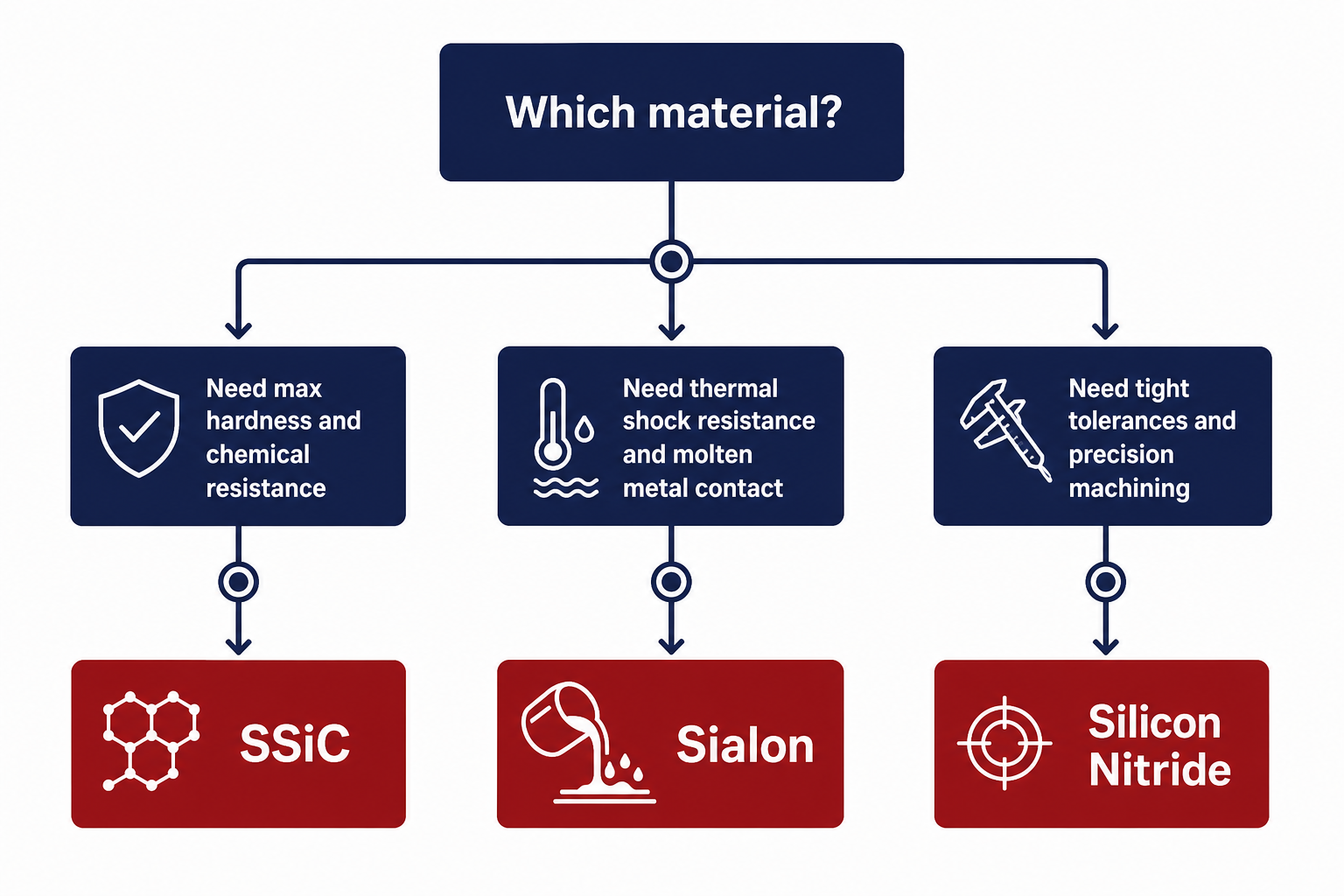 Adopt silicon nitride when:
- Hassas rulmanlar, kesici takımlar veya motor bileşenleri uygulama alanlarıdır
- Termal çevrim altında sıkı boyutsal toleranslar gereklidir
- Dökme demir veya nikel süper alaşımlarının yüksek hızlı işlenmesi kullanım durumudur
- Üst kademe seçeneklere kıyasla maliyet önemli bir kısıttır
Deploy sialon when:
- Erimiş alüminyum, çinko, pirinç veya diğer demir dışı metaller söz konusudur
- Termal şok sık ve şiddetlidir (erimiş metale hızlı girip çıkma)
- Termokupl koruması, daldırma ısıtması veya yükseltici boru uygulamaları
- Korozyon direnci ve orta sıcaklığın birincil yükler olduğu kimyasal işleme ortamları
Sinterlenmiş silisyum karbürü şu durumlarda seçin:
- Aşındırıcı ortamlara karşı maksimum sertlik ve aşınma direnci birincil gereksinimdir
- Havada çalışma sıcaklıkları 1.400°C'yi aşıyor
- Heat transfer through the component is important (heat exchangers, furnace components)
- Chemical processing requires resistance to acids, bases, or molten salts at high temperatures.
- Your application requires large-format components such as mechanical seals, blast nozzles, or kiln shelves.
Malzemeye Göre Uygulama Alanları
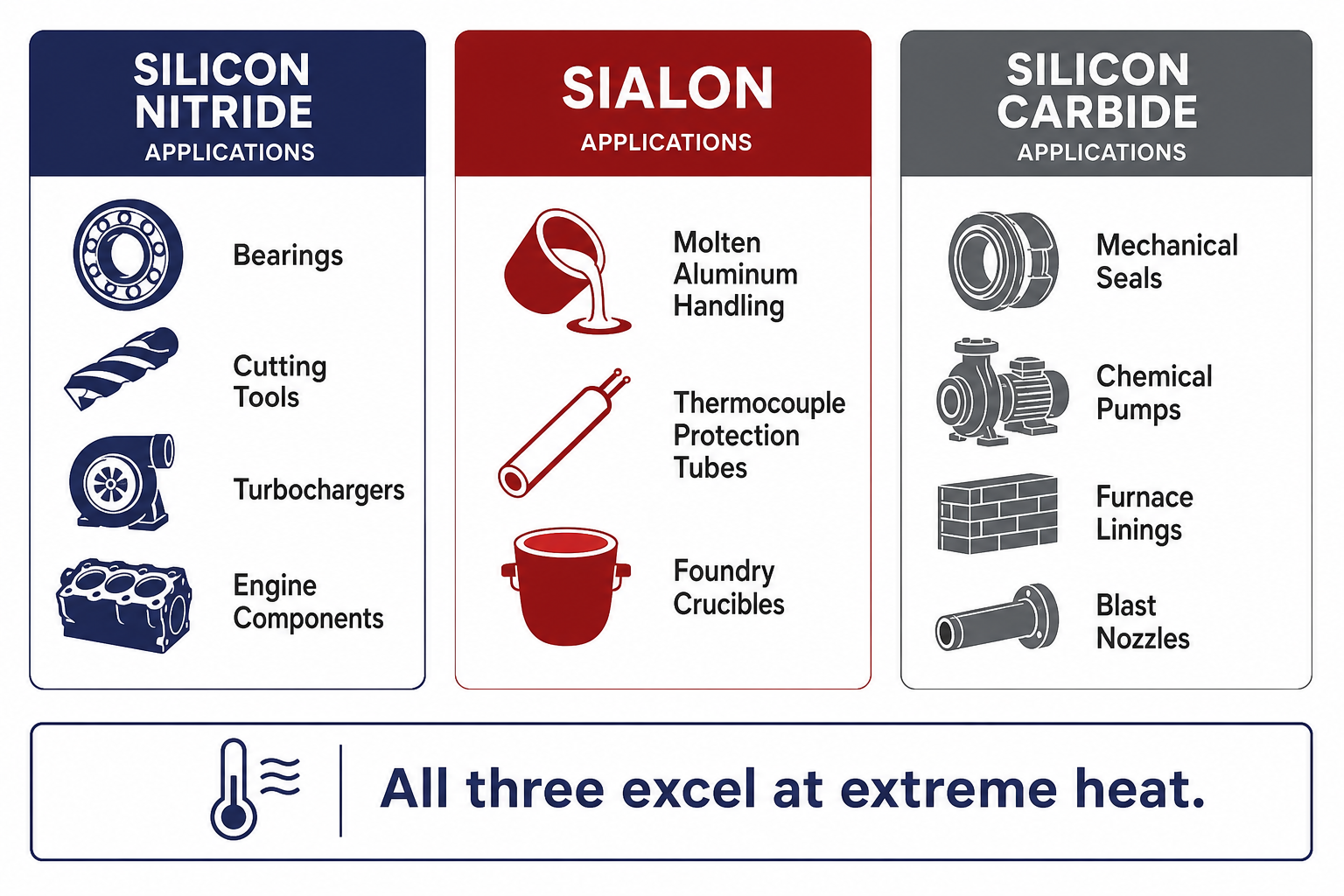 Üç malzeme nadiren aynı uygulamada doğrudan rekabet eder. Pratikte:
-
Silicon nitride primarily dominates automotive powertrain applications, including turbocharger rotors and glow plugs. Engineers also choose silicon nitride for machine tool bearings and cutting tools because of its excellent strength and thermal shock resistance.
-
Similarly, sialon is the preferred material for non-ferrous foundry equipment. For example, foundries use sialon for thermocouple protection tubes, immersion heater tubes, degassing rotors, riser tubes for aluminium diecasting, and ladles and crucibles. This is because it offers outstanding resistance to molten metals.
- Meanwhile, sintered silicon carbide excels in applications that demand maximum hardness, wear resistance, and chemical stability. Therefore, manufacturers rely on sintered silicon carbide for mechanical seals, pump impellers, blast nozzles, kiln furniture, furnace linings, heat exchangers, semiconductor processing fixtures, and ballistic protection panels.
When extreme heat is the only major requirement, material selection becomes a genuine engineering decision rather than an obvious one.
Try Sialon advanced ceramics comparison
Sialon Ceramics has manufactured sialon and sintered silicon carbide components since 1986. The application might call for a Sialon ULTRA™ thermocouple protection tube rated to 1,400°C. It might call for an immersion heater tube guaranteed for 12 months in molten aluminium. Or it might call for a XICAR™ sintered silicon carbide component rated to 1,900°C in controlled atmosphere. Either way, the company produces custom geometries to ±0.02 mm tolerances, in lengths up to 3,000 mm.
sialon.com adresinde tüm ürün yelpazesini keşfedin veya ekiple doğrudan iletişime geçin ve özel uygulamanızı görüşün.
Kaynaklar
- Wikipedia: Sialon
- Wikipedia: Silisyum nitrür
- AZoM: Silisyum Nitrür (Si₃N₄) Özellikleri ve Uygulamaları
- AZoM: Silisyum Karbür (SiC) Özellikleri ve Uygulamaları
- Jack, K.H. (1976). “Sialons and related nitrogen ceramics.” Journal of Materials Science, 11(6): 1135–1158
- Cao, G.Z.; Metselaar, R. (1991). “α’-Sialon seramikleri: Bir inceleme.” Kimya Malzemeleri, 3(2): 242
- Wikipedia: Edward Goodrich Acheson
- Sialon Seramikleri: Sialon ULTRA™ Isıtıcı Tüpleri


 ZDialer Arama