
Ultraschall-Entgasung – Sialon-Sonotroden – Aluminiummd
Why Ultrasonic Degassing with Sialon Sonotrodes Outperforms Graphite Rotors in Molten Aluminum
Acoustic cavitation removes dissolved hydrogen and refines grain structure simultaneously – with no argon, no graphite contamination, and Sialon ceramic sonotrodes that survive where titanium fails.
July 26, 2026 · 9 min read
TL;DR
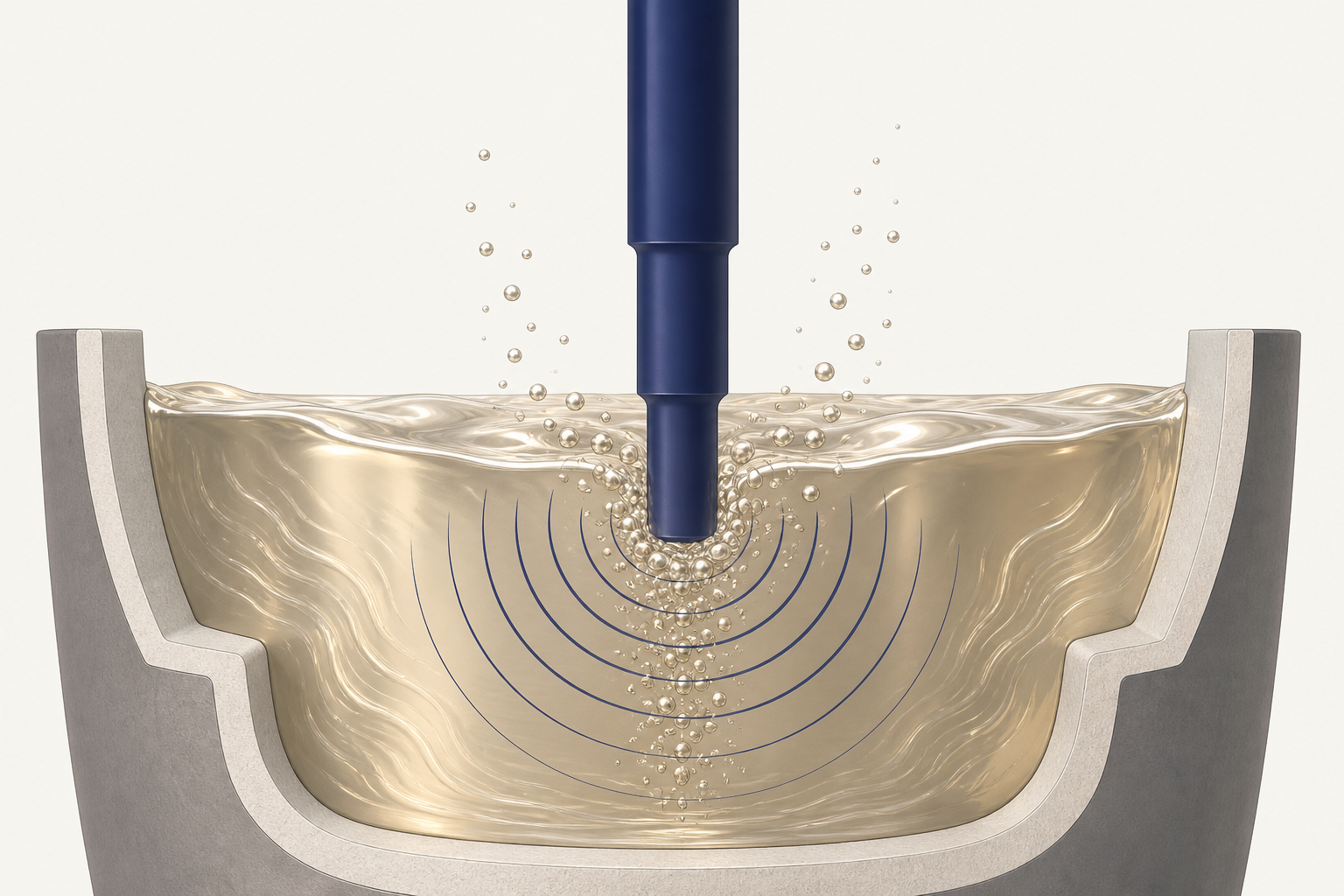
Dissolved hydrogen is the primary cause of porosity in aluminum castings; coarse grain structure compounds every downstream mechanical weakness. Rotary degassing with graphite rotors addresses hydrogen but introduces contamination, consumes argon, generates dross, and leaves grain refinement as a separate process. Ultrasonic degassing does both simultaneously – driving hydrogen out via acoustic cavitation and refining grain through the same shockwave energy – with no carrier gas, no contamination, and treatment times 3× faster than impeller-driven systems. The limiting factor has always been the sonotrode: titanium fails above 700°C, graphite contaminates the melt. Sialon ceramics solve both problems – chemically inert to aluminum, thermally stable, and engineered specifically for ultrasonic transmission into molten metal. What makes the system uniquely effective is the elimination of standing waves — a critical design achievement that enables consistent acoustic field distribution throughout the melt, as explained at ultrasonicdegassing.com.
The problem that every cast-house knows but rarely quantifies
Liquid aluminum at 750°C holds roughly 0.65 cm³ of dissolved hydrogen per 100g of metal. The moment it solidifies, equilibrium solubility collapses to 0.034 cm³/100g – a 94% drop. The hydrogen that can no longer stay in solution has to go somewhere. If the casting solidifies fast enough, it becomes porosity: the bane of structural and pressure-tight components.
One gram of dissolved hydrogen in one tonne of liquid aluminum can produce 2–3% porosity in the finished casting – a figure that comes from straightforward thermodynamics, not an industry worst-case scenario. For aerospace and automotive structural parts, that’s disqualifying on its own. For any part where fatigue life or pressure integrity matters, porosity is where failure initiates.
The hydrogen gets into the melt from water vapor in the atmosphere, from moist charge materials, from wet tooling. At 750°C and 30% relative humidity, natural degassing – just holding the melt and waiting – requires up to an hour to approach the industrial standard residual of 0.1–0.2 cm³/100g. Nobody in a production cast-house is doing that.
Grain structure is the second variable. Coarse columnar grains in a DC-cast billet mean non-uniform mechanical properties, anisotropic response to deformation, and higher susceptibility to hot-tearing during solidification. Grain refinement is conventionally handled by adding titanium-boron master alloys (TiBAl) to the melt – effective, but an additional consumable, an additional logistics chain, and an additional contamination risk if dosing goes wrong.
The question worth asking is why the industry still treats these as two separate problems requiring two separate processes.
How rotary degassing works – and where it runs out of road
The standard approach is a rotary degasser: a graphite rotor spun at high speed into the melt, injecting argon (or argon-chlorine mixtures) through the rotor shaft and dispersing it as fine bubbles throughout the furnace. Hydrogen partitions from the melt into the argon bubbles according to Sievert’s Law, and the bubbles carry it to the surface.
It works. It has worked for decades. But there are structural limitations that experience in the cast-house makes very familiar:
Graphite contamination. The rotor erodes. Graphite particles enter the melt. In aluminum alloys, this can form aluminum carbide (Al₄C₃) phases, which are brittle, moisture-sensitive, and difficult to remove by filtration. The contamination is insidious – small enough to pass upstream quality checks and only manifest as surface staining or mechanical anomalies in finished parts.
Rotor wear and failure. Graphite is brittle. Rotor failure – cracking or fracture – is not rare, particularly with thermal shock from cold charge additions or poor preheating practice. A failed rotor means unscheduled downtime and a melt that needs to be inspected before it can proceed.
Argon logistics. Every kg of argon used has to be sourced, delivered, stored, and managed. Argon-chlorine mixtures (still used in some operations for flux degassing) add regulatory complexity. Chlorine reacts with aluminum to form aluminum chloride (AlCl₃), an effective flux but a material that requires careful handling and disposal.
Dross generation. The vigorous stirring action of a rotary degasser disrupts the protective aluminum oxide skin on the melt surface. Oxide gets entrained into the melt and the dross volume at the surface increases substantially. More dross means more metal loss and more cleaning time between heats.
Limited melt access. A rotary degasser positioned in a furnace or ladle treats the volume around the rotor effectively, but large melt bodies have zones – corners, remote areas – where circulation is limited and hydrogen removal is incomplete. Multiple insertion points or elaborate lance movements are needed to compensate.
None of these are reasons to abandon rotary degassing immediately; they are the operating costs that every cast-house has learned to absorb. The question is whether those costs need to be absorbed at all.
Acoustic cavitation: the physics behind ultrasonic degassing
Introduce an ultrasonic transducer into a liquid and, above a critical power threshold, the liquid tears itself apart – briefly, repeatedly, in millions of locations simultaneously. That is acoustic cavitation, and it is what makes ultrasonic degassing fundamentally different from anything that relies on injected gas.
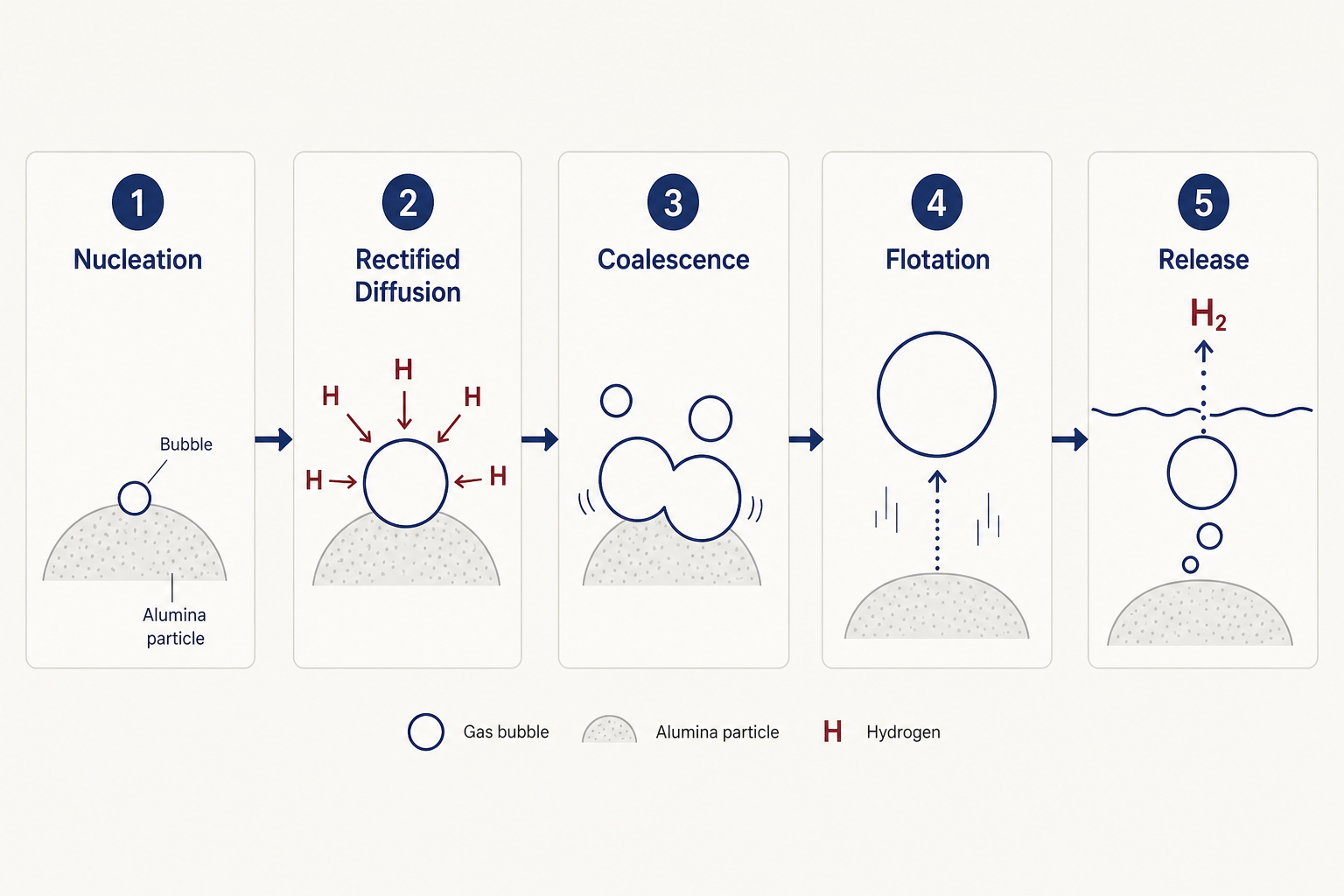 The process in molten aluminum follows five stages:
1. Nucleation. When the ultrasonic pressure drops below the saturated vapor pressure of the melt, cavitation bubbles nucleate on existing heterogeneities – alumina inclusions, microbubbles, grain boundaries. These are the cavitation nuclei.
2. Rectified diffusion. During the low-pressure phase of each acoustic cycle, the bubble expands and its internal partial pressure of hydrogen drops below the local melt concentration. Atomic hydrogen from the surrounding metal diffuses into the bubble. The asymmetry of the oscillation means more hydrogen enters during expansion than leaves during compression – net accumulation.
3. Recombination. Inside the bubble, atomic hydrogen (H) recombines into molecular hydrogen (H₂), which cannot redissolve into the aluminum matrix at the same rate. The bubble now carries a growing H₂ inventory.
4. Coalescence. Bjerknes forces (acoustic radiation pressure) and Bernoulli effects cause neighboring bubbles to attract and merge into larger, more buoyant structures.
5. Flotation and release. Acoustic streaming – the bulk flow induced by the ultrasonic field – carries the coalesced bubbles upward through the melt. At the surface, they burst and the hydrogen escapes.
The critical parameter is the cavitation threshold. In water, cavitation is easily achieved. In liquid aluminum at 700°C, the threshold is substantially higher – the melt is denser, more viscous, and has a higher surface tension than water. Generators for aluminum melt treatment need to deliver sufficient acoustic intensity to exceed this threshold throughout the treatment volume, not just at the sonotrode tip. This is a non-trivial engineering problem and the reason early ultrasonic degassing systems in the 1960s and 1970s – including the Soviet UZD-200 system (10 kW, 19.5 kHz, 250 kg capacity) – demonstrated the principle but struggled to scale it economically.
Grain refinement as a free benefit
The same cavitation field that drives out hydrogen does something else: it refines the grain structure. When a bubble collapses, it releases a shockwave exceeding 400 MPa and a localized temperature spike above 1000 K. These shockwaves fragment existing dendrites, destroy columnar grain fronts, and create thousands of new nucleation sites for equiaxed grain growth. The result is a finer, more uniform grain structure – without any TiBAl addition.
In a documented study on an Al–Mg–Sc alloy, ultrasonic treatment at a reduced casting temperature (700°C vs. 800°C) reduced average grain size from 487 ± 20 µm to 103 ± 2 µm – a 78% reduction. Even without the temperature reduction, progressive treatment showed approximately 5.5% grain size reduction per 20 seconds of treatment, with further reduction beyond 20 seconds. This is not a marginal improvement; it is the kind of microstructural change that previously required master alloy additions and careful process control to achieve.
The sonotrode problem – and why Sialon ceramic solves it
Everything described above depends on one component: the sonotrode. This is the probe that couples acoustic energy from the transducer into the melt. And for decades, the sonotrode has been the bottleneck.
Titanium sonotrodes are the standard in ultrasonic liquid processing for water, polymers, and food applications. In molten aluminum above 700°C, titanium begins to dissolve rapidly. The resulting Ti contamination is not just a metallurgical problem – in aluminum alloys, excess titanium interferes with the very grain refinement mechanisms you are trying to promote. A titanium sonotrode in a large-volume aluminum furnace has a service life measured in hours, not months.
Niobium and refractory metals have been tested. They survive longer but are expensive, difficult to machine into complex sonotrode geometries, and still subject to erosion in the cavitation zone.
Graphite is chemically relatively stable in aluminum, but has no useful acoustic properties for ultrasonic transmission – its Young’s modulus is too low to transmit the acoustic energy required without excessive dissipation.
Sialon ceramics – silicon aluminium oxynitride, the material class Sialon Ceramics ApS has spent 40 years developing – bring together the properties the sonotrode application demands:
Chemical inertness. Sialon does not wet with molten aluminum and does not dissolve in it. The interface between a Sialon sonotrode tip and the melt is chemically stable across extended treatment cycles. There is no titanium pickup, no carbon contamination, no secondary phase formation.
Thermal shock resistance. A sonotrode is inserted into a melt at 700–800°C, withdrawn, and re-inserted. Most ceramics crack under this thermal cycling. Sialon’s combined Si₃N₄–Al₂O₃ structure gives it significantly higher resistance to thermal shock than alumina or zirconia – the same property that makes Sialon heater tubes and thermocouple protection tubes durable in cast-house environments where component failure from thermal cycling is the normal failure mode for conventional ceramics.
Young’s modulus for acoustic transmission. Efficient coupling of acoustic energy into the melt requires a sonotrode material with a Young’s modulus suited to the frequency range (typically 15–25 kHz for industrial aluminum processing). Sialon ceramics have the elastic modulus needed to transmit ultrasonic amplitudes without absorbing energy in the sonotrode body itself – the energy goes into the melt, where it is needed.
Geometry flexibility. Sonotrode design matters for acoustic field distribution. Sialon can be manufactured to ±0.02 mm tolerances, enabling precise control of sonotrode geometry and the resulting acoustic field profile in the melt. Sialon Ceramics also manufactures components up to 3,000 mm in length in their silicon carbide range, reflecting the manufacturing capability required for large-format sonotrode assemblies.
What the numbers actually show
The performance case for ultrasonic degassing is well-documented in peer-reviewed literature and corroborated by independent research at institutions including Brunel University (BCAST) and Oak Ridge National Laboratory. The headline results on an Al–Si–Mg alloy batch:
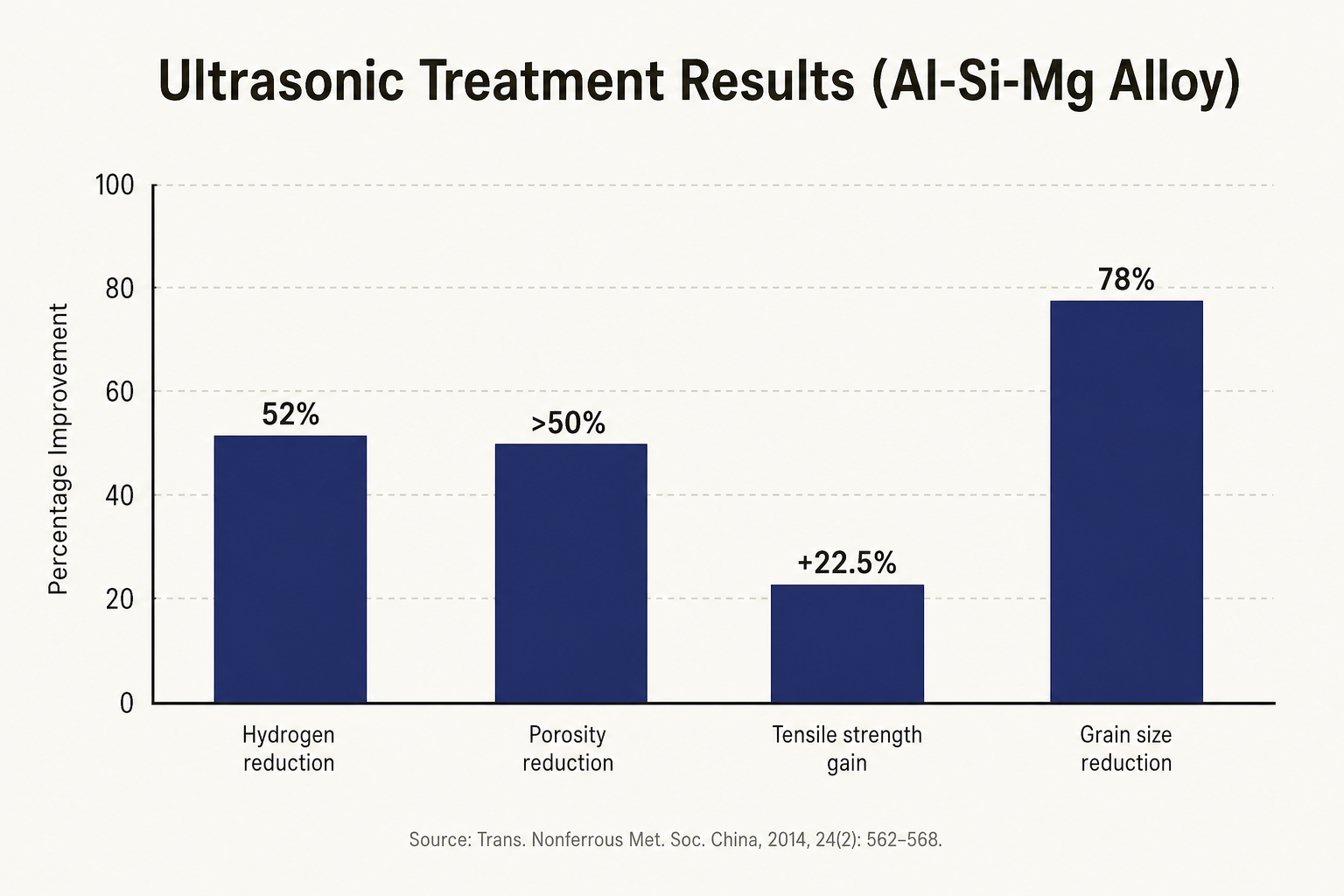 | Metric | Before treatment | After ultrasonic | Change | | — | — | — | — | | Hydrogen content | 0.35 cm³/100g | 0.17 cm³/100g | -52% | | Density | 2.660 g/cm³ | 2.706 g/cm³ | +1.7% | | Porosity rating | 4 (scale) | 1-2 (scale) | >50% reduction | | Ultimate tensile strength | 200 MPa | 245 MPa | +22.5% | | Elongation | 3.8% | 5.1% | +34% |
The elongation improvement is particularly significant. Elongation is sensitive to oxide film content (Bifilm index) as well as to porosity. The fact that elongation improves by 34% – more than can be accounted for by hydrogen reduction alone – reflects the role of cavitation shockwaves in breaking up and redistributing bifilm oxide inclusions that are otherwise invisible to conventional filtration.
In continuous DC casting applications at industrial flow rates of 70–100 kg/min, ultrasonic treatment achieved a 1.5–2× reduction in hydrogen concentration in the flowing melt – a result that holds with a single sonotrode positioned correctly in the launder geometry. Treatment time to reach the industrial standard residual of 0.1–0.2 cm³/100g runs 5–10 minutes in batch mode – comparable to a rotary degasser, but without argon consumption and with simultaneous grain refinement.
Rotary vs. ultrasonic: an honest comparison
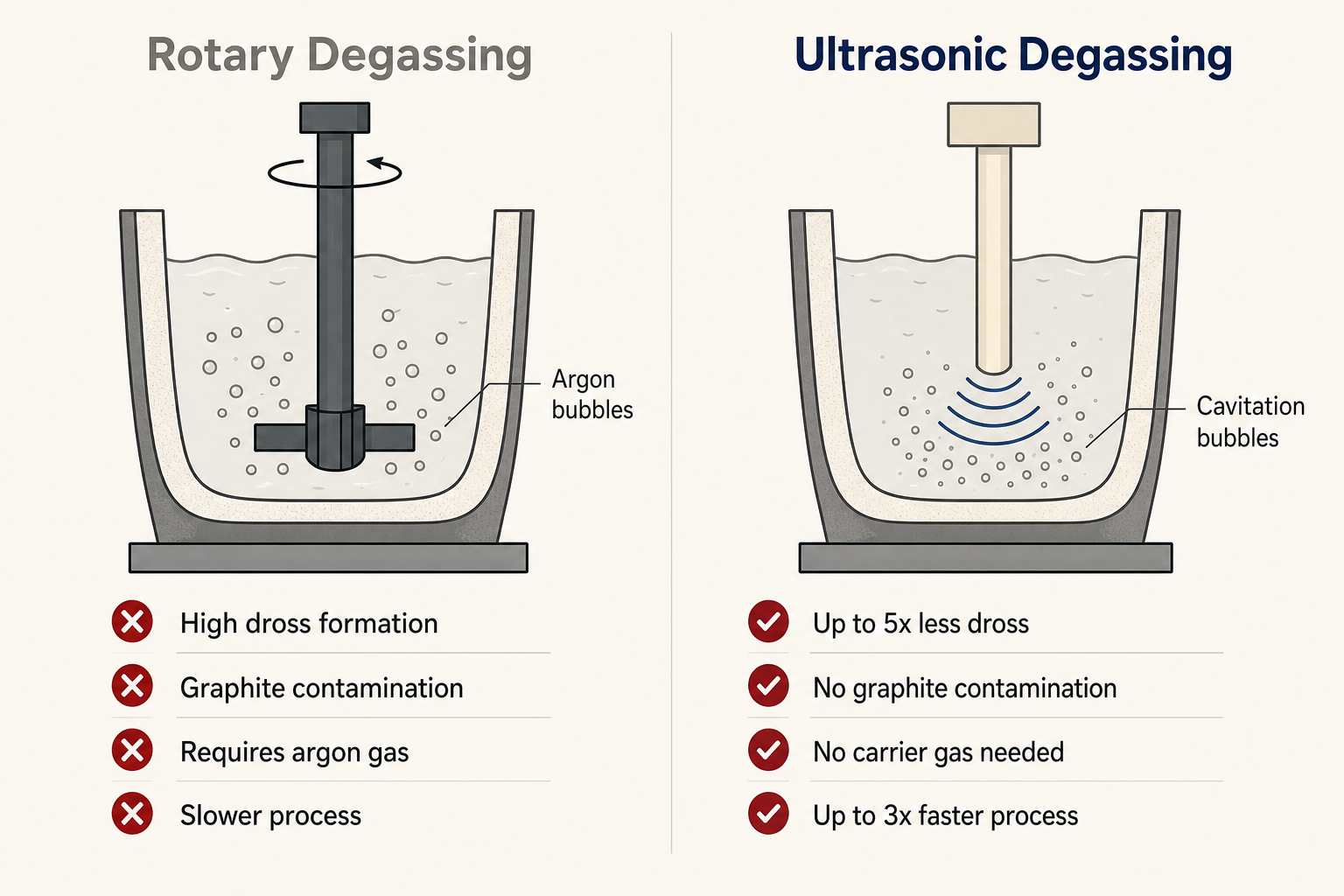 | Parameter | Rotary (graphite rotor) | Ultrasonic (Sialon sonotrode) | | — | — | — | | Hydrogen removal mechanism | Argon bubble diffusion | Acoustic cavitation | | Carrier gas required | Yes (Ar, N₂, or Ar–Cl mixtures) | No | | Contamination risk | Graphite/carbon, Al₄C₃ formation | None (Sialon is inert) | | Dross generation | High (melt surface disrupted) | Low (5× less dross) | | Treatment speed | Baseline | 3× faster | | Grain refinement | No (separate process or additive) | Yes (simultaneous, no additive) | | Moving parts | Yes (rotor, shaft, seals) | No | | Melt quality (bifilm) | Limited improvement | Improved (cavitation breaks bifilms) | | Operating cost | Argon + rotor replacement | Sonotrode maintenance only | | Scalability | Established for large volumes | Good with multi-sonotrode design |
Rotary degassing is not obsolete. For very large melt volumes with established argon infrastructure, the capital case for replacement takes time to build. But for new installations, for foundries evaluating their argon spend, and for any operation where graphite contamination has been a recurring quality issue, the economic math runs in favor of ultrasonic systems – particularly when grain refinement is factored in as a process step that would otherwise require TiBAl master alloy.
“Ultrasonic degassing produces more than 5 times less dross than Ar rotary degassing, while achieving hydrogen reduction kinetics 3 times faster than impeller-driven gas removal.” – Brunel University BCAST, overview of ultrasonic degassing development
Integration in the cast-house
Ultrasonic degassing equipment is not a monolithic system. The configuration depends on the process:
Batch (furnace or ladle treatment). The sonotrode is inserted into the melt volume via a positioning arm, treated for 5–10 minutes, and withdrawn. This is the lowest-capital entry point and works with existing furnace infrastructure. The sonotrode can be moved through programmed positions to maximize acoustic coverage of large melt volumes – robotic positioning is increasingly used for this in modern installations.
Inline (launder or sump treatment). The sonotrode is positioned in a flowing melt stream – the launder between furnace and DC caster, or directly in the casting sump. Treatment is continuous, at flow rates up to 100 kg/min in documented industrial installations. This is the configuration used in vertical Wagstaff and Bruno Presezzi continuous casting line deployments, where it offers the most significant quality-per-tonne improvement with no cycle time impact.
Hybrid (gas + ultrasonic). Some sonotrode designs incorporate a central channel for gas injection – argon lancing combined with ultrasonic field generation. The combination allows existing degassing infrastructure to be retained while adding the cavitation-driven grain refinement and dross reduction benefits. This is a logical transition path for operations with capital tied up in gas supply systems.
The generator requirements are straightforward. Aktive Arc Sarl – the Swiss ultrasonic engineering company behind the NIMA generator series – designs industrial ultrasonic systems for aluminum melt treatment that operate typically around 19.7 kHz with auto-tuning frequency tracking, in power ranges from 100 W to 4,000 W (custom higher power on request). Their “no-standing-waves” design approach allows treatment of large melt volumes without the field inhomogeneity that plagued early installations. Together with Sialon Ceramics ApS, Aktive Arc operates the joint technology portal at ultrasonicdegassing.com – where both companies present integrated system configurations combining NIMA generators with Sialon ceramic sonotrodes as a complete degassing solution.
Try the integrated system
Effective ultrasonic degassing of molten aluminum requires two things to come together: a generator that can deliver sufficient acoustic intensity above the cavitation threshold in liquid metal, and a sonotrode that survives the melt without contaminating it. That is the combination Sialon Ceramics ApS and Aktive Arc Sarl have developed together.
Sialon Ceramics ApS manufactures the ceramic sonotrodes – silicon aluminium oxynitride components with a Young’s modulus of 345 GPa, non-wetting behavior in molten aluminum, and thermal shock resistance across thousands of insertion cycles. With 40 years of experience developing advanced ceramics for extreme-temperature metal processing, Sialon’s sonotrodes are manufactured to ±0.02 mm tolerances and rated to 1,400°C continuous operation in direct melt contact.
Aktive Arc Sarl (Neuchâtel, Switzerland) supplies the NIMA ultrasonic generator systems – purpose-built for molten metal treatment, with auto-tuning frequency tracking, programmable control, and power configurations matched to batch or continuous casting volumes. Founded in 2001 and led by Mario Plasencia, Aktive Arc brings 25 years of power ultrasonics engineering to the generator side of the equation.
Together, both companies present integrated system configurations at ultrasonicdegassing.com. If your cast-house is evaluating ultrasonic degassing – or if graphite contamination, argon spend, or TiBAl master alloy costs are already live concerns – that is the starting point for system specifications matched to your melt volume and process configuration.
Häufig gestellte Fragen
How does ultrasonic degassing remove hydrogen from molten aluminum?
Ultrasonic waves generate acoustic cavitation – millions of microscopic bubbles that nucleate, oscillate, and collapse in the melt. During the low-pressure phase of each oscillation cycle, dissolved atomic hydrogen diffuses into the bubbles and recombines into molecular H₂. The bubbles coalesce and float to the surface, releasing the hydrogen gas. This process can reduce hydrogen content from 0.35 cm³/100g to 0.17 cm³/100g (a 52% reduction) in a single treatment on an Al–Si–Mg alloy batch.
What is the Bifilm index and how does ultrasonic treatment affect it?
The Bifilm index measures the total length of oxide films (bifilms) on a polished cross-section of a casting – it is a direct indicator of melt quality and a predictor of mechanical failure. Bifilms form when the aluminum oxide skin on the melt surface folds back on itself during turbulent pouring and becomes trapped. Ultrasonic cavitation breaks up these oxide films through shockwaves exceeding 400 MPa, reducing the Bifilm index and the crack-initiation sites it represents, leading to measurably higher elongation values in finished castings.
Why use Sialon ceramic sonotrodes instead of titanium or graphite?
Titanium sonotrodes erode rapidly in molten aluminum above 700°C, contaminating the melt with titanium particles. Graphite dissolves and introduces carbon, which can form carbide phases in aluminum alloys. Sialon ceramics are chemically inert to molten aluminum, thermally stable up to 1,100°C with shock resistance across thousands of thermal cycles, and have a Young’s modulus suited to efficient ultrasonic transmission. The result is a sonotrode that lasts significantly longer with zero melt contamination – making it the only material class that is both metallurgically safe and mechanically viable at industrial scale.
Can ultrasonic degassing be integrated into a continuous DC casting line?
Yes. Inline configurations have been demonstrated in vertical DC (direct-chill) casting at flow rates of 70–100 kg/min, achieving a 1.5–2× reduction in hydrogen concentration in the flowing melt. The sonotrode can be positioned in the launder or the sump. Batch treatment is also viable for foundry furnaces and ladles. The key design consideration is acoustic power delivery – the ultrasonic intensity must exceed the cavitation threshold for liquid metal, which is higher than for water.
Does ultrasonic degassing require argon or other carrier gases?
No – that is one of its core advantages over rotary degassing. Rotary systems need argon (or nitrogen, or chlorine-argon mixtures) to carry hydrogen out of the melt. Ultrasonic cavitation is entirely mechanical: the acoustic field creates the nucleation sites and drives hydrogen out without any carrier gas. This eliminates gas procurement, storage, delivery infrastructure, and the associated environmental emissions. It also eliminates the disruption of the protective aluminum oxide skin that argon injection causes.


 ZDialer Anruf