
Inline aluminium degassing: how to choose the right heater tube material
Inline aluminium degassing: how to choose the right heater tube material
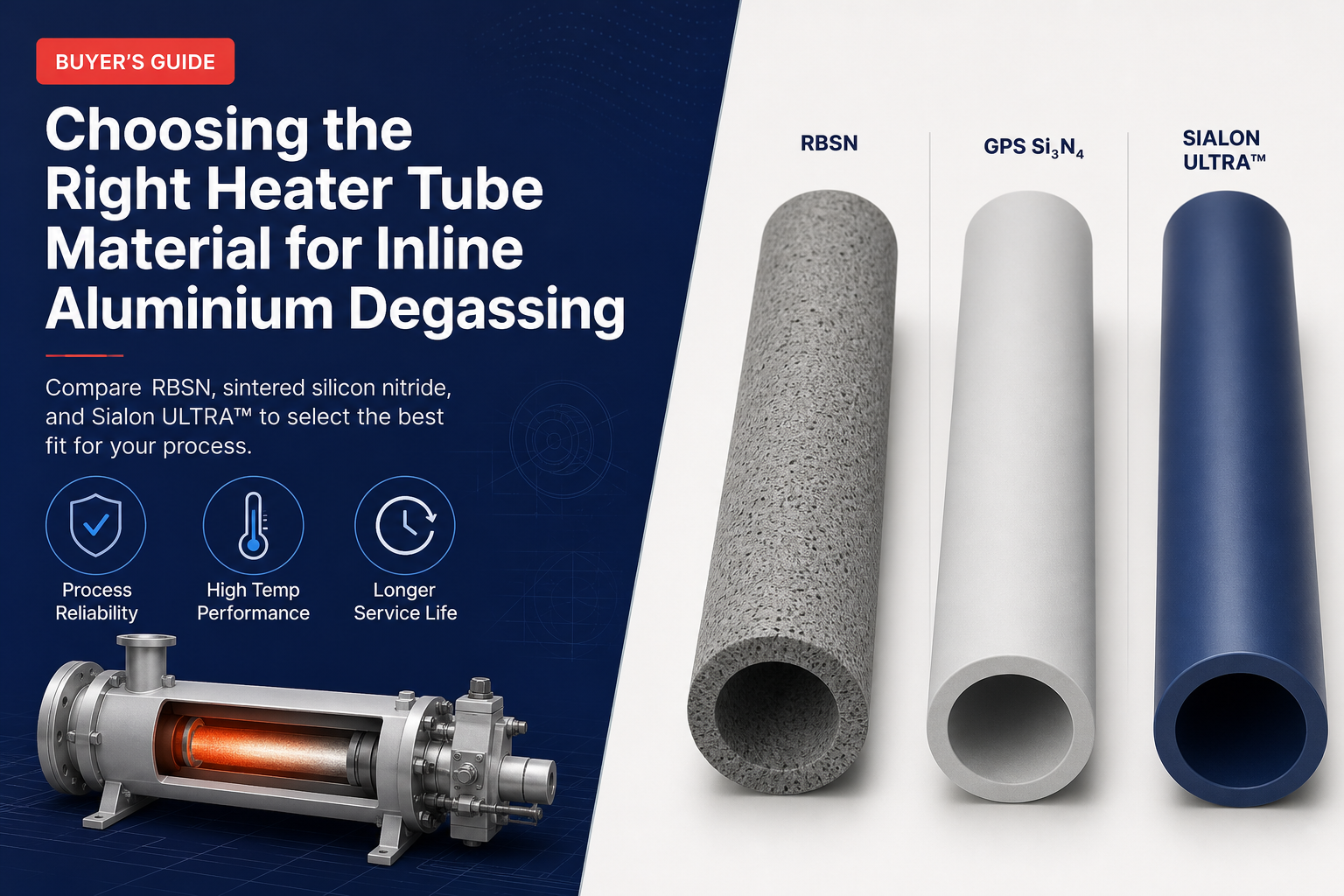
RBSN, sintered GPS Si3N4, or Sialon ULTRA™ — the heater tube material in your inline degassing unit determines service intervals, contamination risk, and casthouse economics.
July 27, 2026 · 15 min read
TL;DR
The heater tube inside your inline degassing unit defines your maintenance rhythm, contamination risk, and ultimately your casthouse economics. Today’s real choice is between three silicon nitride variants: reaction bonded Si3N4 (RBSN) is the accessible entry point; sintered GPS Si3N4 is the industry baseline; Sialon ULTRA™ is the engineered-to-last premium tier. All three are chemically inert to molten aluminium. However, they differ in porosity, mechanical strength, and service life. As a result, those differences lead to significantly different replacement cycles over a three-year period. This guide therefore explains the trade-offs and provides a practical grade selection framework, with all the key data in one place.
For casthouses already running ALPUR®, SNIF®, Hertwich, or Striko Westofen platforms, Sialon Ceramics ULTRA™ heater tubes provide a direct drop-in replacement. In addition, the company custom-manufactures every tube to ±0.02 mm, ensuring a precise fit for your unit geometry.
Why heater tube material is a bigger decision than most casthouses realise
The heater tube’s job sounds simple: protect the electric heating element from direct contact with molten aluminium while transferring heat into the melt. Keep the metal at 700–730°C, which is the optimal temperature for degassing efficiency on most Al-Si casting alloys. Fall below that band and degassing slows; exceed it and hydrogen solubility increases – a 200°F / 111°C rise roughly doubles the dissolved hydrogen load, making subsequent treatment harder.
But the heater tube isn’t just a thermal component.
Indeed, it’s the first part of your degassing unit to fail, and the primary driver of unplanned maintenance intervals. For instance, a porous RBSN tube absorbs atmospheric moisture and can release it as hydrogen inside the melt – the precise gas the entire degassing process is designed to remove. Similarly, a lower-grade sintered tube that reaches its thermal shock limit cracks mid-campaign. As a result, a failing tube at the wrong moment doesn’t just shorten your service interval; it can corrupt the heat.
Ultimately, the choice of material sets the maintenance rhythm for the whole unit. In turn, it determines contamination risk and—once you factor in replacement frequency and associated downtime—largely dictates the real economics of your degassing operation.
](https://cdn-public.eesel.ai/95ace049-b43d-4516-91a5-8cb8151b29d1/ab007f3b-dee0-45e8-839d-0212d2cea820/b006c6f2f04e4c07ba4b1ac8b1dd287d.mp4)
The three silicon nitride variants at a glance
All three materials in this comparison share the same base chemistry – silicon nitride (Si3N4) or silicon aluminium oxynitride (SiAlON) – and all are chemically inert to molten aluminium. The performance differences come down to how they’re made:
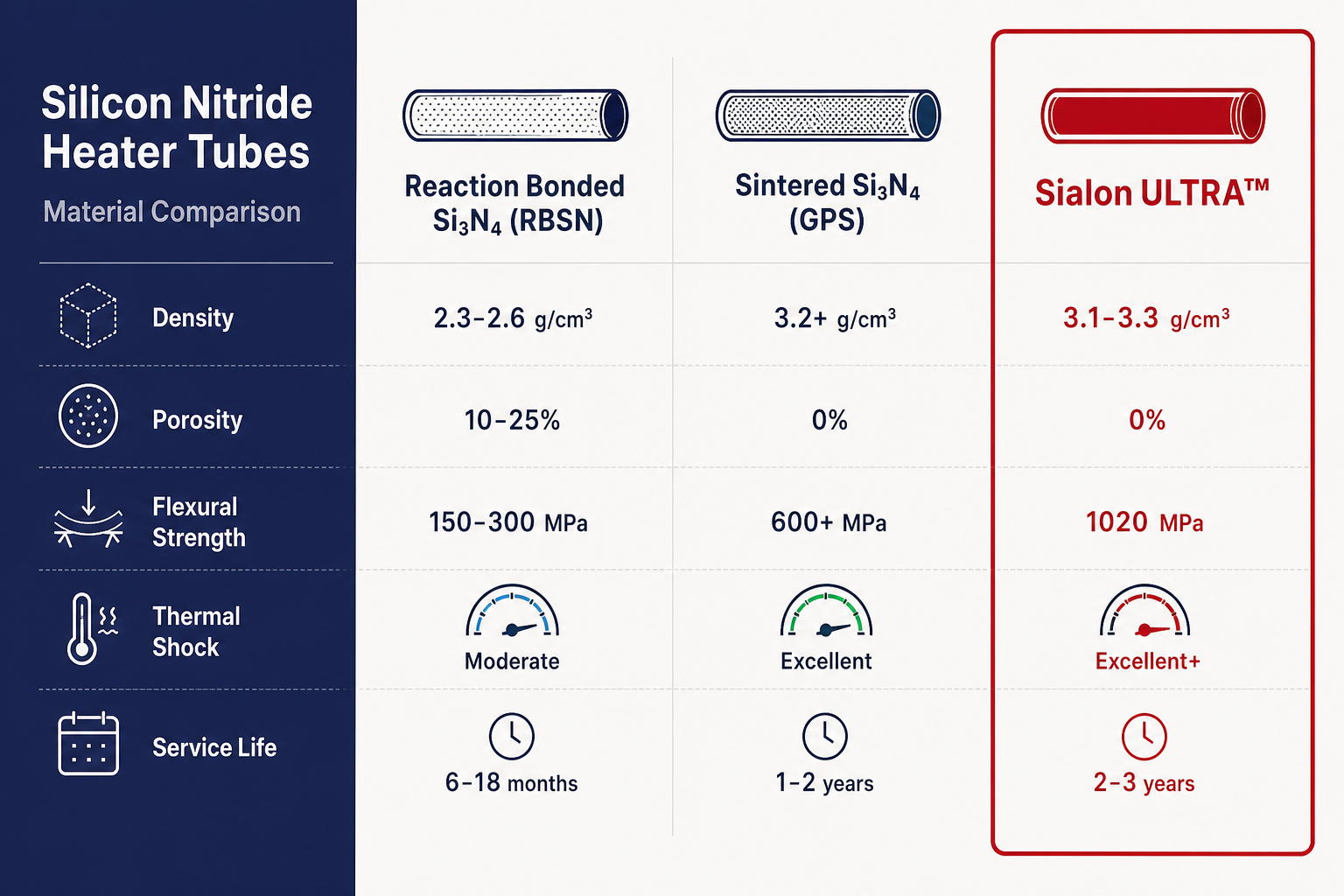
| Property | Reaction bonded Si3N4 (RBSN) | Sintered Si3N4 (GPS/HPS) | Sialon ULTRA™ (SiAlON) |
|---|---|---|---|
| Manufacturing method | Nitriding of Si powder | Gas/hot pressure sintering | Sintering with Al/O additions |
| Bulk density | 2.3–2.6 g/cm³ | >3.2 g/cm³ | 3.1–3.3 g/cm³ |
| Porosity | 10–25% | 0% | 0% |
| Flexural strength | 150–300 MPa | >600 MPa | Up to 1,020 MPa (ULTRA-003) |
| Thermal shock resistance | Moderate | Excellent (>500°C ΔT) | Excellent (550–900°C ΔT) |
| Non-wetting to molten Al | Yes | Yes | Yes – completely |
| Hydrogen re-introduction risk | Moderate (porosity) | None | None |
| Typical service life | 6–18 months | 1–2 years | 2–3 years |
| Thermal expansion | 2.5–3.0 ×10⁻⁶/°C | ~3.2 ×10⁻⁶/°C | 3.2–3.5 ×10⁻⁶/°C |
| Typical purchase cost | Lower | Medium | Higher upfront |
The pattern: all three variants are well ahead of older materials in every dimension that matters. Within the silicon nitride family, the differentiation comes down to density, porosity, and strength.
Reaction bonded silicon nitride: accessible entry point, real limitations
Reaction bonded Si3N4 (RBSN) is made by nitriding silicon powder directly at elevated temperature, without a high-pressure sintering step. The result is a less dense ceramic – typically 2.3–2.6 g/cm³ versus >3.2 g/cm³ for sintered grades – with residual porosity ranging from 10 to 25%. That manufacturing simplicity makes RBSN cheaper to produce, and for lower-criticality applications it delivers meaningful performance.
Porosity is the central limitation. A porous heater tube body absorbs atmospheric moisture during storage, handling, and any maintenance window when the tube is exposed to air. In service, that moisture can vaporise inside the melt environment. Water vapour in contact with molten aluminium decomposes into hydrogen and aluminium oxide – hydrogen goes directly into the melt you’re trying to degas, and aluminium oxide becomes an inclusion. An RBSN tube in poor condition can actively work against the degassing process.
Mechanical strength limits handling durability. At 150–300 MPa flexural strength, RBSN heater tubes are vulnerable during installation, extraction, and emergency cold pulls. Casthouses running frequent maintenance access – particularly on high-production lines where impeller changes are routine – will find RBSN tubes more prone to cracking under the mechanical demands of day-to-day operation.
Service life is variable and environment-dependent. RBSN can deliver 6–18 months in service depending on cycling frequency, melt temperature, and handling conditions. For continuous-operation inline units, the lower end of that range is realistic, meaning at least one replacement per campaign.
Our take: RBSN makes sense for batch operations with lower cycling frequency, lighter mechanical demands, and disciplined tube storage. For continuous inline degassing at sustained production volumes, the porosity risk and strength ceiling make it a compromise where the marginal cost saving rarely offsets the maintenance exposure.
Sintered silicon nitride: the industry baseline
Gas pressure sintered (GPS) or hot pressure sintered (HPS) silicon nitride is the dominant material for heater tubes in inline degassing units worldwide. The sintering process under controlled nitrogen atmosphere at 1,750–1,900°C produces a fully dense ceramic with Si3N4 content exceeding 92% and zero porosity. This is the material that eliminated the porosity and moisture problems inherent in RBSN.
Zero porosity changes the contamination equation entirely.
Silicon nitride exhibits excellent non-wetting properties to molten aluminium and remains chemically inert. With no open pore channels, there is no moisture absorption pathway and no contamination route from the tube to the melt. A GPS Si3N4 heater tube is a passive component – it transfers heat, it survives thermal cycling, and it contributes nothing to hydrogen or inclusion levels.
Thermal shock performance is genuinely excellent.
Silicon nitride’s low thermal expansion coefficient of approximately 3.2 × 10⁻⁶/°C from room temperature to 1,000°C allows operators to insert and remove the tube from a 700–800°C melt without causing it to crack. This is the property that made sintered Si3N4 the industry standard – it survives the operating condition that was the primary failure mode of earlier materials.
Service life of 1–2 years is the industry norm.
GPS Si3N4 heater tubes achieve service lives exceeding one year through their combination of corrosion resistance and non-stick properties. For most casthouses running moderate production volumes, annual tube replacement is a planned, predictable maintenance event.
The limitation is standardisation.
While GPS Si₃N₄ heater tubes are available from multiple manufacturers at broadly similar specifications, these components have essentially become a commodity in the technical ceramics market. Typically, the standard material reaches a service life of 1–2 years; however, this commodity grade offers little scope to optimize performance for abrasive melt compositions, extreme cycling frequencies, or strict energy efficiency requirements.
Our take:
Sintered GPS Si3N4 is the right baseline for most casthouse applications. It removes the porosity and contamination risks of RBSN, it delivers predictable 1–2 year service life, and it is widely available. The question is whether “the industry standard” is the right specification for your specific unit – or whether your operating conditions justify the grade above.
Sialon ULTRA™: purpose-engineered for the conditions that end standard tubes
### Why ULTRA™ Outperforms Standard Si₃N₄
Manufacturers produce silicon aluminium oxynitride (sialon) by substituting aluminium and oxygen into the silicon nitride crystal lattice in controlled proportions. This process creates a distinct material rather than a generic Si₃N₄ variant. Engineers design its microstructure specifically to outperform commodity sintered Si₃N₄ inside continuously operating inline degassing units.
### Higher Mechanical Strength
Strength is the headline difference. ULTRA-003 reaches 1,020 MPa flexural strength—roughly 70% higher than standard GPS Si₃N₄ (>600 MPa). At ceramic density, 1,020 MPa is comparable to many engineering alloys. Consequently, the tube withstands frequent maintenance pulls without cracking and resists mechanical erosion from inclusion-laden melts that progressively wear lower-strength ceramics.
### Longer Service Life
Service life extends the standard Si₃N₄ baseline by 30% or more. Sialon Ceramics ULTRA™ customers routinely achieve 2–3 years of continuous operation—around 30% longer than standard silicon nitride heater tubes. As a result, operators reduce planned downtime, labour, and replacement costs over the life of the equipment.
### Superior Thermal Shock Resistance
Thermal shock performance reaches 900°C ΔT with ULTRA-004. Standard GPS Si₃N₄ handles thermal shock above 500°C. By contrast, ULTRA-004 withstands a 900°C ΔT, allowing operators to insert it directly from ambient temperature into a 700°C melt without a staged preheat protocol. Consequently, operations that perform emergency cold pulls and rapid recommissioning can eliminate an entire category of thermally induced failures.
### Precision Custom Manufacturing
Custom-engineered geometry eliminates fit compromise. Sialon Ceramics manufactures every ULTRA™ tube to order with a ±0.02 mm tolerance. Commodity Si₃N₄ tubes come in standard sizes, whereas the company builds each ULTRA™ tube to the required OD/ID, length, flange geometry, and mounting configuration. As a result, the tube fits correctly without shimming, rework, or vibration-induced mechanical stress.
### Zero Porosity and Chemical Stability
Zero porosity and complete non-wetting are standard across every ULTRA™ grade. Like GPS Si₃N₄, all ULTRA™ grades are fully dense, with zero porosity, zero moisture absorption, and no contamination pathway. Furthermore, sialon remains non-reactive to molten aluminium during extended operation and carries a 12-month chemical attack warranty, reflecting its proven long-term service life.
The full picture: key metrics at a glance
Furthermore, the infographic below consolidates the complete dataset into a single reference—featuring a material-by-material comparison across every relevant metric, detailed technical specifications for all four Sialon ULTRA™ grades (ULTRA-001 through ULTRA-004), compatibility guidelines with major foundry platforms, and key headline performance figures.
Full interactive infographic: Inline Aluminium Degassing – Sialon ULTRA™ Heater Tubes
The four ULTRA™ grades: which one fits your process
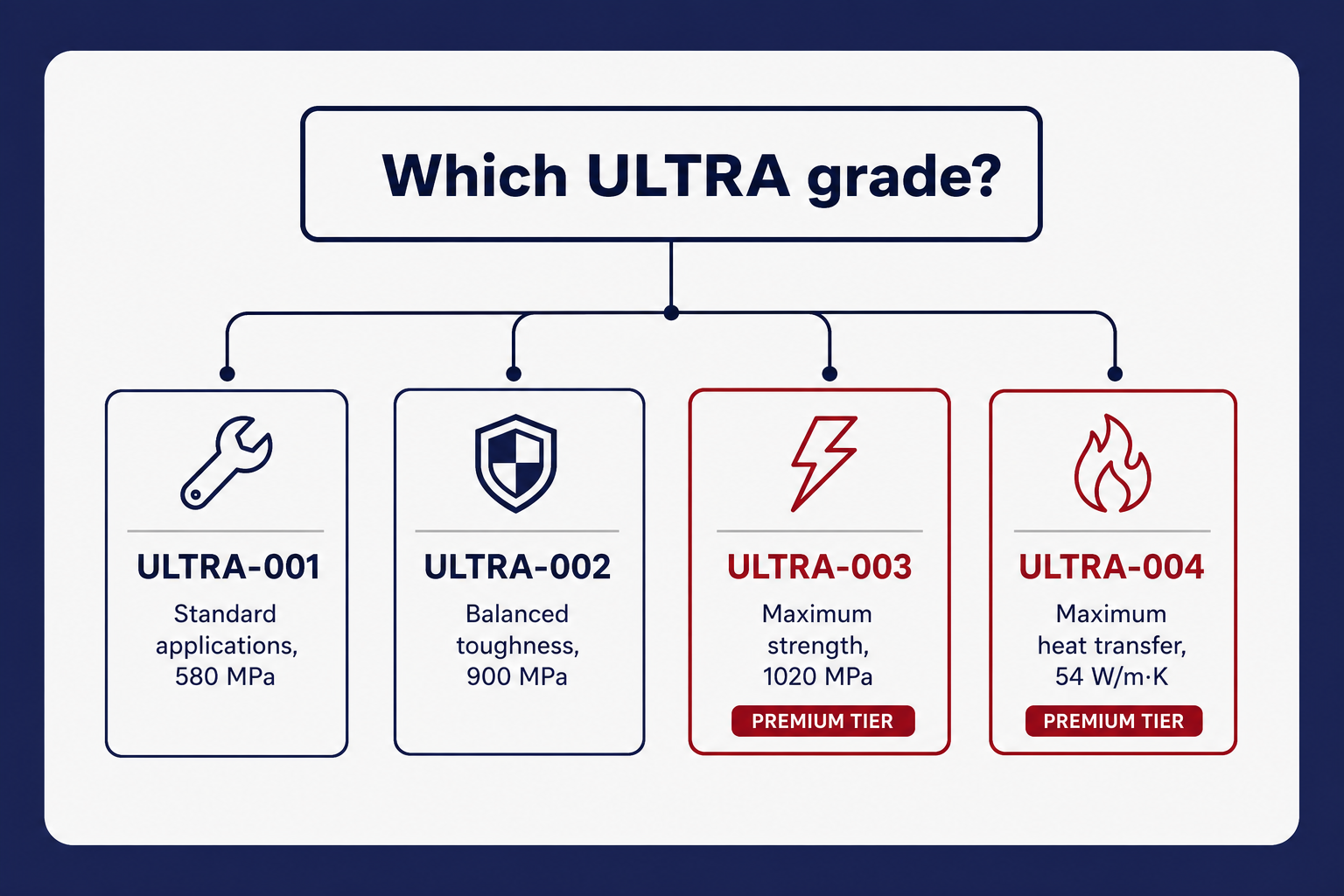
Sialon Ceramics’ ULTRA™ range includes more than 20 grades rather than a single specification. However, four primary formulations cover most casthouse applications. Therefore, the final grade selection depends on the operating constraint that matters most in your specific unit.
| Grade | Flexural strength | Fracture toughness | Thermal shock ΔT | Thermal conductivity | Best for |
|---|---|---|---|---|---|
| ULTRA-001 | 580 MPa | 4–5 MPa·m¹/² | 550°C | 25 W/m·K | Standard duty, lower cycling frequency |
| ULTRA-002 | 900 MPa | 6–7 MPa·m¹/² | 800°C | 23 W/m·K | High impact toughness, frequent cycling |
| ULTRA-003 (MAX STRENGTH) | 1,020 MPa | 7 MPa·m¹/² | 800°C | 27 W/m·K | Maximum mechanical strength, abrasive melts |
| ULTRA-004 (MAX HEAT) | 790 MPa | 6–7 MPa·m¹/² | 900°C | 54 W/m·K | Best thermal transfer, energy-efficient heating |
All grades: bulk density 3.1–3.3 g/cm³ · water absorption 0% · Young’s modulus 270–300 GPa
ULTRA-001:
Is the entry-level grade above commodity GPS Si₃N₄. For standard-duty applications with moderate thermal cycling, it delivers the service life of sialon while providing the custom-geometry manufacturing that defines the ULTRA™ range.
ULTRA-002:
It is where most continuous-casting operations land. The step up to 900 MPa flexural strength and 6–7 MPa·m¹/² fracture toughness means the tube survives the routine mechanical abuse of frequent maintenance access, impeller changes, and emergency pulls without cracking.
ULTRA-003:
It is the ideal choice for abrasive melt conditions. For example, it performs well in operations that process recycled scrap with high inclusion loads or aluminium-silicon alloys containing hard silicon particles. It also suits applications where mechanical failure has historically caused most tube losses. With a flexural strength of 1,020 MPa, this grade effectively eliminates the perception that ceramic components are inherently brittle.
ULTRA-004:
Trades some flexural strength (790 MPa) for 54 W/(m·K) thermal conductivity – the highest in the ULTRA™ range – and a 900°C thermal shock rating that covers every realistic insertion scenario. Standard GPS Si3N4 delivers 16–22 W/(m·K); ULTRA-004’s 54 W/(m·K) is more than double, which translates directly into more heat transferred to the melt per unit of heater element energy. For energy-cost-sensitive operations or units where the heating element is running at capacity, ULTRA-004 changes the efficiency equation.
Dimensional precision is grade-independent. Every tube in the ULTRA™ range is manufactured to order at ±0.02 mm tolerance, covering your specific OD/ID, length, flange geometry, and mounting configuration.
Which degassing platforms specify sialon?
Sialon heater tubes are specified and in service across all major inline degassing platforms:
- ALPUR® TS range (PAE Technologies) – TS15, TS35, TS55, TS75, TS90, and the G3 cc Line. The ALPUR uses an integrated long-life sialon heater sheath specifically to maintain melt temperature during treatment. ALPUR’s in-situ heating system is designed around a sialon sheath – it’s not an aftermarket upgrade.
- SNIF® (Pyrotek) – the benchmark spinning nozzle platform. SNIF systems run silicon nitride on most configurations targeting tight hydrogen specifications.
- Hertwich – wire bar and rolling slab casting lines.
- Striko Westofen – dosing and transfer systems in diecasting and foundry operations.
- Ultrasonic degassing systems – sialon sonotrode tubes for ultrasonic hydrogen removal, where chemical and thermal performance requirements mirror those of rotary degassing.
The practical implication: if you’re operating any of these systems, there is no integration work required. The tube is a consumable component; the ULTRA™ replacement is manufactured to the same geometry as the OEM specification.
](https://cdn-public.eesel.ai/95ace049-b43d-4516-91a5-8cb8151b29d1/ab007f3b-dee0-45e8-839d-0212d2cea820/c4f70baf18924af6923175821af8d69e.mp4)
The TCO calculation
Purchase price comparisons between silicon nitride variants are misleading without accounting for replacement frequency. Here’s how the arithmetic plays out for a continuously-operating inline degassing unit:
| RBSN | Sintered GPS Si3N4 | Sialon ULTRA™ | |
|---|---|---|---|
| Typical service life | 6–18 months | 12–24 months | 24–36 months |
| Replacements per 3 years | 2–6 | 1–3 | 1–2 |
| Each replacement: planned downtime | 4–8 hrs | 4–8 hrs | 4–8 hrs |
| Total downtime over 3 years | 8–48 hrs | 4–24 hrs | 4–16 hrs |
| Porosity-driven contamination risk | Moderate | None | None |
| Hydrogen re-introduction risk | Moderate | None | None |
| Custom geometry | Standard sizes | Standard sizes | ±0.02 mm to spec |
The downtime column tells the real story. An RBSN tube typically fails twice over a three-year period, with each replacement requiring an 8-hour shutdown. As a result, operators lose 16 hours of planned downtime, compared with only 4–8 hours for a single ULTRA™ replacement. Moreover, that comparison does not include RBSN’s unplanned failures caused by moisture-induced hydrogen spikes. For a casthouse operating three shifts, 12 additional hours of lost production represent far more than the cost of a replacement tube—they represent a significant production loss.
Sialon Ceramics backs the ULTRA™ range with a 12-month warranty against chemical attack – a guarantee that implicitly prices in multi-year actual service life.
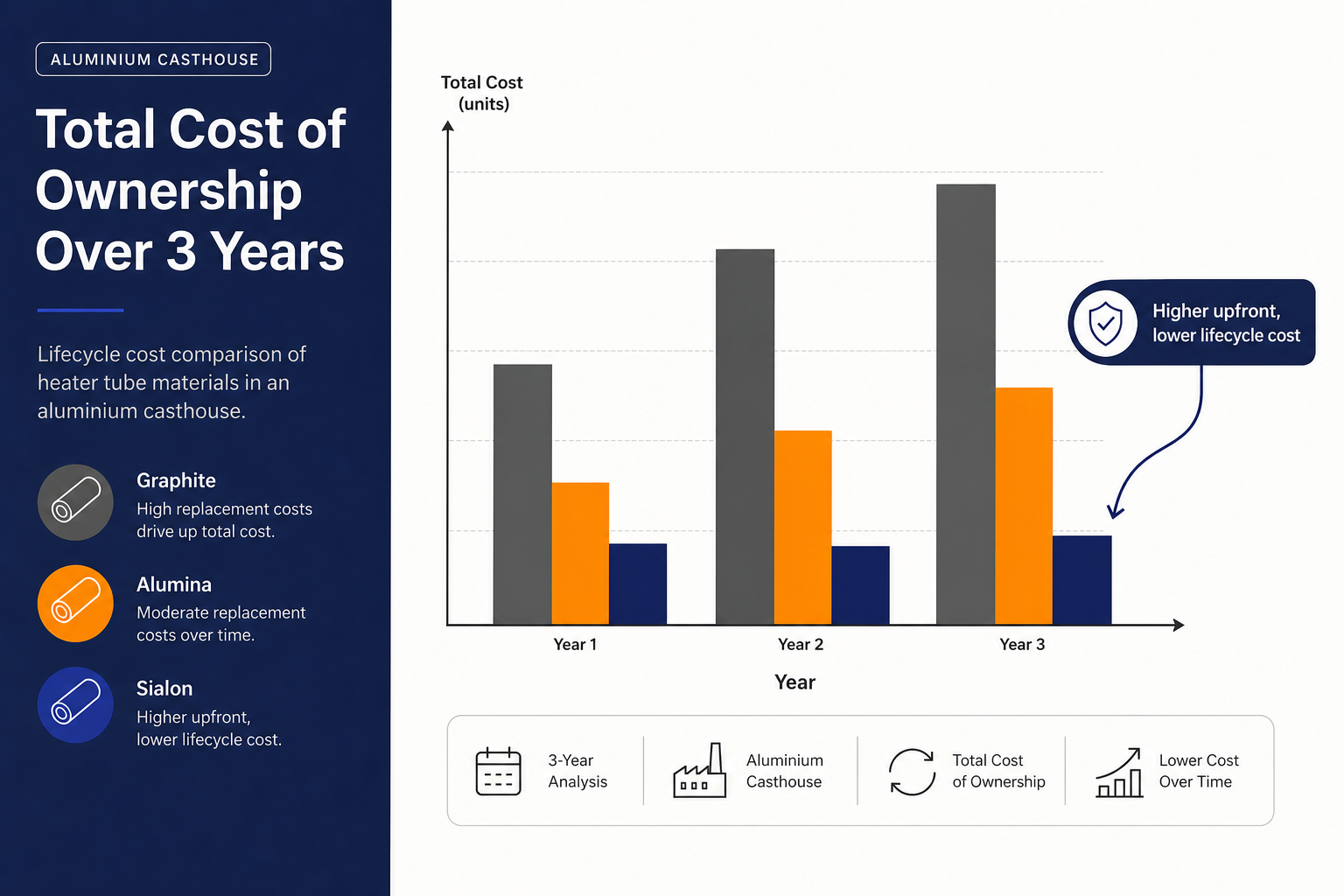
One number worth fixing in mind: ULTRA™ customers routinely achieve 2–3 years of continuous operation – 30% longer than standard silicon nitride heater tubes. That 30% translates directly into fewer shutdowns per three-year period, which is where the economics tip firmly in favour of the premium material.
How to specify the right tube
Once you’ve decided on Sialon ULTRA™, the specification process is straightforward. Sialon Ceramics needs:
- Unit make and model (ALPUR TS35, SNIF HD-200, etc.) – to confirm the standard geometry and any known fit considerations
- Internal dimensions – OD, ID, and working length (or the OEM part number if available)
- Flange and mounting geometry – if non-standard
- Operating temperature – melt temperature and typical preheat conditions
- Alloy type – relevant for alloys with high silicon or zinc content, which affect thermal behaviour
- Cycling frequency – how often the tube is inserted and extracted per shift, and whether emergency cold pulls occur
With this information, Sialon Ceramics can confirm the appropriate ULTRA™ grade and provide a dimensioned quotation. Every tube is manufactured to order; lead times vary by grade and configuration.
Try Sialon Ceramics
Since 1986, Sialon Ceramics ApS has manufactured advanced sialon ceramics for molten non-ferrous metal processing. Over four decades, the company has continuously refined tube composition and geometry for the operating conditions described in this guide. As a result, the ULTRA™ heater tube range includes more than 20 grades, custom manufacturing to ±0.02 mm, a 12-month chemical attack warranty, and confirmed compatibility with all major inline degassing platforms.
For casthouses running RBSN or standard sintered Si3N4 heater tubes and looking to extend service intervals, the ULTRA™ range delivers 30% more life than commodity GPS Si3N4 – at custom geometry that eliminates fit compromise. View the full product range or contact Sialon Ceramics with your current unit and dimensions for a tailored quotation.


 ZDialer Call