
Silicon Nitride vs Sialon vs Silicon Carbide
Silicon Nitride vs Sialon vs Silicon Carbide: which advanced ceramic should you choose?
Silicon nitride vs sialon and silicon carbide all handle extreme heat and outlast metals – but they win in very different applications. This guide covers the properties, history, and selection logic engineers actually use.
July 28, 2026 · 10 min read
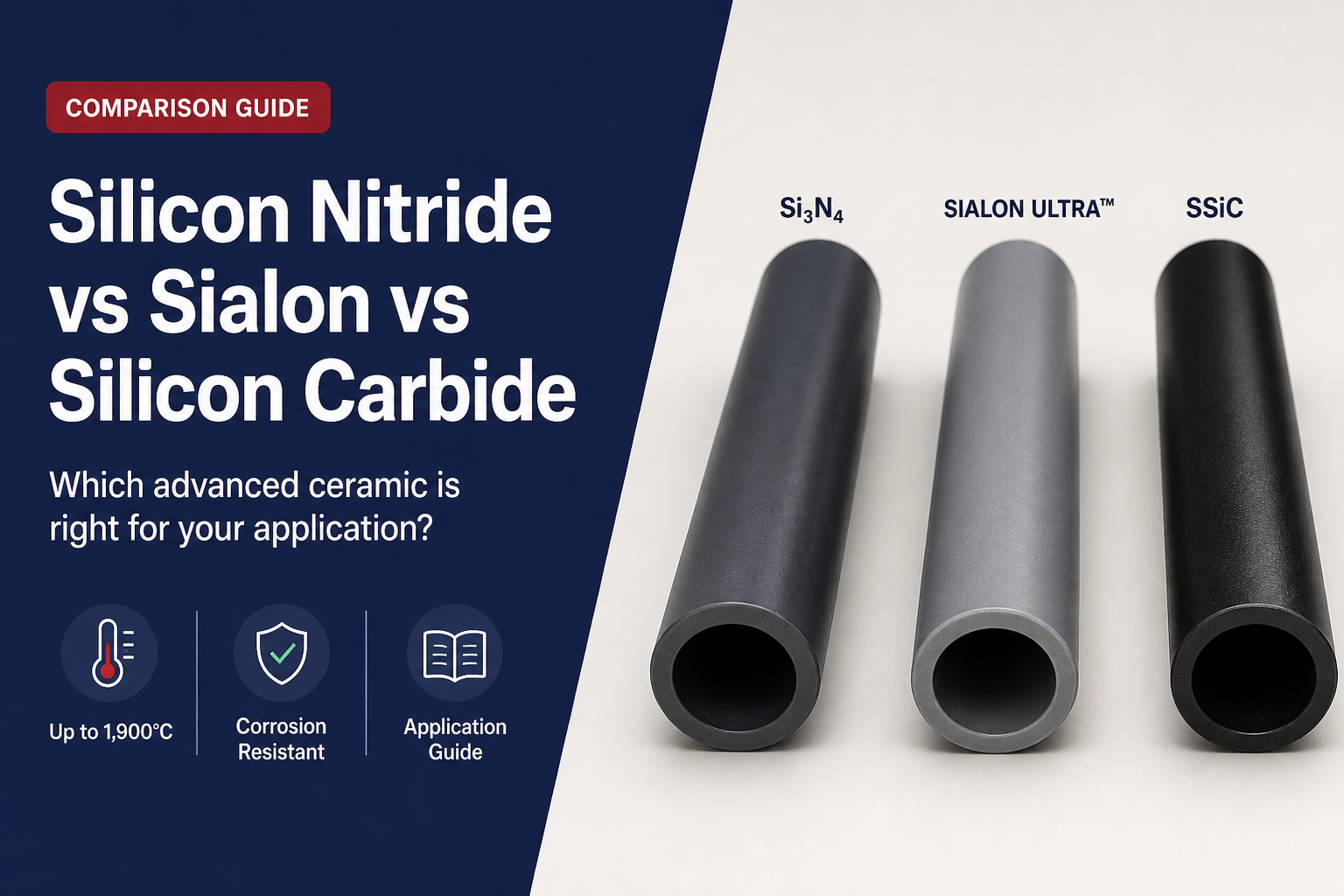
Walk into any serious foundry, chemical plant, or high-temperature furnace installation and you’ll find advanced ceramics doing the hard work that metals cannot. But which one? Silicon nitride, sialon, and sintered silicon carbide are frequently named in the same breath – all three handle extreme heat, all three resist corrosion, and all three outlast metals in demanding applications. The differences between them, though, are sharp enough to make the wrong choice expensive.
This guide cuts through the overlap. It covers where each material came from, what it can actually do, and – most importantly – which applications it wins in and which it doesn’t.
At a Glance: The Three Materials
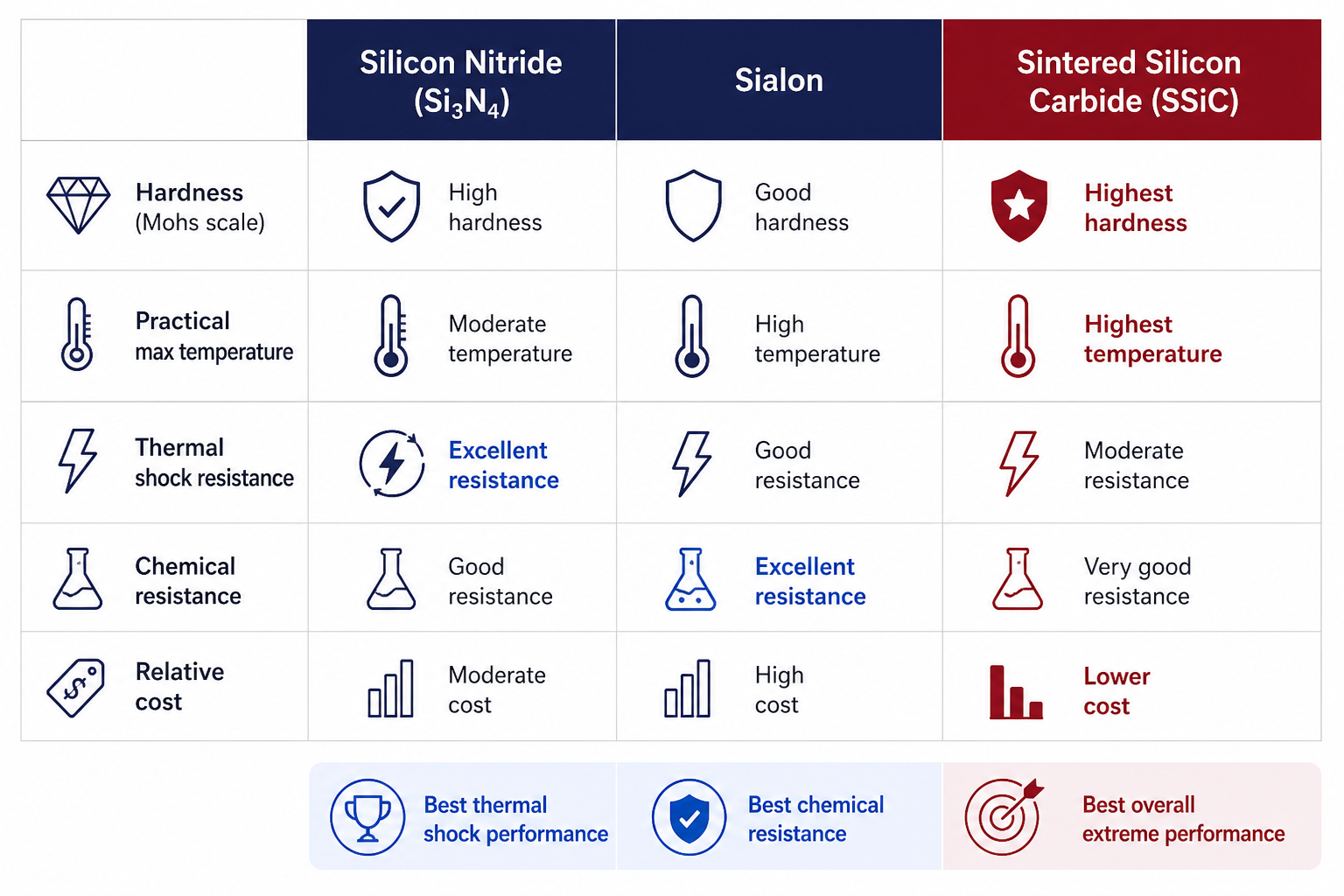 | Property | Silicon Nitride (Si₃N₄) | Sialon (SiAlON) | Sintered SiC (SSiC) | | — | — | — | — | | Hardness (Mohs) | ~9 | ~9 | 9–9.5 | | Practical max temperature (air) | ~1,200–1,400°C | Up to ~1,400°C | 1,600–1,700°C | | Thermal shock resistance | Excellent | Excellent | Good | | Resistance to molten metals | Good | Exceptional | Good | | Chemical corrosion resistance | Good | Good | Excellent | | Density (g/cm³) | ~3.2 | ~3.2–3.4 | ~3.1–3.2 | | Relative cost | Medium | Medium–High | Medium–High |
No single material wins every row. That’s the entire point – and the reason this comparison exists.
Silicon Nitride: The Precision Ceramic
A 170-Year Journey to Industry
Silicon nitride has the longest history of the three, though most of it wasn’t particularly useful. It was first synthesized in 1857 by French chemists Sainte-Claire Deville and Wöhler – a laboratory curiosity that sat largely ignored for a century. It wasn’t until the 1960s and 1970s, when engineers began seriously searching for materials that could survive inside aircraft turbine engines, that Si₃N₄ received the industrial attention it deserved.
The ceramic engine dream – replacing metal with silicon nitride for turbocharger rotors, glow plugs, and combustion chambers – was only partially realized. But the research it generated was not wasted. By the 1980s and 1990s, silicon nitride had found its real calling in bearings, cutting tools, and molten metal handling, where its unique combination of properties proved genuinely hard to match.
What Silicon Nitride Does Well
Silicon nitride’s defining characteristic is its combination of high strength and excellent thermal shock resistance. It can be rapidly heated and cooled without cracking – a property that comes from its low thermal expansion coefficient and the covalent bonding structure of its Si–N framework.
Its other standout trait is wear resistance at speed. The ~300,000 silicon nitride turbocharger rotors manufactured annually are there because the material stays hard and dimensionally stable at temperatures and rotational speeds that would destroy conventional bearings. The $50 million annual cutting tool market for Si₃N₄ exists for the same reason: it machines cast iron and nickel-based superalloys at surface speeds up to 25 times faster than tungsten carbide.
Silicon nitride also handles molten non-ferrous metals – aluminium, zinc, tin, lead – without contaminating the melt. This makes it viable for thermocouple sheaths, nozzles, and crucibles in metal processing.
Where Silicon Nitride Falls Short
Silicon nitride decomposes above about 1,850°C, but that’s a theoretical ceiling, not a working temperature. In practice, practical operating temperatures top out at approximately 1,200–1,400°C depending on the grade and atmosphere. It cannot be used above this range without material degradation.
It also loses ground to sialon specifically when molten aluminium contact is involved. Silicon nitride is attacked by molten aluminium more readily than sialon – a narrow but commercially significant difference in the foundry world.
Sialon: The Foundry Ceramic
Born from Silicon Nitride
Sialon – pronounced “sigh-alon” – is not a compound but a family of ceramic alloys derived from silicon nitride. The name is an acronym: Silicon Aluminium Oxynitride. Replacing some silicon and nitrogen atoms with aluminium and oxygen stabilizes the silicon nitride crystal lattice. This modification also gives sialon enhanced thermal and chemical properties.
The material was first reported in 1971, developed through parallel research at Newcastle University and the UK’s National Physical Laboratory. K.H. Jack’s 1976 paper in the Journal of Materials Science, “Sialons and related nitrogen ceramics,” provided the theoretical framework that accelerated commercialization across the following decade.
Sialon transitioned from a laboratory material to a commercial product during the 1980s. Sialon Ceramics ApS launched in 1986 and has manufactured sialon and silicon carbide components for extreme-temperature foundry and industrial applications ever since.
What Sialon Does Well
Sialon’s headline property is its exceptional resistance to wetting and corrosion by molten non-ferrous metals, particularly aluminium. Where silicon nitride is merely resistant, sialon is genuinely immune in most aluminium processing conditions. Thermocouple protection tubes, immersion heater tubes, riser tubes for low-pressure diecasting, and degassing rotors for aluminium all benefit from this property in ways that other ceramics struggle to match.
The second headline is thermal shock resistance. Sialon’s low thermal expansion and high-temperature strength allow it to withstand repeated immersion in molten metal without cracking. It can be plunged into the melt, rapidly cycled, and withdrawn time after time. As a result, Sialon Ceramics rates its Sialon ULTRA™ thermocouple protection tubes for operation at temperatures up to 1,400°C and manufactures them to tolerances of ±0.02 mm. The company also rates its heater tubes for direct contact with molten metal at temperatures up to 1,100°C.
Beyond foundry applications, manufacturers use sialon in cutting tools for machining chill cast iron, welding fixtures, chemical processing equipment, and oil and gas components. Engineers choose the material because it maintains excellent chemical stability at elevated temperatures.
Where Sialon Falls Short
Sialon is not the hardest of the three – silicon carbide beats it on the Mohs scale. In applications where sheer abrasion resistance against hard particles is the primary load (blast nozzles, mechanical seals in abrasive slurries), SSiC is typically the stronger choice.
Sialon also cannot match SSiC at the upper temperature extreme. Sialon Ceramics’ SSiC product line (XICAR™) is rated to 1,700°C in air and up to 1,900°C in controlled atmospheres – a range sialon simply cannot reach.
Sintered Silicon Carbide: The Extreme-Conditions Ceramic
130 Years from Abrasive to Engineering Ceramic
Silicon carbide has the most dramatic origin story of the three. In 1891, Edward Goodrich Acheson was trying to make artificial diamonds when he accidentally passed current through a clay-and-coke mixture and produced something that cut glass. He named it Carborundum and founded the company that bore its name – giving industry its first man-made abrasive harder than corundum.
For most of the 20th century, SiC remained primarily a powder: grinding wheels, sandpapers, cutting compounds. The leap to dense sintered engineering ceramics came in the 1970s and 1980s, when improved sintering techniques allowed engineers to produce solid components with the material’s full mechanical properties intact. XICAR™ sintered silicon carbide from Sialon Ceramics represents the current state of the art in this lineage – components rated to 1,900°C and manufactured up to 3,000 mm in length.
What Sintered SiC Does Well
SSiC’s competitive advantages cluster around two properties that no other advanced ceramic matches simultaneously: hardness and thermal conductivity.
Sintered silicon carbide sits at 9–9.5 on the Mohs scale, with a Vickers hardness of approximately 2,500 HV. This makes it the hardest of the three materials, and among the hardest substances known outside diamond and cubic boron nitride. This translates directly into superior wear life in abrasive applications. Think blast nozzles, pump impellers handling abrasive slurries, mechanical seals in chemically aggressive environments, and kiln furniture subject to constant thermal and mechanical wear.
Its thermal conductivity of 120–200 W/m·K is exceptional for a ceramic. This is far above silicon nitride (~20–30 W/m·K) and sialon (~10–20 W/m·K). That property makes SSiC the natural choice for heat exchangers and furnace components. It’s also the right pick for any application where heat must move through the component efficiently rather than be resisted by it.
Continuous service temperature in oxidizing atmospheres exceeds 1,600°C. XICAR™ components are rated to 1,700°C in air and 1,900°C in controlled or reducing atmospheres. No silicon nitride or sialon product reaches these temperatures.
Chemical resistance is comprehensive: SSiC withstands most acids, bases, and molten salts without meaningful attack. This makes it the preferred material for pump impellers and valve seats. It’s also the go-to for process equipment in chemical plants where the fluid is aggressive and contamination from the vessel material isn’t acceptable.
Where Sintered SiC Falls Short
SSiC’s thermal shock resistance is good but not exceptional – inferior to both silicon nitride and sialon.
SSiC is also the most brittle of the three in impact terms. In applications with mechanical shock loading, sialon’s slightly better fracture toughness becomes relevant.
Which Material Wins Where
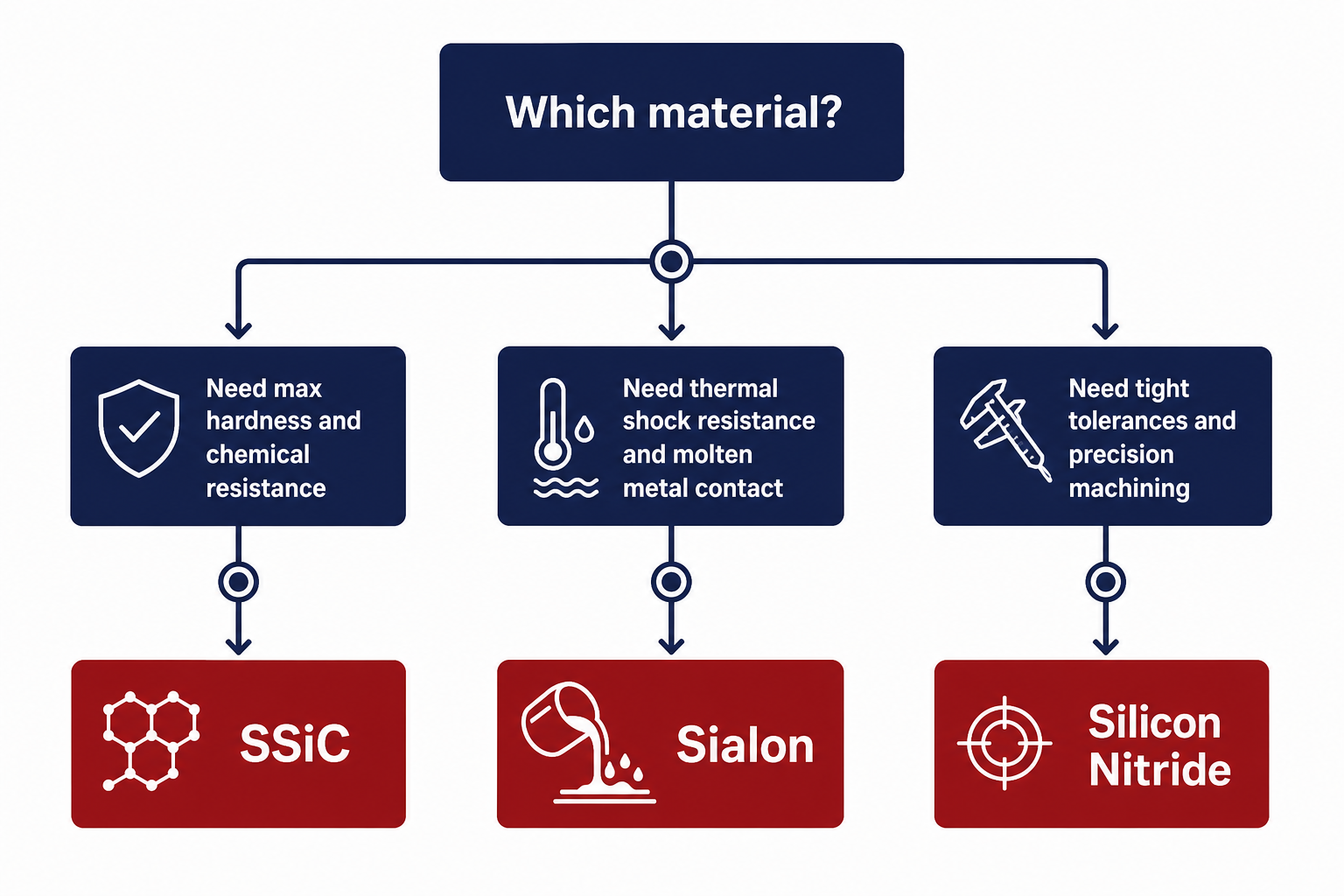 Adopt silicon nitride when:
- Precision bearings, cutting tools, or engine components are the application
- Tight dimensional tolerances under thermal cycling are required
- High-speed machining of cast iron or nickel superalloys is the use case
- Cost is a meaningful constraint relative to the upper-tier options
Deploy sialon when:
- Molten aluminium, zinc, brass, or other non-ferrous metals are involved
- Thermal shock is frequent and severe (rapid cycling in and out of molten metal)
- Thermocouple protection, immersion heating, or riser tube applications
- Chemical processing environments where corrosion resistance and moderate temperature are the primary loads
Choose sintered silicon carbide when:
- Maximum hardness and wear resistance against abrasive media is the primary requirement
- Operating temperatures exceed 1,400°C in air
- Heat transfer through the component is important (heat exchangers, furnace components)
- Chemical processing requires resistance to acids, bases, or molten salts at high temperatures.
- Your application requires large-format components such as mechanical seals, blast nozzles, or kiln shelves.
Application Domains by Material
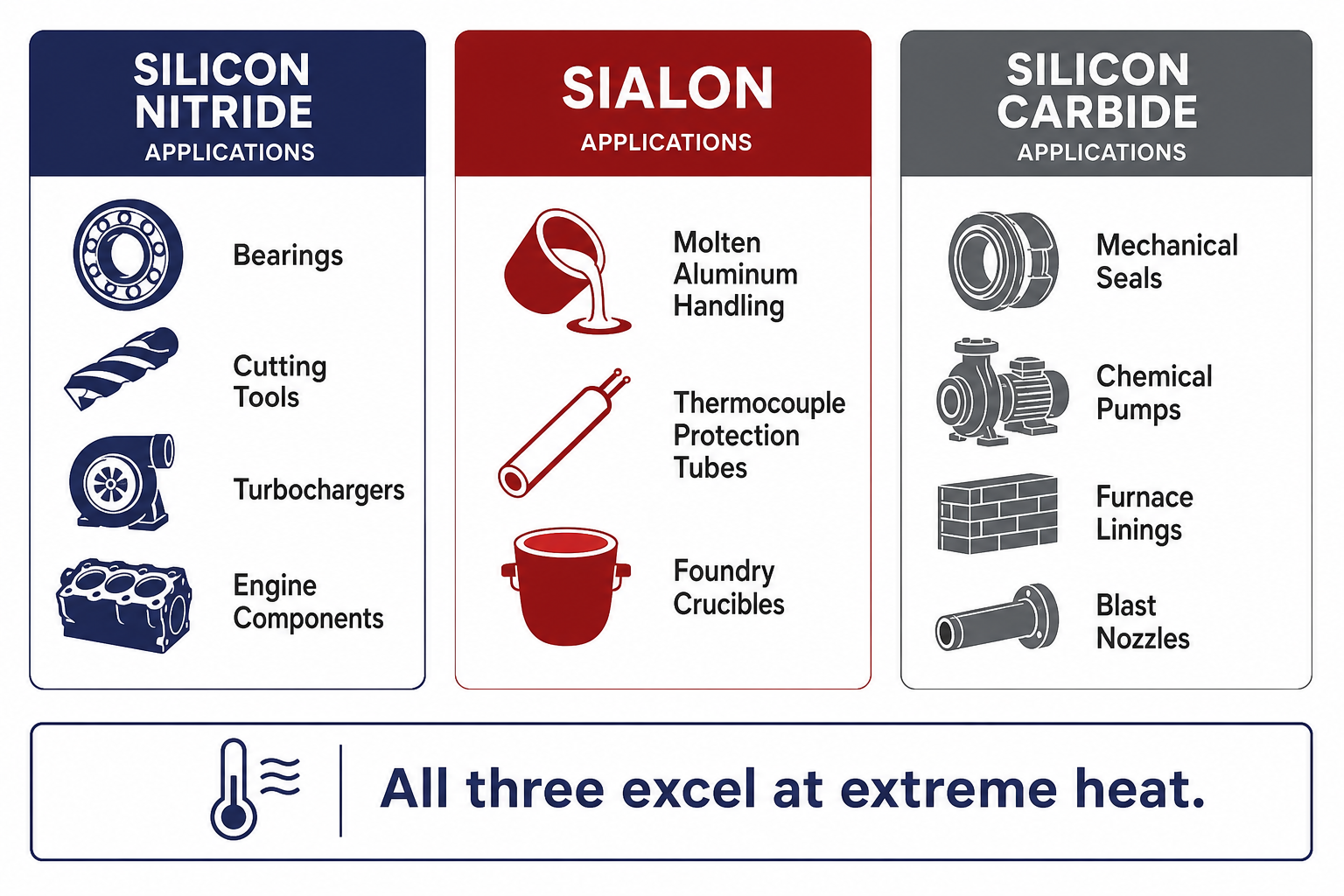 The three materials rarely compete directly in the same application. In practice:
-
Silicon nitride primarily dominates automotive powertrain applications, including turbocharger rotors and glow plugs. Engineers also choose silicon nitride for machine tool bearings and cutting tools because of its excellent strength and thermal shock resistance.
-
Similarly, sialon is the preferred material for non-ferrous foundry equipment. For example, foundries use sialon for thermocouple protection tubes, immersion heater tubes, degassing rotors, riser tubes for aluminium diecasting, and ladles and crucibles. This is because it offers outstanding resistance to molten metals.
- Meanwhile, sintered silicon carbide excels in applications that demand maximum hardness, wear resistance, and chemical stability. Therefore, manufacturers rely on sintered silicon carbide for mechanical seals, pump impellers, blast nozzles, kiln furniture, furnace linings, heat exchangers, semiconductor processing fixtures, and ballistic protection panels.
When extreme heat is the only major requirement, material selection becomes a genuine engineering decision rather than an obvious one.
Try Sialon advanced ceramics comparison
Sialon Ceramics has manufactured sialon and sintered silicon carbide components since 1986. The application might call for a Sialon ULTRA™ thermocouple protection tube rated to 1,400°C. It might call for an immersion heater tube guaranteed for 12 months in molten aluminium. Or it might call for a XICAR™ sintered silicon carbide component rated to 1,900°C in controlled atmosphere. Either way, the company produces custom geometries to ±0.02 mm tolerances, in lengths up to 3,000 mm.
Explore the full product range at sialon.com, or contact the team directly to discuss your specific application.
Sources
- Wikipedia: Sialon
- Wikipedia: Silicon nitride
- AZoM: Silicon Nitride (Si₃N₄) Properties and Applications
- AZoM: Silicon Carbide (SiC) Properties and Applications
- Jack, K.H. (1976). “Sialons and related nitrogen ceramics.” Journal of Materials Science, 11(6): 1135–1158
- Cao, G.Z.; Metselaar, R. (1991). “α’-Sialon ceramics: A review.” Chemistry of Materials, 3(2): 242
- Wikipedia: Edward Goodrich Acheson
- Sialon Ceramics: Sialon ULTRA™ Heater Tubes


 ZDialer Call