
Sintered silicon carbide
Sintered silicon carbide: properties, history, and industrial applications
Sintered silicon carbide handles temperatures that would destroy virtually any other material. Here’s the full story: how it was discovered, what makes it exceptional, and where it’s used.
July 26, 2026 · 13 min read
Sintered silicon carbide: the complete engineering guide
 ## TL;DR
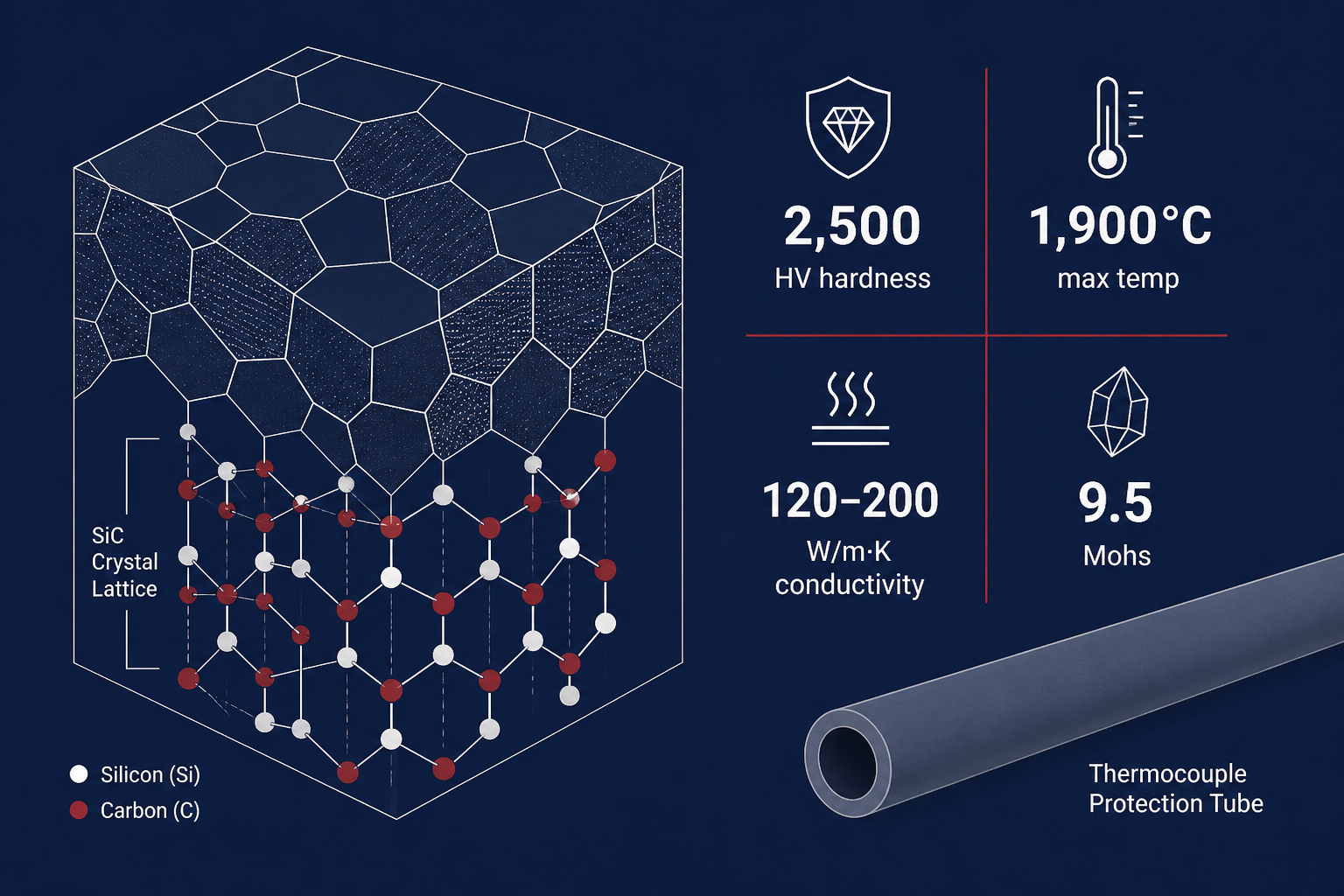
Sintered silicon carbide (SSiC) is one of the hardest and most thermally stable engineering materials on the planet. It ranks 9 to 9.5 on the Mohs scale (just below diamond), operates continuously at 1,700°C in air and 1,900°C in controlled atmospheres, and resists chemical attack from virtually every acid, base, and molten metal short of hydrofluoric acid. The material traces its roots to an 1891 accident – an American inventor named Edward Acheson was trying to make artificial diamonds and made something almost as useful. It took another 80 years of materials science before sintering technology could turn SiC powder into the dense, reliable structural ceramics used today. The applications range from mechanical seals in chemical pumps to ballistic armor to semiconductor wafer fixtures. If you need custom SSiC components for high-temperature industrial work, Sialon Ceramics’ XICAR™ line – rated to 1,900°C and available up to 3,000 mm in length – is a cost-effective alternative to Saint-Gobain HEXOLOY®.
The accidental discovery that built a material industry
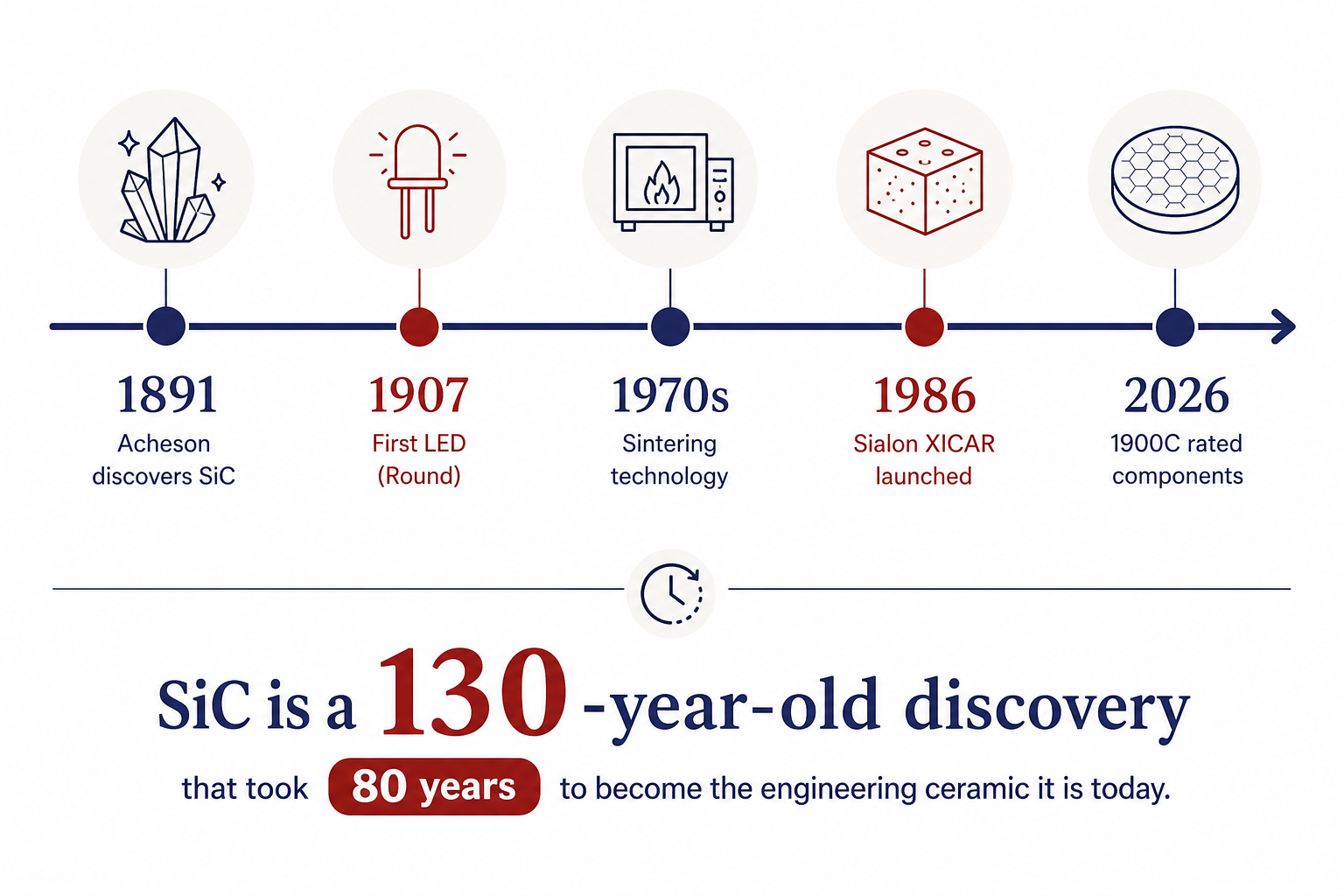
In 1891, Edward Goodrich Acheson was running current through a mixture of clay and powdered coke, trying to synthesize artificial diamonds. He didn’t get diamonds. He got silicon carbide.
The tell was immediate: when he drew one of his leads across a pane of glass, it cut clean through. The material was harder than anything commercially available at the time except diamond itself. Acheson named it “Carborundum” – a portmanteau of carbon and corundum, the aluminum oxide mineral that had been the leading industrial abrasive. He founded the Carborundum Company to produce and sell it, and within years it had displaced corundum across grinding wheels, sandpapers, and cutting tools worldwide.
This makes silicon carbide one of the oldest synthetic hard materials in industrial use. But the Acheson process produced loose powder and polycrystalline masses, not the dense, shaped ceramics needed for structural applications. That development took most of the next century.
Silicon carbide is also, technically, not entirely synthetic. Moissanite is the natural mineral form of SiC, found in meteorites including the Murchison meteorite – microscopic crystals formed under conditions of extreme pressure and temperature in outer space. Natural moissanite is rare enough that it has no commercial significance, but its existence confirmed that SiC could form under extreme conditions and remain stable essentially forever. Today, lab-grown moissanite is used in jewellery as a diamond simulant; it’s the same material as the ceramic in a pump seal or a furnace tube, just grown as a single crystal for optical clarity.
 ## From abrasive powder to engineering ceramic: the sintering breakthrough
For the first half of the 20th century, silicon carbide was primarily an abrasive – used in grinding wheels, cutting fluids, and polishing compounds. Its properties were well understood and genuinely remarkable, but no one had a reliable way to form it into dense, shaped structural components.
The barrier was thermodynamic. Silicon carbide doesn’t melt in the conventional sense – it sublimes (transitions directly from solid to gas) at approximately 2,700°C. You cannot cast it like a metal or glass-form it. The only path to dense solid components is sintering: applying heat and sometimes pressure to compact the powder until atomic diffusion bonds the particles together without ever reaching the sublimation point.
Pressureless sintering of pure SiC proved particularly difficult because the material has covalent bonding that resists diffusion. Progress came in the 1970s and 1980s when researchers developed sintering aids – small amounts of boron and carbon, or alumina and yttria – that could promote densification at manageable temperatures. Pressureless sintering of SSiC typically runs at temperatures exceeding 1,950°C in an argon atmosphere, below the sublimation point but high enough to drive the atomic diffusion needed to fuse particles into a dense monolithic structure.
The result is a single-phase ceramic with essentially no residual porosity, no binder phases, and no secondary materials that could corrode or soften at high temperatures. This purity is what gives sintered silicon carbide its temperature capability and chemical resistance.
What the properties actually mean in practice
Numbers on a datasheet only make sense when you connect them to what they explain in the real world.
| Property | Sintered SiC (SSiC) value | What it means |
|---|---|---|
| Hardness | 9-9.5 Mohs / ~2,500 HV | Third hardest material after diamond and cubic boron nitride |
| Density | 3.1-3.2 g/cm³ | ~40% the density of steel — same weight class as aluminium |
| Thermal conductivity | 120-200 W/m·K | Better heat transfer than most metals; minimises thermal gradients |
| Thermal expansion | 4-5 × 10⁻⁶ K⁻¹ | Very low; resists cracking from thermal cycling |
| Max service temp (air) | 1,700°C | Far above steel (melts at ~1,400°C), alumina (~1,500°C in service) |
| Max service temp (inert) | 1,900°C | Among the highest of any engineering ceramic |
| Young’s modulus | 380-410 GPa | Very stiff — maintains shape under load |
| Flexural strength | 300-450 MPa | Strong enough for structural and load-bearing components |
| Chemical resistance | Resists most acids, bases, molten salts | Fails only with hydrofluoric acid and strong alkalis at high temp |
The hardness. At 9-9.5 Mohs and around 2,500 Vickers, SSiC cuts, abrades, or outlasts almost anything it contacts. Blast nozzles made from SSiC last 50% longer than tungsten carbide equivalents. Pump seal faces in SSiC survive slurries of abrasive particles that destroy steel and conventional ceramics within hours.
The temperature capability. Steel melts at roughly 1,400°C. Alumina, the workhouse advanced ceramic, starts losing mechanical strength above 1,500°C. SSiC maintains near-full structural integrity to 1,750°C and in a controlled atmosphere can hold its properties to 1,900°C. The reason is the covalent Si-C bond — it is among the strongest bonds in chemistry, and it doesn’t soften until temperatures that most industrial processes never reach.
The thermal conductivity. At 120-200 W/m·K, SSiC conducts heat better than most metals. Steel is around 50 W/m·K; alumina is roughly 30 W/m·K; SSiC more than doubles that. The consequence is that SSiC components equilibrate quickly with their environment, reducing thermal gradients and the internal stresses those gradients create. This, combined with the low thermal expansion coefficient, explains why sintered SiC has excellent thermal shock resistance despite being a ceramic — a class of material usually associated with brittleness under rapid temperature change.
The chemical resistance. SSiC is attacked by hydrofluoric acid and certain strong alkalis at elevated temperatures, and that’s essentially the list. Acids, bases at moderate temperatures, molten non-ferrous metals, molten salts, oxidising and reducing atmospheres — SSiC handles all of them. The single-phase purity matters here: there are no metal phases, no secondary binders, nothing that can selectively dissolve out of the matrix under chemical attack.
The four types of silicon carbide ceramic — and when each makes sense
“Silicon carbide” is not a single material. The manufacturing route determines the properties, and the properties determine the application fit.
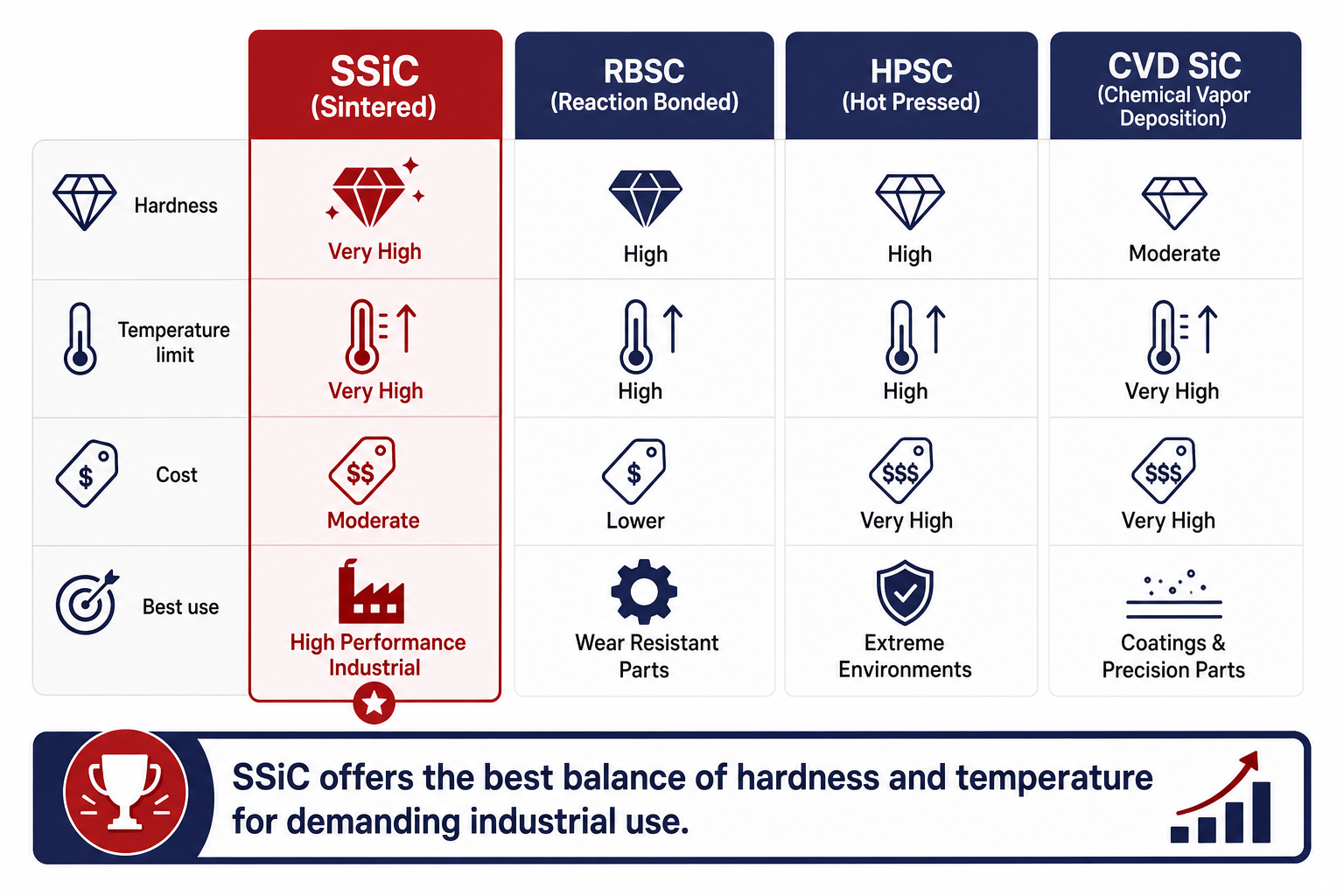 Sintered SiC (SSiC) is the purest form — no binders, no secondary phases, maximum hardness (~2,500 HV) and temperature resistance (1,900°C). The right choice when you need the highest performance in the most demanding environments. More expensive to produce, and slightly more brittle than reaction-bonded variants, but that brittleness is often a non-issue because SSiC rarely sees impact loads in the applications where it’s specified.
Reaction bonded SiC (RBSC/RBSIC) contains 6-15% residual metallic silicon bonded into the structure. This makes it easier and cheaper to produce in complex near-net shapes, provides better chip resistance, and improves thermal shock resistance in some scenarios. The trade-off: the residual silicon limits maximum operating temperature to approximately 1,380°C (above this, the silicon phase softens). RBSC wins on cost and thermal shock tolerance; SSiC wins on temperature, hardness, and chemical purity.
Hot pressed SiC (HPSC) applies simultaneous heat and pressure during sintering, achieving near-theoretical density (~3.3 g/cm³) and flexural strength up to 500-600 MPa — meaningfully above SSiC. The process is expensive and restricts component size and geometry. HPSC is used in specialized aerospace and defence applications where nothing else qualifies.
CVD SiC (chemical vapour deposition) grows SiC atom-by-atom from a gas phase, producing the highest-purity material available. Extremely expensive, limited to relatively thin layers or small components. Used in semiconductor processing equipment and precision optics where absolute purity and dimensional stability at the micron level matter more than cost.
For the vast majority of industrial applications — furnace components, thermocouple tubes, mechanical seals, wear parts, crucibles — SSiC is the answer.
Where sintered silicon carbide is used
The industrial footprint of SSiC follows directly from its property profile. Whenever you need something that is simultaneously hard, heat-resistant, and chemically inert, SSiC is usually on the shortlist.
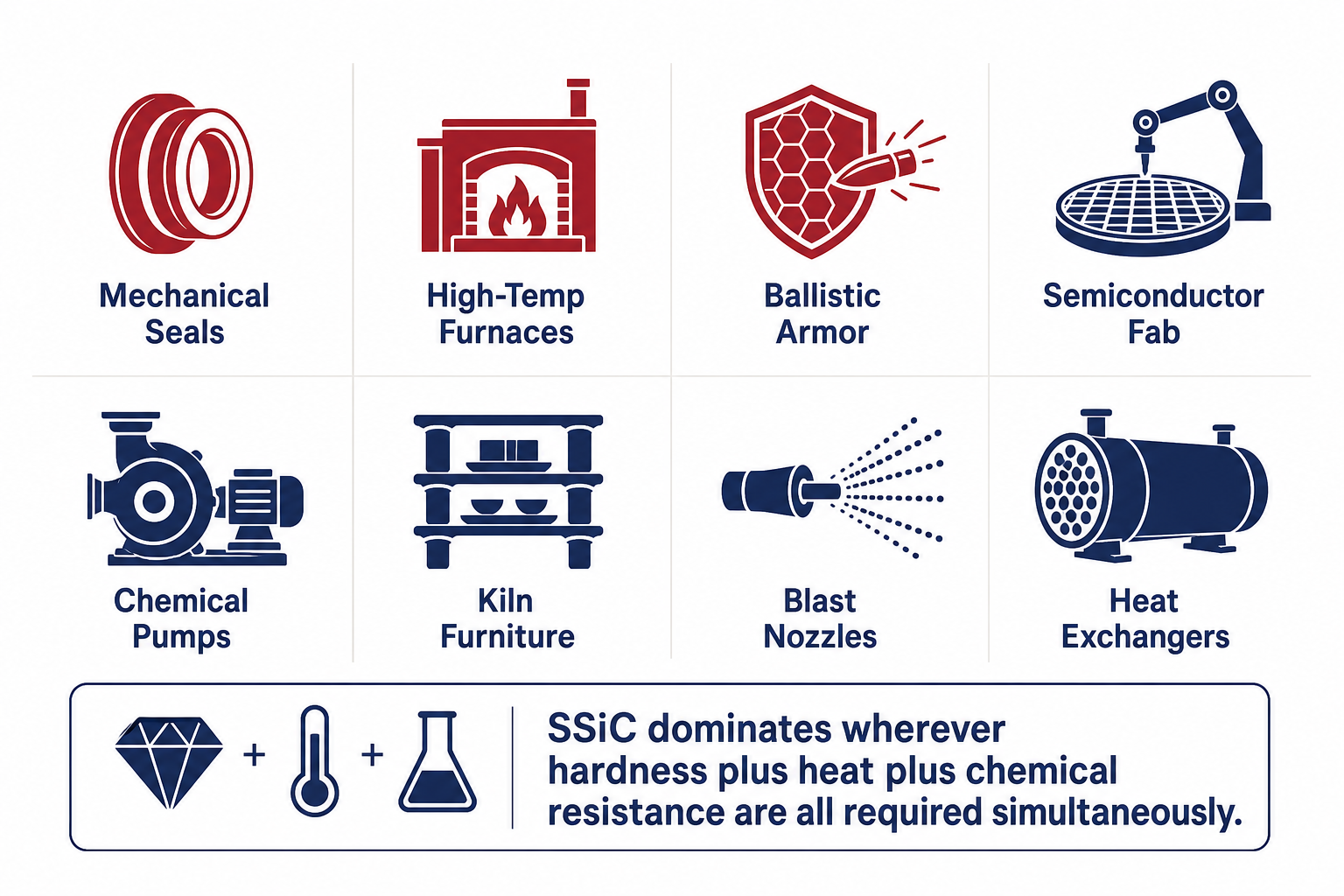 Mechanical seals and bearings. This is one of the largest markets for SSiC by volume. Pumps in chemical plants, refineries, mining operations, and water treatment facilities handle corrosive and abrasive slurries that would destroy conventional seal materials within weeks. SSiC mechanical seal faces and bearings survive these conditions indefinitely because the material is harder than the abrasive particles, chemically inert to the fluid, and dimensionally stable under load and temperature. The same properties make SSiC bearings useful in high-speed rotating equipment where conventional metal bearings heat, wear, and eventually seize.
High-temperature furnaces and foundries. This is SSiC’s home territory. Thermocouple protection tubes, burner nozzles, crucibles, kiln furniture, furnace tubes, and structural supports all sit in environments where metals have long since melted and conventional ceramics would crack from thermal shock or erode from molten metal contact. SSiC handles all of it. In foundries handling molten brass, copper, cast iron, stainless steel, or silicon metal, SSiC thermocouple protection tubes protect temperature sensors that would otherwise be destroyed by the melt within minutes. Crucibles for zinc oxide distillation, copper alloy processing, and induction furnace melting are all natural applications.
Blast and atomisation nozzles. Any nozzle that accelerates an abrasive or corrosive stream — sandblasting, water jetting, flame spraying, atomisation of metal powders — wears rapidly. SSiC blast nozzles outlast tungsten carbide equivalents by roughly 50%, which means significantly lower replacement frequency and downtime in operations that run continuous shifts.
Semiconductor manufacturing. The semiconductor industry uses SSiC extensively for wafer processing fixtures, susceptors, diffusion furnace tubes, and chemical mechanical polishing equipment. The requirements here are demanding in a different way: extreme dimensional stability, chemical purity (no metallic contamination that could dope the wafer), and the ability to withstand thousands of thermal cycles without distortion. SSiC’s covalent structure means it holds its shape where metallic components would creep over time.
Ballistic protection. Silicon carbide’s hardness and low density make it one of the primary materials for composite armour plates. A SiC plate of equivalent stopping power is lighter than a steel alternative, which translates to wider body coverage at the same carried weight, or equivalent protection at lower soldier burden. Military and law enforcement applications specify SiC armour worldwide.
Heat exchangers. SSiC’s thermal conductivity of 120-200 W/m·K, combined with corrosion resistance, makes it useful in heat exchangers that need to transfer heat efficiently between aggressive or high-temperature streams where metallic exchangers would corrode. Shell and tube configurations with SSiC tubes are used in chemical processing plants and waste heat recovery systems.
Chemical and pharmaceutical processing. Pump impellers, reactor liners, valve seats, and transfer lines in corrosive chemical environments. The chemical resistance of SSiC means essentially no risk of contamination from material dissolution — important in both aggressive chemical manufacture and pharmaceutical production where product purity is tightly controlled.
Diesel particulate filters. The porosity of SSiC can be engineered to trap diesel exhaust particulates while maintaining acceptable backpressure, and the high temperature capability allows regeneration (burning off trapped particulates) without material degradation. SSiC DPFs have become standard equipment in modern diesel engines complying with emissions regulations.
What “sintered” means for manufacturing — and why size matters
The sintering process for SSiC creates some specific manufacturing constraints and capabilities worth understanding if you’re specifying components.
Pressureless sintering — the standard route for most commercial SSiC — involves pressing fine SiC powder (sub-micron particle size) mixed with sintering aids, then heating to above 1,950°C in an argon atmosphere. Sintering shrinks the green part by roughly 20% as porosity is eliminated, which means the tooling and the final dimensions need to be precisely planned in advance. Complex internal geometries, tight tolerances, and large components all require careful process engineering.
The practical size limits for SSiC components are much larger than most people expect. Sialon Ceramics produces XICAR™ components up to 3,000 mm in length with outer diameters to 300 mm. This is exceptionally large for a structural ceramic and opens up applications — long thermocouple protection tubes, large furnace supports, extended wear liners — that would be impossible in other hard ceramic materials with more restrictive size limits.
Custom SSiC components can take virtually any shape: burner nozzles, wear plates, seals, furnace fixtures, complex geometrical forms. The engineering constraint is that sharp internal corners and extremely thin walls require more care than in softer materials, but the general design freedom is broad. Lead times for custom components are typically around four weeks.
Sintered SiC vs. its main competitors
The honest materials selection conversation involves comparing SSiC to the alternatives it most often displaces.
vs. Tungsten carbide (WC-Co). Tungsten carbide is the incumbent in many wear and cutting applications. SSiC is harder, lighter (3.2 g/cm³ vs. ~14-15 g/cm³ for WC-Co), and chemically inert to the acids and alkalis that attack cobalt-bonded tungsten carbide. For blast nozzles, SSiC wins on both service life and weight. For cutting tool applications where cobalt-bonded WC has well-established machining data and tool geometry libraries, the decision is more nuanced.
vs. Alumina (Al₂O₃). Alumina is the most widely used advanced ceramic and is cheaper than SSiC. It has lower thermal conductivity (~30 W/m·K vs. 120-200 W/m·K), lower hardness (~9 Mohs but lower Vickers values), and lower maximum service temperature. In molten metal environments, alumina is chemically attacked by many alloys. SSiC is usually the upgrade path when alumina is failing from thermal shock, chemical attack, or insufficient hardness.
vs. Sialon (Si-Al-O-N). Sialon is the material Sialon Ceramics is named for, and it has its own strong suit: exceptional resistance to wetting by molten non-ferrous metals (aluminium, zinc, copper), and excellent thermal shock resistance in the 1,100-1,400°C range. Sialon ULTRA™ heater tubes and thermocouple protection tubes dominate applications in direct contact with molten aluminium. SSiC takes over where the temperature exceeds sialon’s practical limit, or where the process involves molten metals that attack even sialon (brass, copper, cast iron, stainless steel at high temperatures). The two materials are complementary, not competing — see the sialon vs. silicon nitride overview for background on the material family.
The practical rule: when the process exceeds ~1,400°C or involves chemistries that attack sialon, reach for SSiC. When the process is molten aluminium at foundry temperatures, sialon is often the better fit.
Try Sialon Ceramics’ XICAR™ sintered silicon carbide
Sialon Ceramics ApS has manufactured sintered silicon carbide components since 1986. Their XICAR™ SSiC product line is positioned as the most cost-effective alternative to Saint-Gobain’s HEXOLOY® SE, with matching performance specifications: 1,700°C in air, 1,900°C in controlled atmosphere, maximum length 3,000 mm, outer diameter up to 300 mm. Products include thermocouple protection tubes, the full XICRU™ crucible family (HT, NF, resistance furnace, induction furnace, and SSiC-grade), and custom components in any geometry. Standard turnaround is four weeks from confirmed order, with a 12-month warranty against chemical attack. Upload a drawing or send dimensions for a no-obligation quote.

Frequently Asked Questions
What temperature can sintered silicon carbide withstand?
Sintered silicon carbide (SSiC) operates continuously at up to 1,700°C in air and up to 1,900°C in a controlled (inert or reducing) atmosphere. This makes it one of the highest-temperature-rated structural ceramics available. Sialon Ceramics’ XICAR™ SSiC products are rated to these exact limits and are used in thermocouple protection tubes, crucibles, and custom components in the most thermally demanding foundry and industrial environments.
What is the difference between sintered silicon carbide and reaction bonded silicon carbide?
Sintered silicon carbide (SSiC) is produced by direct sintering of pure SiC powder without binder phases, resulting in a single-phase material with exceptional hardness (~2,500 HV), chemical purity, and temperature resistance to 1,900°C. Reaction bonded silicon carbide (RBSC) is made by infiltrating porous SiC with molten silicon; it retains 6-15% residual silicon, which limits its maximum temperature (typically ~1,380°C before the silicon phase softens) but provides better thermal shock resistance and lower cost. SSiC wins where temperature and chemical purity matter most; RBSC wins where cost and thermal shock cycling are the primary concerns.
Who discovered silicon carbide?
Silicon carbide was discovered in 1891 by Edward Goodrich Acheson, an American inventor who had previously worked for Thomas Edison. Acheson was attempting to synthesize artificial diamonds when he accidentally created SiC. He named it ‘Carborundum’ and founded the Carborundum Company to commercialize it as an abrasive. The material’s development into structural and engineering ceramics took another 80 years, with sintered silicon carbide becoming commercially viable in the 1970s-80s.
What are the main applications of sintered silicon carbide?
Sintered silicon carbide’s combination of extreme hardness (9-9.5 Mohs), high-temperature stability (up to 1,900°C), and chemical inertness makes it the material of choice across several demanding domains: mechanical seals and bearings in pumps handling corrosive fluids, thermocouple protection tubes and crucibles in metallurgical furnaces, blast nozzles (where it lasts 50% longer than tungsten carbide), kiln furniture and furnace components, semiconductor wafer processing fixtures, and composite ballistic armor. Custom SSiC components can be manufactured to virtually any shape up to 3,000 mm in length.
Is sintered silicon carbide the same as HEXOLOY?
HEXOLOY is a trademarked grade of sintered silicon carbide made by Saint-Gobain. It is SSiC – the same material class. Other manufacturers, including Sialon Ceramics with their XICAR™ line, produce equivalent pressureless-sintered SiC materials with matching performance specifications (1,900°C operating temperature, comparable hardness and corrosion resistance) at a more competitive price point. The underlying material is the same; what differs between manufacturers is production precision, available dimensions, and support.


 ZDialer Call