
Sialon vs Silicon Nitride
Sialon vs silicon nitride: the engineer’s comparison guide
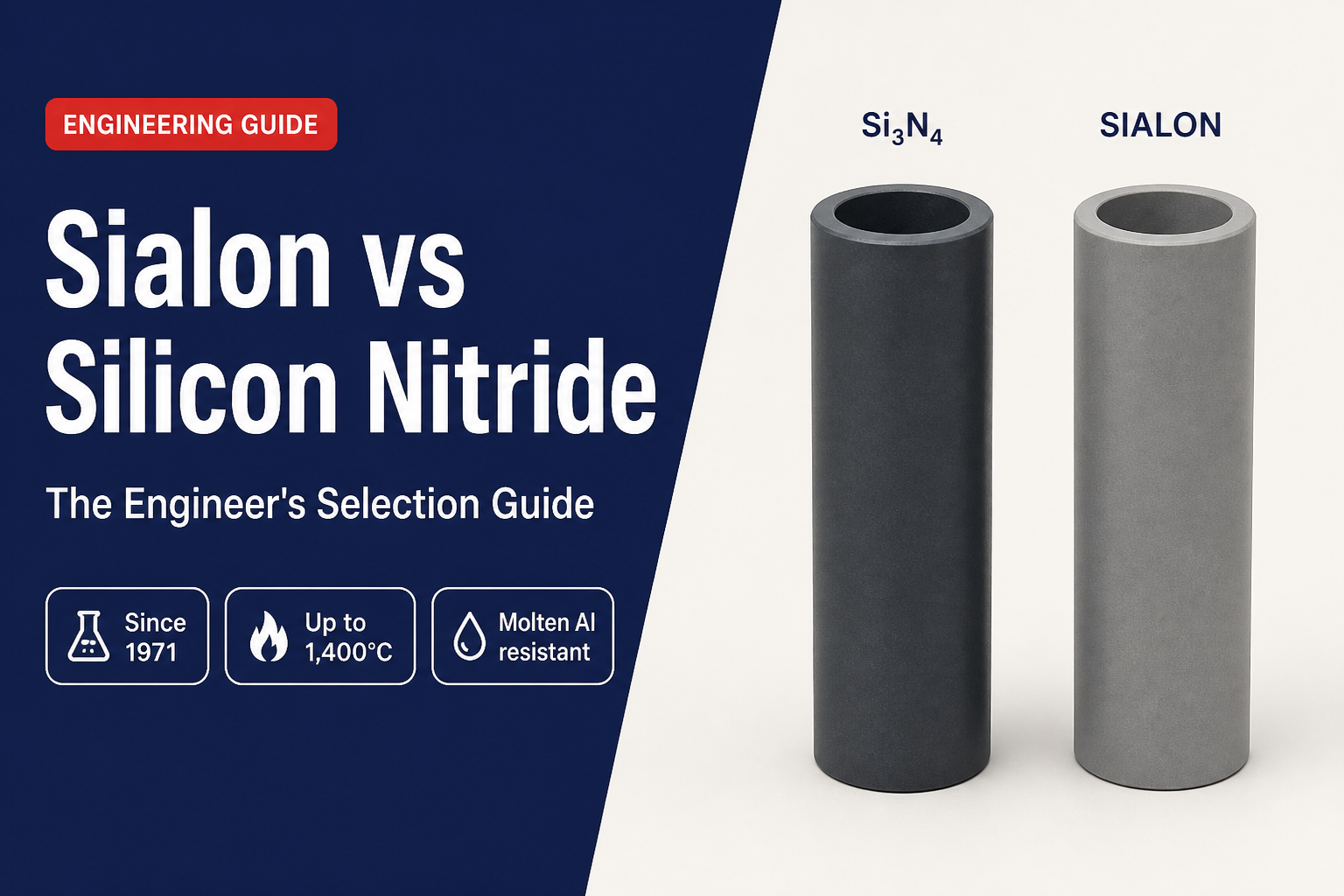
Sialon and silicon nitride share the same chemistry roots but win in very different applications. This guide explains the key considerations in the sialon vs silicon nitride debate and covers the material science, history, and selection logic for foundry engineers and technical buyers.
July 28, 2026 · 10 min read
TL;DR
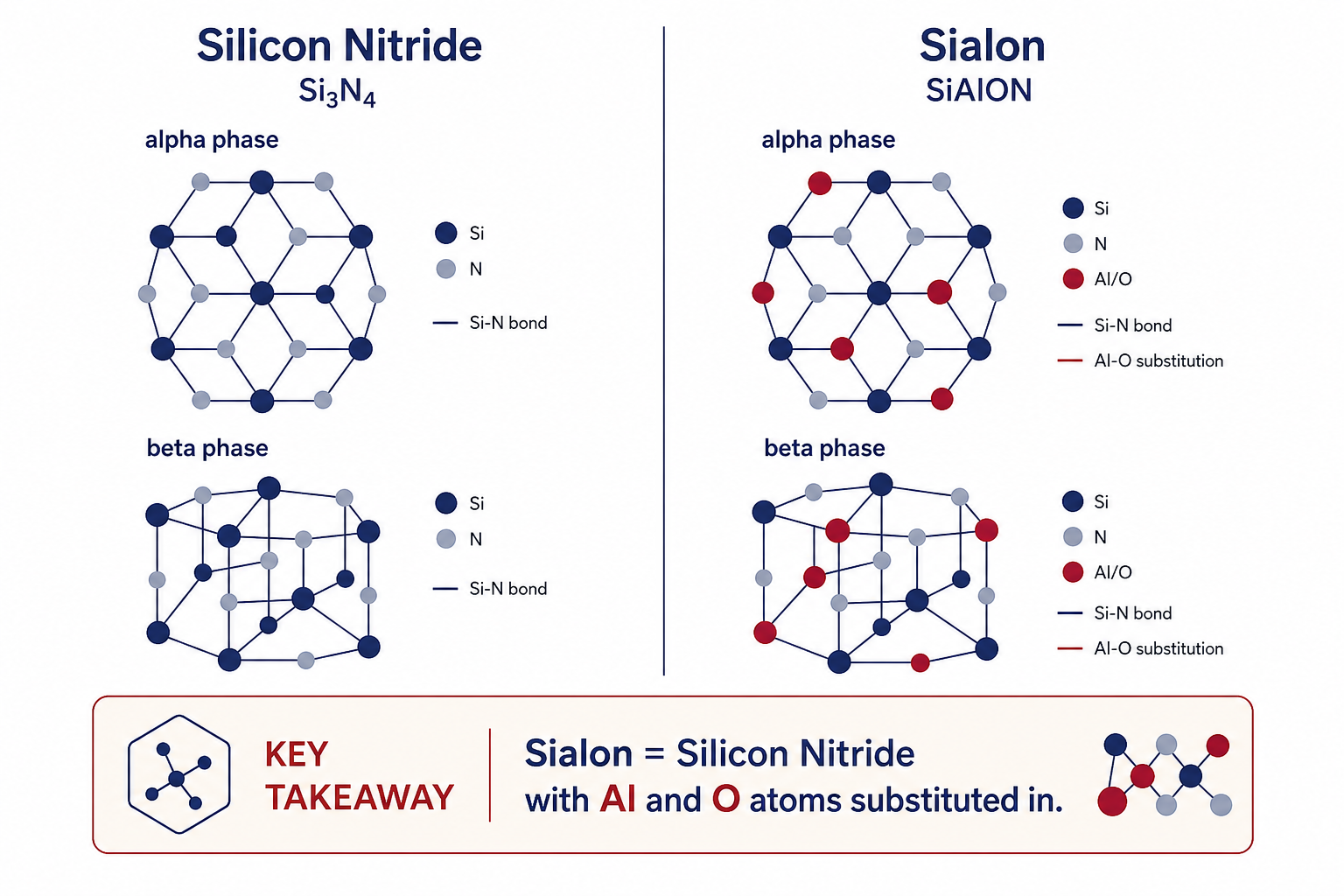
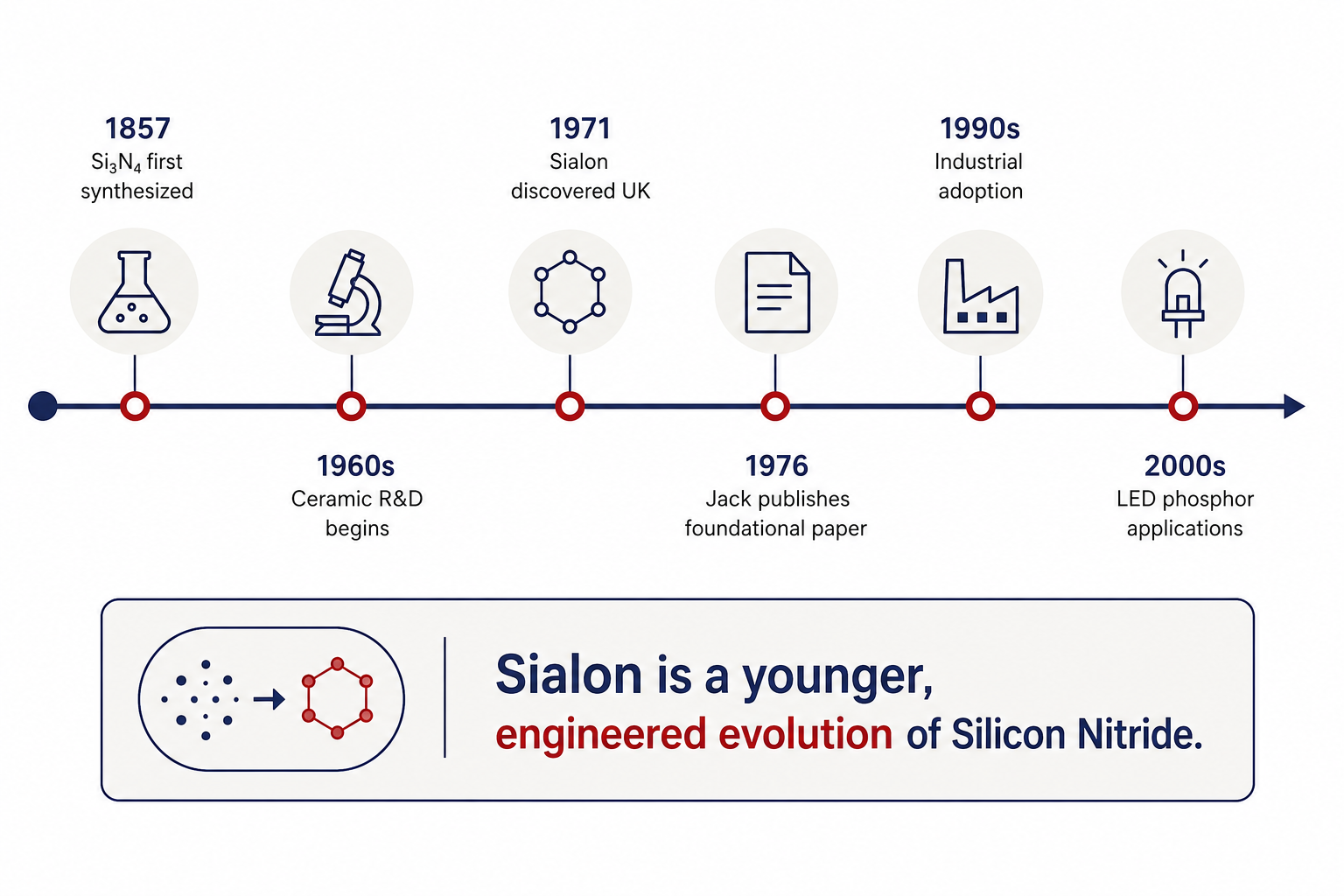
Silicon nitride (Si3N4) was first synthesized in 1857 and became a serious engineering ceramic in the 1960s-70s. Sialon – Silicon Aluminium Oxynitride – is its younger cousin, discovered around 1971 at Newcastle University and the UK’s National Physical Laboratory. Chemically, sialon is silicon nitride with some silicon-nitrogen bonds swapped out for aluminium-nitrogen and aluminium-oxygen bonds.
That substitution sounds modest but changes the material’s behaviour in ways that matter enormously on an industrial floor: sialon is markedly better at resisting molten non-ferrous metals and surviving rapid thermal cycling, while silicon nitride retains the edge in raw hardness and high-speed cutting applications. If your process involves molten aluminium – heater tubes, riser tubes, thermocouple protection, crucibles – sialon is almost certainly the right call. If you’re machining cast iron at high surface speeds, silicon nitride wins. Sialon Ceramics ApS has been manufacturing sialon-based components since 1986 and offers the full range of products covered in this post.
A tale of two materials born in the same lab tradition
Ask a ceramics engineer to explain the difference between sialon vs silicon nitride, and you’ll often get an answer that starts with the same phrase: “well, sialon is based on silicon nitride.” Which is true, and almost immediately unhelpful – the same way “a diesel engine is based on a petrol engine” is technically accurate but tells a mechanic nothing about which one to put in a specific machine.
The better starting point is the question these materials were developed to answer: what do you do when standard refractory ceramics crack, corrode, or get eaten alive by molten aluminium?
Silicon nitride gave researchers the first serious answer to that question. Sialon gave them a better one for a specific subset of the most punishing industrial environments.
Both materials trace their roots to the same materials-science tradition – the search for ceramics that could handle temperatures, thermal shocks, and chemical environments that would destroy metals and traditional oxides. Understanding where each material came from, and what its chemistry actually does, makes the application differences obvious rather than arbitrary.
The silicon nitride story: from 1857 to the factory floor
Silicon nitride has a peculiarly long history for an industrial material. It was first synthesized in 1857 by French chemists Henri Sainte-Claire Deville and Friedrich Wöhler – the same Wöhler who synthesized urea and effectively launched organic chemistry. The discovery sat largely dormant for a century. Interesting chemistry, not yet useful engineering.
The material’s real development came in the 1960s and 1970s, driven by a very specific goal: a ceramic engine. The idea was compelling – replace metal components in gas turbines and reciprocating engines with ceramics that could operate at much higher temperatures, extracting more energy from every combustion cycle. Silicon nitride was developed in the 1960s and 70s in a search for fully dense, high strength and high toughness materials suitable for exactly this kind of application.
Three manufacturing routes emerged during this period, each offering different trade-offs:
- Reaction Bonded Silicon Nitride (RBSN) – produced by direct nitridation of compacted silicon powder. Near-net-shape, minimal machining, but lower density.
- Hot Pressed Silicon Nitride (HPSN) – sintered under heat and pressure, achieving higher density and mechanical performance.
- Sintered Silicon Nitride (SSN) – conventional sintering with aids, allowing complex shapes at near-HPSN performance levels.
The ceramic engine dream never fully materialised – the engineering challenges of mass-producing reliable ceramic components proved harder than expected, and design conservatism in the engine industry is entirely rational when component failure means catastrophic engine damage. But silicon nitride carved out a durable commercial niche. Approximately 300,000 sintered silicon nitride turbocharger rotors are manufactured annually. The cutting tool market reached around $50 million per year. Hybrid ball bearings with silicon nitride balls and steel races became the standard for high-speed machine tool spindles.
The material’s key properties explain why it succeeded where it did. Silicon nitride has low density, high temperature strength, superior thermal shock resistance, excellent wear resistance, good fracture toughness, creep resistance, and good oxidation resistance. It is also resistant to all acids except dilute hydrofluoric acid and hot phosphoric acid – chemical inertness that makes it valuable in a wide range of process environments.
The sialon origin story: an engineered improvement
Sialon was not a serendipitous discovery. It was the product of deliberate materials engineering, building on silicon nitride’s established crystal structure and asking: what happens if we partially substitute aluminium for silicon?
The answer came around 1971, from researchers at Newcastle University and the UK’s National Physical Laboratory. The theoretical framework was consolidated in K.H. Jack’s influential 1976 paper in the Journal of Materials Science, “Sialons and related nitrogen ceramics” – a document that effectively founded the field and remains a foundational reference. Cao and Metselaar’s 1991 review in Chemistry of Materials mapped the rapid progress of the two decades that followed.
The key insight was compositional flexibility. Sialons are ceramics based on silicon, aluminium, oxygen, and nitrogen, forming solid solutions of silicon nitride where Si-N bonds are partly replaced with Al-N and Al-O bonds. The charge discrepancy from this substitution is compensated by adding metal cations – Li⁺, Mg²⁺, Ca²⁺, Y³⁺, and lanthanide elements are common dopants, each shifting the material’s property profile.
This created a family of ceramics with three distinct crystal phases, each with its own performance character:
- Beta (β) sialon – the most commercially significant phase. Hexagonal structure, formula Si₆₋ₙAlₙOₙN₈₋ₙ, with n ranging from 0 to 4.2. The workhorse for high-temperature structural applications.
- Alpha (α) sialon – trigonal structure, formula Si₁₂₋ₘ₋ₙAlₘ₊ₙOₙN₁₆₋ₙ. Stabilised by rare-earth dopants; particularly relevant for cutting applications.
- O-prime (O’) sialon – orthorhombic, more compositionally restricted. Formula Si₂₋ₙAlₙO₁₊ₙN₂₋ₙ with n from 0 to 0.2.
The practical result of this tuneable chemistry: manufacturers can engineer sialon compositions optimised for specific application environments, rather than working with a single fixed-property material.
 ## What the chemistry actually changes: properties head-to-head
At the physical property level, silicon nitride and sialon look quite similar on paper. Both are hard, both have low thermal expansion, both resist thermal shock, both tolerate high temperatures. The differences only become decisive when you look at the extremes – and those extremes are exactly where industrial components live.
| Property | Silicon nitride (Si₃N₄) | Sialon (SiAlON) |
|---|---|---|
| Density | ~3.17 g/cm³ (HPSN/SSN) | 3.0-3.3 g/cm³ (phase-dependent) |
| Hardness | Mohs 8.5; gamma-phase ~35 GPa | Mohs 8-9 (composition-dependent) |
| Thermal expansion | Low | Very low |
| Thermal shock resistance | Good | Exceptional |
| Molten non-ferrous metal resistance | Good | Exceptional – superior to alumina and Si₃N₄ |
| Oxidation resistance | Good (self-protecting SiO₂ layer) | Good to above 1000°C |
| Chemical inertness | Resists most acids except HF, hot H₃PO₄ | High chemical stability; enhanced by Al-O substitution |
| Practical max operating temperature | ~1,200-1,400°C in air (material decomposes at 1850°C – a theoretical limit, not a working temperature) | Up to ~1,400°C depending on product; heater tubes rated to 1,100°C, thermocouple protection tubes to ~1,400°C |
The two key divergences tell the selection story clearly.
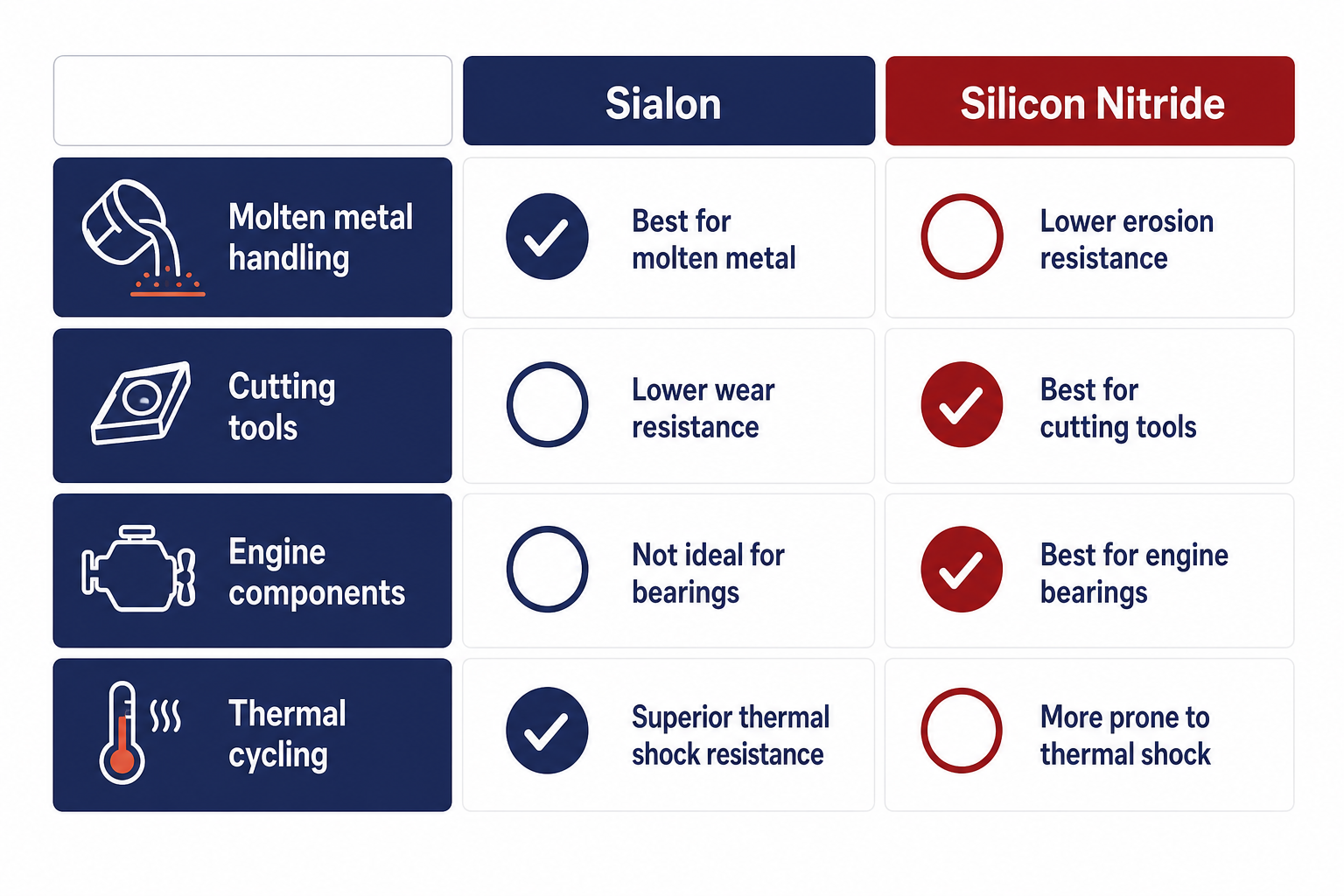
On hardness, silicon nitride has the edge – the gamma phase in particular reaches extraordinary values. This is why silicon nitride dominates cutting tool applications. It can machine cast iron and nickel-based superalloys at surface speeds up to 25 times quicker than tungsten carbide. Sialon is also used in cutting tools, particularly for machining chill cast iron, but for the hardest, fastest cuts, silicon nitride usually wins on raw numbers.
On molten metal resistance, the order reverses. Sialons show exceptional resistance to wetting or corrosion by molten non-ferrous metals, compared to other refractory materials such as alumina – and that comparison includes plain silicon nitride. The Al-O substitutions in the crystal lattice create a ceramic matrix that is inherently resistant to dissolution and wetting by molten aluminium and similar metals. A sialon tube immersed in molten aluminium at 750°C survives where an alumina tube would be eroded within hours and a steel component would simply dissolve.
On thermal shock, sialon’s very low thermal expansion coefficient gives it the advantage in applications with rapid, repeated temperature cycling – exactly the operating cycle of a foundry component that gets plunged into molten metal and withdrawn repeatedly, dozens of times a day.
Where each material belongs: application map
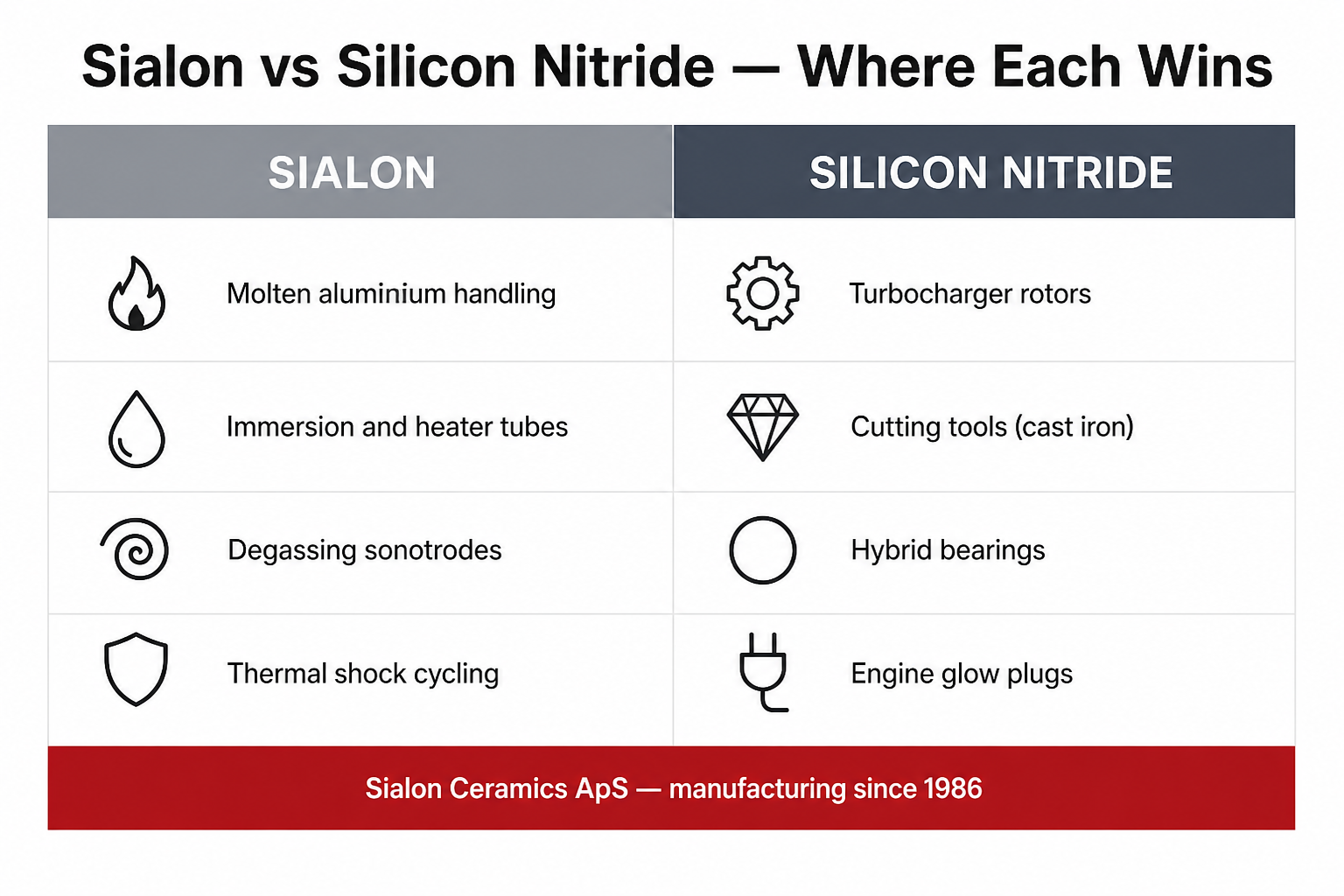
Understanding the property differences makes the application split intuitive.
 ### Silicon nitride: precision, speed, and rotating components
Silicon nitride’s mix of high hardness, fracture strength, wear resistance, and low density makes it the top material anywhere rotating or cutting speed is the main design goal.
Turbochargers are the highest-volume use. Manufacturers make approximately 300,000 silicon nitride turbocharger rotors each year. The low density matters here – a lighter rotor has lower spin resistance, which means faster spool-up time and less engine lag. Both diesel and spark-ignited engines use silicon nitride turbochargers; Japan led the way in light-duty use while the US focused on medium and heavy-duty units.
Engine parts beyond turbochargers include diesel glow plugs for faster cold starts, precombustion chambers for lower emissions and quieter running, rocker arm pads for less wear, and exhaust gas control valves.
Bearings are a mature commercial use. Hybrid ball bearings – ceramic balls in steel races – improve bearing life, speed, and resistance to rust compared to all-steel bearings. Machine tool spindles often run at speeds that steel bearings can’t handle without oil; silicon nitride hybrid bearings allow dry, high-speed use. Dental drills use silicon nitride bearings because technicians can sterilise them without rust or wear. All-ceramic bearings appear in tidal flow meters where seawater rust rules out any metal.
Cutting tools – silicon nitride-based tools cut cast iron and nickel alloys at speeds 25x faster than tungsten carbide’s limits. The car and aerospace industries are the main users. One key catch: silicon nitride does not cut high-silicon aluminium alloys well – which means the shift toward aluminium-block engines limits its growth in the car cutting tool market.
Industrial fixtures for induction heating and resistance welding also use silicon nitride, drawing on its electrical insulation, low heat flow, and heat-shock resistance. Arc welding nozzles are a steady market for reaction-bonded silicon nitride.
Sialon: the foundry floor and molten metal handling
Sialon’s key strength – strong resistance to attack by molten non-ferrous metals – has made it the go-to material for non-ferrous metal work and foundry jobs.
Indeed, non-ferrous metal handling is sialon’s main use. For example, makers rely on the material for metal feed tubes for aluminium die casting, burner and dip heater tubes, injector tubes, degassing gear, thermocouple guard tubes, crucibles, and ladles. Every one of these parts sits in direct contact with molten aluminium or similar metals – places where molten metal eats away at plain ceramics and metals alike within hours. As a result, sialon survives thousands of heat cycles and years of steady molten-metal contact.
The reason is not magic: the Al-O swaps in the sialon lattice build a ceramic base that simply does not wet well with molten aluminium, so the metal cannot seep in or eat away at the grain edges the way it does in alumina or plain silicon nitride. The result is a clearly longer service life – 30% longer than standard technical ceramics in like-for-like foundry use.
Low-pressure diecasting (LPDC) uses sialon riser tubes to guide the flow of molten metal into precise moulds. In aerospace parts casting – where makers must produce aluminium alloy parts to tight size limits, batch after batch – the riser tube sees hundreds of dip-and-pull cycles per day. Sialon’s heat-shock resistance and chemical steadiness are why these tubes last months rather than days.
Chemical and process plants use sialon where jobs need both chemical wear resistance and heat steadiness at once – conditions that test even the best oxide ceramics.
Oil and gas is a smaller but real sector: sialon’s mix of chemical steadiness, wear resistance, and rust resistance suits it to gear exposed to hot, harsh fluids.
An unexpected use: LED phosphors. Europium-doped β-SiAlON takes in UV and visible light and gives off strong broadband visible light – a glow trait that makes it useful as a green light-shift phosphor for white LEDs. Its brightness and colour stay steady as heat changes thanks to its heat-steady crystal build, beating many rival phosphor materials. Makers can even forge sialon gears from billets at around 1200°C in 2 seconds, showing a superplastic forming skill that opens the door to complex precision parts.
 ## Manufacturing: both are hard to make, but differently so
Both materials share a fundamental manufacturing challenge: silicon nitride decomposes above 1850°C, preventing manufacturers from using conventional high-temperature densification routes. Conventional sintering requires sintering aids that induce liquid-phase sintering – the composition of the grain boundary glass phase significantly affects high-temperature performance and is a major area of ongoing materials engineering.
Sialon manufacturing is more complex. Production involves combining silicon nitride, alumina, aluminium nitride, silica, and the oxide of a rare-earth element, then densifying via pressureless sintering or hot isostatic pressing. Researchers have extensively documented abnormal grain growth, which creates bimodal grain size distributions and influences the final mechanical properties.
This additional complexity delivers the compositional flexibility discussed above. Engineers can tune the crystal phase ratio and dopant concentration for specific application environments. This makes sialon a better solution than silicon nitride where those properties matter most.
A key manufacturing distinction: the fabrication method strongly influences silicon nitride’s properties. Therefore, engineers should not treat it as a single material. For instance, an RBSN component and an HPSN component can carry the same “silicon nitride” label. Yet they can differ dramatically in density, strength, and performance. Similarly, the same applies to sialon – phase composition, dopant selection, and processing route all determine the final material behaviour. This is why materials selection in technical ceramics is never just picking a material name from a list.
Making the call: a practical selection framework
The research and historical picture here leads to a fairly crisp decision framework:
Choose silicon nitride when:
- Maximum hardness is the performance driver (cutting tools, abrasive applications)
- The application involves rotating components where low density matters (turbochargers, bearings)
- You need chemical inertness without the compositional complexity of sialon
- The operating environment is oxidising at very high temperatures
- Cost sensitivity is high and the extreme corrosion resistance of sialon is not needed
Choose sialon when:
- The component will contact molten non-ferrous metals (aluminium, zinc, tin, lead alloys)
- Thermal cycling is severe and frequent (foundry equipment, riser tubes, immersion heaters)
- Both thermal shock resistance and chemical corrosion resistance are required simultaneously
- You need long service life from components in hostile chemical process environments
- You are engineering LED phosphors requiring temperature-stable luminescence
The most common expensive mistake is selecting silicon nitride – or worse, alumina – for components that live in direct contact with molten aluminium. The initial cost difference seems small. The replacement frequency and downtime cost difference is not.
A useful rule of thumb: if the part touches molten metal, reach for sialon. If it cuts metal, reach for silicon nitride.
Try Sialon Ceramics ApS
Sialon Ceramics ApS has been manufacturing sialon-based technical ceramics since 1986. That’s four decades of refining the exact material and design choices described in this post. Their Sialon ULTRA™ product line delivers 30% longer service life than standard technical ceramics. It also carries a 12-month warranty against chemical attack in molten aluminium. Products cover the full range of foundry and metallurgical applications. These include heater tubes, riser tubes for low-pressure diecasting, and thermocouple protection tubes up to 1600 mm. The range also covers custom-machined components to ±0.02 mm tolerances and the XICRU™ foundry crucibles. These are the world’s largest manufactured sialon crucibles, up to 1.5 metres wide. Their XICAR™ sintered silicon carbide line extends the range to 1900°C for applications that exceed even sialon’s thermal limits.

Frequently Asked Questions
What does the acronym Sialon stand for?
Sialon stands for Silicon Aluminium Oxynitride. The name is a direct chemical term. Sialon is a solid mix of silicon nitride (Si₃N₄). Aluminium and oxygen replace some silicon-nitrogen bonds, creating aluminium-nitrogen and aluminium-oxygen bonds. Sialon Ceramics ApS (sialon.com) takes its name from this material and has made sialon-based products since 1986.
id=”is-sialon-harder-or-softer-than-silicon-nitride”>Is sialon harder or softer than silicon nitride?
Silicon nitride edges ahead on raw hardness: the gamma phase of Si3N4 reaches around 35 GPa, making it one of the hardest ceramics known. In comparison, standard sialon typically ranges from Mohs 8-9, slightly below that peak. As a result, silicon nitride tends to win for cutting tools where hardness matters most. However, sialon makes up for this – and often does better – in a different way: it resists thermal shock and attack by molten metals better. Indeed, these are the traits that matter most in foundry work.
id=”which-is-better-for-molten-aluminium-applications-sialon-or-silicon-nitride”>Which is better for molten aluminium applications: sialon or silicon nitride?
Sialon is the top choice for direct contact with molten aluminium and other non-ferrous metals. Research confirms that sialon resists wetting and attack by molten non-ferrous metals better than other refractory materials, including plain silicon nitride. This is why Sialon ULTRA™ heater tubes, riser tubes, and thermocouple protection tubes are all made from sialon rather than silicon nitride.
id=”when-was-sialon-discovered-and-who-developed-it”>When was sialon discovered, and who developed it?
Sialon was first reported around 1971 by researchers at two UK groups: Newcastle University and the National Physical Laboratory (NPL). K.H. Jack brought the theory and lab work together in his landmark 1976 paper, “Sialons and related nitrogen ceramics,” in the Journal of Materials Science (doi:10.1007/BF00553123). Commercial use grew fast through the 1980s and 1990s. During this time, makers built new blends for foundry gear, cutting tools, and thermocouple protection.
id=”how-do-i-choose-between-sialon-and-silicon-nitride-for-my-application”>How do I choose between sialon and silicon nitride for my application?
The deciding factor is almost always the work setting. If you need top hardness, fast cutting tool speed, or engine bearing parts – pick silicon nitride. If you need to survive repeat contact with molten non-ferrous metals, harsh heat cycles in foundry gear, or chemical wear in process plants – pick sialon. Sialon Ceramics has solved these material choices since 1986. They offer custom work to ±0.02 mm tolerances and guidance built for your specific job.


 ZDialer Call